Sunday, August 31, 2008

Teach Both

by Randall Stephens

As many readers will know by now, almost two years ago the hot potato issue of creationism came up in the Alaska governor race. Running as the Republican candidate Sarah Palin responded with something like the old teach-the-controversy chestnut: “Teach both. You know, don't be afraid of information. Healthy debate is so important, and it's so valuable in our schools. I am a proponent of teaching both.”

(Teach both, you know. . . Flat earth theory vs. round earth theory; aliens built the pyramids vs. humans constructed them; stars are holes in the canopy of the sky vs. stars are massive, luminous balls of plasma; thunder is caused by God bowling vs. thunder is the sonic shockwave from lightning.)

According to the Anchorage Daily News at the time of the debate “Democrat Tony Knowles and Independent Andrew Halcro, said such alternatives to evolution should be kept out of science classrooms. Halcro called such lessons ‘religious-based’ and said the place for them might be a philosophy or sociology class.” The creationism of John McCain's newly announced running mate is stirring up some dust among liberals.

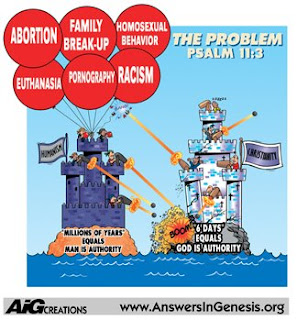
And will the issue ever go away? It’s like a vampire. But in this case not even a fact-based stake through the heart can kill it. In the research that Karl Giberson and I are doing for a new book, we’ve seen that Ken Ham, Aussie creation prophet based out of Kentucky, has captured the attention and imagination of millions of conservative Christians. Since his creation museum opened a little over a year ago attendance has well-exceeded original estimates. Bus and van-loads of home schooled youngsters are gobbling up Ham’s alternative “science” like so much manna from heaven.

The creation-evolution controversy is about more than science vs. pseudo-science. Considering what is at stake for conservative evangelicals and fundamentalists—civilization, human dignity, the sanctity of the Bible, the sacredness of marriage, etc., etc.—it’s hard for me to imagine the hubbub will ever die down.

[PS: See these recent takes on the subject: "With Palin on the Ticket, Evangelicals Are Energized," Washington Post; and a dose of skepticism: "Is She Really a Creationist?" Answers in Genisis.]

Saturday, August 30, 2008

Can You Go Home Again to the Way of Improvement?

Paul Harvey

First, to the many of you who wrote kind notes to me concerning the death of my father, my thanks and gratitude. I'm back and looking forward to a school year with my long-suffering students.

Our contributing editor John Fea has been active here and on his own blog with updates on religion and presidential politics. John's book The Way of Improvement Leads Home has just received a wonderful review from the prolific Lauren Winner at Books And Culture -- no link yet, so just subscribe already. Lauren addresses the broader issue of how the life of Phillip Vickers Fithian speaks to the issue of what happens when the provincial encounters the cosmopolitan -- the can you go home again question. She writes:

Though firmly embedded in the particulars of the 18th century, the story Fea tells has resonance today. That is one of the many reasons I so love this book -- Fithian's problem is no less acute today for men and women whose education takes them geographically and imaginatively beyond their local communities. . . we may flatter our post-modern selves by imagining that we have moved beyond the Enlightenment, now ironically criticized for its parochialism. But the tensions between cosmopolitan aspirations and local commitments are with us still.

Reminds me also of John's recent post about whether Joe Biden's rootedness in working-class Catholic PA will offset Obama's cosmopolitan persona.

Friday, August 29, 2008

Does Sarah Palin Speak in Tongues?

BY JOHN FEA

We know she is an Alaskan reformer. We know she is pro-life. We know she was a beauty queen and basketball star. We know she eats moose burgers. But does Sarah Palin speak in tongues?

According to some reports, Palin attends church at the Juneau Christian Center, a congregation affiliated with the Assembly of God. As many of you know, the Assembly of God is the largest pentecostal denomination in the world. It is known for speaking in tongues, healing, and an emotional and contemporary style of worship with a lot of hand-raising.

Palin appears to have grown up pentecostal or at least attended a local Assembly of God Church (Wasilla Assembly of God Church) during her junior high school years.

NOTE: In an interview with Time Magazine, Palin said she was born and baptized Catholic but now attends a "non-denominational Bible Church." (I am sure this will all be cleared up shortly).

If Palin is indeed a pentecostal, I am sure the pundits will compare her to two other noteworthy members of the Assembly of God who were also involved in Republican politics: Bush's Attorney General, John Ashcroft and Reagan's Secretary of the Interior, James Watt.

I am eager to hear what Matt Sutton and Randall Stephens, our "resident" pentecostsal experts, have to say about all this.

I have posted a longer version of this post at The Way of Improvement Leads Home.

Thursday, August 28, 2008

Joel Hunter's Prayer

BY JOHN FEA

If you were watching tonight's Obama speech on broadcast television or a commercial cable network you missed it. After the usual celebratory hugs between the president and vice-presidential candidates and their families, pastor Joel Hunter approached the lectern to close the evening in prayer.

Joel Hunter is the pastor of Northland Community Church (now called "Northland: A Church Distributed"), a 10,000 member evangelical megachurch in Orlando, Florida. He is the former president of the Pat Robertson-founded Christian Coalition. He is a registered Republican.

Hunter's tenure as president of the Christian Coalition did not last long. In fact, he was gone in about four months. He resigned in November 2006 because the leadership and the base of the Coalition did not like his attempt to expand the mission of the organization to include climate change and the alleviation of poverty. Since then he has been one of the voices pushing for a broader evangelical agenda that goes beyond the issues of gay marriage, abortion, and stem-cell research. (He seems to uphold traditional views on all of these issues). Hunter is now associated with this new cadre of evangelical leaders that includes Rick Warren. He has also participated in events with the old guards of the evangelical left--Jim Wallis and Tony Campolo. He was one of the prominent participants in several faith and politics forums, including "Compassion Forum" at Messiah College last spring.

Here was his prayer:

We are all here to devote ourselves to the improvement of this country we love. In one of the best traditions of our country, would those of you who are people of faith join me in asking for God's help?

Almighty God, let your will be done on earth as it is in heaven. Give us a reverence for all life. Give us a compassion for the most vulnerable among us - the babies, the children, the poor, the sick, the enslaved, the persecuted. For all of those who have been left out of the advantaged world. Give us a zeal to clean the environment we have polluted while we create an economy where everyone who can work can have a job. Help us to honor those who defend our country by working harder and smarter for peace. Help us to counter those that incite fear and hatred by becoming people who are informed and respectful and are known for principles and projects that aim higher than our own group's benefit. Guide Barack Obama and all of our leaders to be agents of your will and recipients of your wisdom. And grant that all of us citizens will continually do our part to contribute to the common good by loving our neighbor as we love ourselves.

Now, I interrupt this prayer for a closing instruction: Because we are gathered in a country that continues to welcome people of all faiths, let us personalize this prayer by closing according to your own tradition. On the count of three, end your prayer as you would usually do. Amen! Let's go out and change the world for good!


His invitation to everyone to end the prayer according to their own faith tradition showed this new evangelical commitment to religious pluralism and, I am certain, will irritate and anger many on the Christian Right who will not understand how an evangelical minister could encourage people to pray to Buddha or Allah. (Hunter prayed in the name of Jesus). Hunter's appearance tonight reminds us that some evangelicals are changing and Barack Obama wants to win their votes.

Cross-posted at The Way of Improvement Leads Home.

Hooray for 500 posts!


Kelly Baker

Our blog has now reached 500 posts. Hooray! John's recent post was the 500th, but alas, I have no prize besides my admiration and appreciation. Or I could pony up a drink at the next conference I attend (see you at AHA in January).

Thanks to our contributors, guest posters, and readers for making this possible. A special thanks to Paul, our faithful leader and commander who always has insightful posts (and the occasional snarky one).

I look forward to seeing what kinds of commentary and conversations appear each day at Religion in American History, and our collaborative effort makes this blog a vibrant forum for a variety conversations that prove useful to specialists and non-specialists alike. Thanks again.

Wednesday, August 27, 2008

Joe Biden's Catholic America


BY JOHN FEA

Much of the analysis of Joe Biden's speech at the Democratic Convention last night has focused on its attack on John McCain or its flubbed line about the vice-president answering the phone in the White House.

Perhaps I am reading too much into it, and perhaps some scholars of Catholicism can correct me, but it seemed that Biden's speech was informed by a small dose of Catholic social teaching, especially on the dignity of human work. He actually used the term "dignity" in relation to work four times.

Here were Biden's words:

My parents taught us to live our faith and to treasure our families. We learned the dignity of work, and we were told that anyone can make it if they just try hard enough. That was America’s promise.

Barack Obama...chose to go to Chicago. The South Side. There he met men and women who had lost their jobs. Their neighborhood was devastated when the local steel plant closed. Their dreams deferred. Their dignity shattered. Their self-esteem gone

And he (Obama) made their lives the work of his life. That’s what you do when you’ve been raised by a single mom, who worked, went to school and raised two kids on her own. That’s how you come to believe, to the very core of your being, that work is more than a paycheck. It’s dignity. It’s respect.

Because Barack made that choice, 150,000 more children and parents have health care in Illinois. He fought to make that happen. And because Barack made that choice, working families in Illinois pay less taxes and more people have moved from welfare to the dignity of work.

I could not help hear the influence of John Paul II's 1981 encyclical Laborem Exercens (On Human Work):

But the Church considers it her task always to call attention to the dignity and rights of those who work, to condemn situations in which that dignity and those rights are violated, and to help to guide the above-mentioned changes so as to ensure authentic progress by man and society.

If I am right here, Biden was arguing, in a very Catholic way, that the policy of the Bush-Cheney administration has created an economic environment in America that is equivalent to, in the Pope's words, a "situation in which that dignity and those rights are violated."

And then there was his reference to suffering. He talked about suffering in relation to the tragic death of his wife and daughter, but in this context it could have been indirectly applied to the suffering of the working man under Bush-Cheney's watch. He talked about how his mother taught him that "God sends no cross that you cannot bear.”

As some of you know, I grew up in working class north Jersey, the son of Italian and Slovakian Catholic parents. I have heard this kind of speech numerous times--a combination of the dignity of hard work, the American dream, faith and family, suffering and a tragic sense of life, and, for lack of a better term, a masculine sense of Catholic toughness and pride. (When bigger kids were picking on him, Biden's mother told him to “Bloody their nose so you can walk down the street the next day.”). This is the kind of Catholic ethnic identity that Matthew Jacobsen writes about in Roots Too: White Ethnic Revival in Post-Civil Rights America and, to some degree, John McGreevy writes about in Parish Boundaries.

Biden certainly has his disagreements with the American Catholic Bishops, especially on the issue of abortion (see Kelly's recent post), but this speech displayed the kind of hardscrabble, working class rootedness that the cosmopolitan, placeless, Protestant Obama really needs to win in November.

I have cross-posted this piece at The Way of Improvement Leads Home.

Democrats and Abortion

Kelly Baker

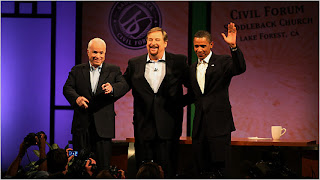
With the Democratic convention in full swing, it is not surprising that journalists are weighing in on a variety of issues, especially abortion. Two pieces appeared today that explore the position of the party and the presumptive nominee, Barack Obama, on the issue. In Newsweek, George Wiegel argues that the Democrats are dodging this important issue:

Then there are the multiple confusions of House Speaker Nancy Pelosi. In her "Meet the Press" appearance Aug. 24, Pelosi was asked by Tom Brokaw whether she agreed with Senator Obama's statements on abortion at Saddleback. Pelosi, declaring herself an "ardent, practicing Catholic," told Brokaw that "this is an issue that I have studied for a long time"—and then got herself into a deep muddle, in which she seemed to confuse St. Augustine with St. Thomas Aquinas (neither of whom, in any case, knew anything about modern embryology); misrepresented the settled (and scientifically informed) judgment of the Catholic Church on when life begins by declaring it an open question, and concluded by suggesting that none of this really makes a difference, because what the scientists, theologians, and philosophers say "... shouldn't have an impact on a the woman's right to choose." The Speaker then misrepresented the legal impact of Roe v. Wade, arguing that the Supreme Court hadn't created a right to "abortion on demand"—which will come as news to those on both sides of the ongoing debates over partial-birth abortion and other late-term abortion procedures, parental- and spousal-notifications laws and regulatory oversight of abortion clinics.

Democrats who had hoped to persuade a good number of evangelicals and Catholics to return to their traditional 20th-century political home in November 2008 cannot be very encouraged by such intellectual disarray on the part of their party's senior federal official. For more than three decades, the abortion license created by the high court in Roe v. Wade has been an important factor in determining American voting behavior—in more than a few instances, the decisive factor. Yet, judging by her performance on "Meet The Press" (which seemed to surprise the usually unflappable Tom Brokaw), the Democratic Speaker of the House of Representatives is as ill-informed on the scientific and legal facts involved in the abortion debate as she is of the teaching of the Catholic Church. Speaker Pelosi is, like most "ardent, practicing" Catholics, a great admirer of the late Pope John Paul II. Was John Paul wrong, one wants to ask Speaker Pelosi, when he wrote in the 1995 encyclical Evangelium Vitae [The Gospel of Life] that "abortion ... always constitutes a grave moral disorder, since it is the deliberate killing of an innocent human being"? Was he wrong when he further stated that this moral truth could be known by reason, and was thus a matter of grave concern to public policy?

While Wiegel points to the "intellectual disarray" of the party, Michael Sean Winters of Slate offers another interpretation: The Democrats are attempting to allow a plurality of opinions on abortion, while not compromising their pro-choice lineage. This strategy would allow for voters who want abortions "legal, safe, and rare" to find a home in the party, especially Catholic voters who are vehemently pro-life. Winters notes that Sen. Bob Casey Jr.'s address to the convention (when his father was denied this privilege in 1992 for being pro-life) and the selection of the Catholic Joe Bidden as Obama's running mate signals that Democrats are open to a new plank about abortion. The party, according to Winters, is seeking to show that it is no longer militantly pro-choice to attract those in the middle of the pro-life and pro-choice positions. He writes:

The trend among Catholic Democrats is not toward a doctrinaire pro-life or pro-choice position but instead toward what could be called "pro-choices," plural. They defend the legality of Roe, but they want to make sure that programs are in place to help women make the choice to carry the child to term, such as adequate and affordable pre- and postnatal care and a less-cumbersome adoption system. They also favor programs to reduce the need for abortions in the first place through better age-appropriate sex education and family-planning services. These proposals were part of a legislative effort to reduce the number of abortions led by Democrats in Congress, including pro-life Rep. Tim Ryan of Ohio and pro-choice Rep. Rosa DeLauro of Connecticut.

Barack Obama has warmed to this approach, altering the abortion plank in the Democratic Party platform. After affirming the party's unequivocal commitment to Roe, the platform asserts: "We also recognize that such health care and education help reduce the number of unintended pregnancies and thereby also reduce the need for abortions. The Democratic Party also strongly supports a woman's decision to have a child by ensuring access to and availability of programs for pre and post natal health care, parenting skills, income support, and caring adoption programs." This language does not please some hard-core pro-choice activists because it implies a stigmatization of abortion, but it is difficult to portray oneself as championing women's reproductive freedom if you oppose such measures.

So, what do our blog readers think? Is the Democratic party in "disarray" about the issue of abortion or is this supposed confusion a strategy to highlight the importance of "pro-choices" to bring along evangelical and Catholic voters? How do y'all think the abortion issue is going to play out in the election this year? Will it be simply categorized as a "values" issue? Or will the nominees have to address this issue to win over voters? (I would love to hear analysis from our religion and politics junkies as well as from Mike on the characterization of Catholic voters.)

Tuesday, August 26, 2008

Portraits of Hate, Lessons of Hope


Kelly Baker

Recently while reviewing textbooks for my Religions in the U.S. class, I found myself getting more and more frustrated at narratives of progress and triumphalism while underplay the role of conflict in American religious history. For anyone familiar with my work, this should be no surprise (and this is likely a tired lament of mine you have heard before). Anyone who works on including the Klan as a viable religious movement in American culture tends to predisposed to looking for the seamy side of religious experience. As I looked through some of the texts, I craved any mention of intolerance and violence. Where were those very real trends that also mark our history?

An addendum to whatever text I chose will be the Portraits of Hate, Lessons of Hope website created and designed by Lynn Neal and her students at Wake Forest University. Lynn brought together graduate and undergraduate students to discuss the history of religious intolerance in the U.S., and the website is the fruition of their efforts. Portraits of Hate uses visual imagery to tell the stories of anti-Catholicism, Antisemitism, anti-Mormonism, the Klan (the order merits its own page), and the process of dehumanization. The images depict common prejudices about a variety of groups but also the commonalties between attacks on different groups. Sexuality emerges as a consistent theme from fear of lecherous priests to polygamous Mormons. The site provides an excellent teaching tool to get our students to think about interaction between religious peoples and types of conflict that arises. The images also allow them to see how the same tropes are recycled in the twenty-first century against other groups, especially Muslims. Portraits of Hate demonstrates that alongside progress, intolerance has also festered. To tell the stories of the religious nature of our nation is to embrace both. Lynn writes:

However, while many remain unaware of the scope of contemporary religious intolerance, even more fail to realize that it has been a persistent theme in U.S. history. From the very start of European settlement, religious groups—Catholics, Native Americans, and Pilgrims—viewed the world in different ways, which led to forced conversions, if not religiously “justified” conquering and killing. Similarly, many laud the Puritans as the epitome of religious freedom—they left the Netherlands and England to avoid religious persecution and built what is now the Commonwealth of Massachusetts. However, many neglect to consider how the Puritans built a religiously intolerant society—they banished religious dissenters like Anne Hutchinson and they hanged Quakers like Mary Dwyer. Religious freedom for the Puritans meant the freedom to be a Puritan. Failure to understand this dimension of American religious history makes it difficult for people to understand the present vitality of religious intolerance. It then becomes easy to write off acts of religious violence as aberrant and random, rather than as constituent parts of a larger historical trajectory. Consequently, this gap in our historical knowledge fuels apathy about the protection of religious rights and an inability or unwillingness to talk about religious violence. If we do not begin to learn about this unsavory part of our history, little or no substantive change will occur to promote greater peace between religions and increased tolerance of religious difference.

Given this lack of knowledge and awareness, this spring (2008) a group of nineteen students in my class, “Religious Intolerance in the United States,” undertook the creation of a web-site designed to educate people about the history of religious intolerance in the United States through images of religious hatred. Together the students collected the resources, conceived of the site, and created the content for this venture. Portraits of Hate, Lessons of Hope provided the class with a way to put their learning and commitments into action—to bridge our classroom learning and our cultural problems in a positive way. As a learning community, we believe in the power of education and discussion to create positive social change. In her preface to The New White Nationalism in America, Carol M. Swain writes, “White nationalism thrives by its willingness to address many contemporary issues and developments that mainstream politicians and media sources either ignore entirely or fail to address with any degree of openness or candor” (xv). So, too, does religious intolerance thrive on our unwillingness to acknowledge its present and historical reality. This site is our attempt to fight religious intolerance. We must begin to educate ourselves and others about religious intolerance, provide conceptual tools for thinking about it, and establish forums for discussing it. Hate groups already have web-sites advocating for their causes, as responsible citizens can we do any less?

(Please note all the images posted come from the Portraits of Hate, Lessons of Hope website.)

Monday, August 25, 2008

Away

Dear Readers: Due to the death of my father, I'll be away from the blog for a short period. See ya'll again soon. Paul

Sunday, August 24, 2008

What is it about the devil?

BY MICHAEL PASQUIER

Click here for After the Storm: A Special Issue on Hurricane Katrina in the Journal of Southern Religion
What is it about New Orleans that brings the devil to mind? A Baptist preacher by the name of James Raynoldson arrived at New Orleans in 1816 and promptly retreated from what he called “the stronghold of Satan.” A Catholic priest by the name of Michel Portier arrived at New Orleans a couple of years later and remarked how “it would be more consoling to go throw oneself among the savage and ignorant nations, to go freeze in the Canadian and Illinois woods than to work in… the cesspool of the universe.” During the twentieth century, Tracy Fessenden reminded us of Bob Dylan’s description of the Crescent City as a place where “The devil comes here and sighs.” Flannery O’Connor once commented that “If I had to live in a city, I think I would prefer New Orleans to any other—both Southern and Catholic and with indications that the Devil’s existence is freely recognized.” And then there are those organizations like the American Family Association that correlate the devastating aftermath of Hurricane Katrina with God’s wrathful desire to remove Satan from the streets of New Orleans.

The repulsion and attraction of something called “the devil” has quite a history in New Orleans. It also has quite a staying power, as photographer Mary Lou Uttermohlen captured in her piece “The Devil,” shown a year ago at New Orleans’s Jonathan Ferrara Gallery in the exhibition “No Dead Artists.” Scholars have exhibited great eagerness to uncover the layers of meaning behind conceptions of Satan in premodern and early modern societies (see John Putnam Demos’s Entertaining Satan and Fernando Cervantes’s The Devil in the New World). But it was different then, right? People really believed in that sort of stuff. But what about now? Where are the academic types when you need them? Maybe it’s just me, but it appears as though the artistry and imagination (among other things) required to conceive of such a supernatural entity—or to grasp those who conceive of something so seemingly foreign to the modern world—makes most scholars (myself included) more than a tad uncomfortable.

And that’s why I will leave such questions to people like Peter Entell, director of the documentary film “Shake the Devil Off.” Set in New Orleans six months after Hurricane Katrina, Entell documents how the community of St. Augustine Parish opposed the decision of Archbishop Alfred Hughes to close one of the oldest African American Catholic churches in the United States. At a particularly poignant moment in the film, after the forced removal of their African American pastor Jerome Ledoux, parishioners begin singing the spiritual “Shake the Devil Off” during a mass celebrated by the archdiocese’s new appointee overseeing the closure of St. Augustine. The replacement priest leaves the altar to the applause, singing, and dancing of the parishioners. In this case, the devil is the church and the people doing the shaking are also the church. It all makes for a compelling story, one that can help students and scholars of religion decipher another brushstroke in a larger portrait of the devil in modern America. For more on “Shake the Devil Off,” you can read Zada N. Johnson’s review or my interview with the director in the Journal of Southern Religion. Or you can watch the film's trailer.

It’s worth noting, if it weren’t already obvious, that the devil in the minds of the parishioners of St. Augustine contrasts with most conventional representations of “evil.” I was reminded of this discrepancy as I drove down Interstate-10 this afternoon through the rainy aftermath of Tropical Storm Fay over the Atchafalaya Basin in south-central Louisiana. I was listening to the radio program American Routes when Nick Spitzer started playing Eddie Bo’s rendition of “When the Saints Go Marching In.” Speaking of his hometown for the PBS series River of Song, Bo said, "There's that mysticism, that little extra beat that you can always tell comes from New Orleans. It's an extra beat inside the beat that we can't seem to explain to people. We call it a stutter step, that extra step that the second liners do. We incorporate that from when we are children, and when you hear it, then you know it, 'cause there's only one set of people that's able to bring that forth, to incorporate that extra little thing that's going on in there. Mister, you can tell New Orleans anywhere you go."

Hell yeah.

On Target?: Religion and the Olympics

by Phillip Luke Sinitiere

A recent thread on H-World alterted me to yet another story on religion and the Olympics.

I posted about the topic a few weeks back, Art offered his reflections, and I'm sure many readers saw Louis A. Ruprecht's thoughts here and here at Religion Dispatches.

The H-World post cited an August 19 New York Times article that discussed American archery coach Kisik Lee, who reportedly targeted his own athletes with evangelism. And in the weeks leading up to the Olympics, Lee baptized several athletes.

The article begins:

Two weeks before leaving to compete in the Olympics, the archer Brady Ellison waded into a pool not far from the Olympic Training Center in Chula Vista, Calif., and was baptized in the Christian faith.

In the water with him was Kisik Lee, the head coach of the United States archery team and a Christian who has become a spiritual guide for Ellison, 19, and the larger group of athletes who train and live full time at the Olympic Training Center. He has also served as a sponsor in the baptism of three other resident archers.

During the Olympics, Lee and at least three of the five United States archers who qualified to compete in Beijing met every morning to sing hymns and read from the Bible, and to attend church together in the chapel at the Olympic Village. Lee believes having a strong faith makes for better archers because it helps quiet their minds. To that end, he tailored Ellison’s Olympic schedule to include spiritual and athletic objectives.


Read the full article here.

Friday, August 22, 2008

The Devil Comes Here and Sighs

Paul Harvey

Continuing from yesterday's post on the special issue of the Journal of Southern Religion: it's up. Click here for After the Storm: A Special Issue on Hurricane Katrina, courtesy of our guest contributor Tracy Fessenden and our contributing editor Michael Pasquier. With her permission, below is Tracy's introduction to the issue, which will double as her guest post here. Thanks to Tracy and Mike for their hard work, passion for the city, and scholarly skill in pulling all this together in such a short time.
_____________________________________________________________

There are a lot of places I like, but I like New Orleans better. There's a thousand different angles at any moment . . . Bijou temple-type cottages and lyric cathedrals side by side. Houses and mansions, structures of wild grace. Italianate, Gothic, Romanesque, Greek Revival standing in a long line in the rain. Roman Catholic art. Sweeping front porches, turrets, cast-iron balconies, colonnades, 30-foot columns, gloriously beautiful double-pitched roofs, all the architecture of the whole wide world and it doesn't move. All that and a town square where public executions took place. In New Orleans you could almost see other dimensions. There's only one day at a time here, then it's tonight and then tomorrow will be today again. Chronic melancholia hanging from the trees. You never get tired of it. After a while you start to feel like a ghost from one of the tombs, like you're in a wax museum below crimson clouds . . . One of Napoleon's generals, Lallemaud, was said to have come here to check it out, looking for a place for his commander to seek refuge after Waterloo. He scouted around and left, said that here the devil is damned, just like everybody else, only worse. The devil comes here and sighs.

—Bob Dylan, from Chronicles, Part One (2004)

Mike Pasquier and I began discussing the possibility of a special JSR issue focused on Katrina in late 2006. We both had spent a lot of time in various archives in New Orleans—Mike's Fathers on the Frontier: French Missionary Priests and the Transformation of American Catholicism is forthcoming from Oxford, and I had written about the Sisters of the Holy Family, an African-American order of nuns in New Orleans, with plans for returning to that project just as the storm hit. Beyond the connections forged on our respective research trips (or "research" trips, as was the case with some of mine) each of us has personal ties to the city and a deep, widely shared appreciation for the peculiar densities—historical, musical, spiritual, literary, culinary, and otherwise—that make New Orleans unlike any other place. So it's far more than a blow to scholarship we've been coming to terms with since August 29, 2005, when Katrina ravaged the Gulf coast and the breaching of the city's levees put most of New Orleans under water.

Perhaps because we're both so invested in New Orleans, we deliberately cast a wide net when coming up with a CFP for this special issue. We encouraged potential contributors to consider religion in any period or region and from any methodological vantage point, as long as they engaged in a rethinking of U.S. religious history in the wake of Hurricane Katrina. How might the historical plotlines shaping the field, we wondered, come in for new scrutiny, be rendered less helpful or telling, take on unexpected curves and angles? How might the federal response to Katrina shed light on the vexed role of the Gulf South within the national imaginary? How, for example, does a hemispheric narrative of colonialism and slavery, to which the Gulf South more centrally belongs, trouble a national narrative of freedom and progress, to which it has never been easily assimilated? How might the very American myth of self-recreation—of packing up and starting over elsewhere, seemingly without loss—impede recovery projects on the scale of those undertaken in Europe: the rebuilding of bombed-out cities after WWII, for example, or the massive construction of the Dutch levee system after the flood of Amsterdam in1953? What can now be said—or no longer be said—about the unifying power of "civil religion" in moments of national crisis? How has religion, however construed, come to aid or to obstruct the rebuilding of the Gulf South?

We began distributing the CFP a year ago, to coincide with the second anniversary of Katrina. And as much as we'd tried to push potential contributors to consider religious history after Katrina in the broadest of regional, national, and transnational contexts, it became clear over the next several months of responding to submissions and inquiries that this would still be a special issue about New Orleans, after all. With the exception of artist Lynda Frese's mixed-media images of Hindu deities in ravaged Gulf towns, which take their cue from the more familiar Catholic/vodun shrines of Louisiana, every contributor featured here and many more we were unable to include saw the special issue as a forum for reflection about New Orleans, not about the Gulf South as a region, about hemispheric narratives or new directions for American religious history. The near-exclusive focus on New Orleans tells us that a great deal remains to be done to integrate Hurricane Katrina, its historical conditions and aftermath, into the America we study as American religious historians. Likewise and perhaps more importantly, however, it tells us that the devastation of an irreplaceable city cannot simply be taken up into this or that new scholarly frame, and that the confrontation with loss undertaken by the essays and other forms of expression collected here necessarily remains ongoing.

Grief and rage at their starkest animate Anthea Butler's 2008 revisiting of the September 2, 2005 essay she published in The Revealer: A Daily Review of Religion and the Press, whose editors praised the unfit-for-mainstream-media jeremiad as "language appropriate to atrocity." Essays by Randy Sparks, Richard Newman, Elizabeth Goodine, and Karla Goldman engage responses to atrocity by various faith communities in New Orleans, all of which powerfully reclaim the meaning of "faith-based" from the Administration that Butler calls so blisteringly to account.

JSR has long encouraged a range of scholarly contributions in addition to standard research articles. For this special issue we made a decision to extend the scope of possible contributions even further to honor the distinctive culture of New Orleans and environs. Thus Lynda Frese and Lynda Doussan Rosamano present mixed-media assemblages; Rebecca Carter looks at houses and spiritual dwelling; Peter Cooley and John Gery give us poetry, Heather Nicholson and Zada Johnson review movies; Cynthia Hogue, Rebecca Ross, and the musician Kid Merv collaborate on an interview-poem, and Mike Pasquier shares a conversation with filmmaker Peter Entell. That generic diversity is matched by the religious diversity of the lives examined here. The distinctive dynamics of New Orleans's overlapping African-American and Catholic communities come in for sustained attention, but so too do Lutheran Oktoberfests, Jewish tzedakah, Hindu altars, and countless other traditional and nontraditional ways of making and sustaining spiritual connection in times of crisis, displacement, and loss.

We didn't think to invite musical contributions when planning the issue, but no doubt the generosity and expertise of our crack team of editors would have made even a library of MP3s possible. This is an unpecedented, "off-calendar" issue of JSR, and the long hours put in by Randall Stephens, Bland Whitley, and webmaster Art Remillard far exceeded the call of duty. Members of our editorial and advisory boards refereed all submissions; for additional advice on particular submissions we thank Greg Miller, Brent Plate, and Cammy Thomas.

We hope that the diversity of materials presented here pays fitting tribute to the place that inspires them. On the morning of August 30, 2005, I'd gone to bed after midnight to helicopter footage of parts of New Orleans submerged to the rooftops and woke to the shaky voice of Governor Kathleen Blanco on my clock radio, telling reporters that there was "no choice but to abandon the city." (These may not have been her exact words; I was deranged.) Soon enough I realized she was saying that those who were still in New Orleans now had no choice but to evacuate—the hows of course were still forthcoming—but for those few impossible seconds the image I had was of New Orleans entirely buried by the storm, lost to the world like Atlantis. This issue of JSR presents a blessedly different picture. It's much too early still to say laissez les bon temps rouler. But together with a number of new books suggesting that, as Mike puts it, New Orleans might in fact be more central to American religious history than the reigning narratives let on, the energy, passion, and resilience demonstrated by the contributors to this special issue insist that, national neglect be damned, New Orleans isn't going away.

Tracy Fessenden

People Magazine for Historians

Paul Harvey

Just a brief digression from our blog's business. The below is from Ralph Luker, and features a new site that may be diverting for the historians who lurk here. Would be fun if someone started (or if there already exists) a similar site for Religious Studies.

Ambrose Hofstadter Bierce, III, at The Broad-Gauged Gossip, may have the hottest new site as the "Wonkette" of the the history blogosphere. He* specializes in, well, history gossip -- the latest travail at Princeton, Rutgers, Stanford, Texas, or whatever. As Rebecca Goetz at Historianess points out, internet gossip can be deeply misleading, but so far as I can tell Ambrose Hofstadter Bierce, III, knows his business. Brother Bierce welcomes your contributions, sent to bierce*dot*history* at*yahoo*dot*com. Hat tip.*Could be "she's." Can't be certain.

Sorry, I couldn't resist. Now, back to Katrina and the JSR.

Thursday, August 21, 2008

Katrina's Sheep Without a Shepherd

Paul Harvey

As the anniversary of Katrina nears, dwarfing (for me) all the patter of presidential politics, the Journal of Southern Religion is about to release its special Katrina issue (link will be up soon, as soon as everything is finalized). I wanted here to put up a couple of brief teasers, today and to be continued, to entice as many of you as possible to check out the issue. Originally we blogged about this project here.

We'll start with two pieces from Anthea Butler, our friend and editor of the North Star: A Journal for African American Religious History. Shortly after Katrina, Anthea issued this memorably blistering jeremiad for The Revealer.

Three years later, Anthea reflects further on her original piece for the Journal of Southern Religion -- and in case you're wondering, while she finds some reasons for hope, she's still righteously pissed off.

Three years after writing "As Sheep without a Shepherd" for the online journal The Revealer you might wonder if I am still just as angry about the response to Hurricane Katrina as I was back in early September of 2005. Have no fear, I still am. My anger has turned into disgust and bitterness tempered with occasional glimmers of hopefulness. Since the fateful landfall of Katrina and the breaching of the levee, the lives of thousands of people in New Orleans are changed. Some have not returned to the Crescent City. Others have, only to become discouraged with crime, poor living conditions, and the sadness that seeps around residents as they try to preserve a semblance of their lives in a town that will never be the same.

Anthea concludes by remembering the President's speech at the St. Louis Cathedral:

What stays with me now is the image of President Bush on the Square, in a city without electricity, the St. Louis Cathedral lit up with generators like a Disneyworld castle in the background. Not far from that spot is the port of New Orleans, where the slave ships rolled in. In the news footage of Bush's shameful performance, the strangely lit cathedral, beautiful in its own right, looked to me like a whitewashed tomb. And the darkness was deep behind it. To the slaves that came in on the boats, the church perhaps looked the same way. Then as now the promise of light seemed to beckon beauty, but the reality was a kind of death.

Read the whole piece here, and stay tuned for more in this series of posts on Katrina and the special issue of JSR.

Obama and King Sr.

Paul Harvey

Next week, Barack Obama will deliver his nomination acceptance address at Invesco Field in Denver, timed to coinicde with the 45th anniversary of King' s "Dream" speech. This has elicited much predictable commentary.

For a more interesting and historically informed view, Adele Oltman, author of the excellent work Sacred Mission, Worldly Ambition, about black churches in Savannah during the Jim Crow era, offers this intriguing analysis of Obama and religion for The Nation. She finds the recent discussion of faith and politics to echo Martin Luther King Sr.., more than Jr. She writes:

Given all that we know about the leadership of the civil rights movement--King and Ralph Abernathy and their Southern Christian Leadership Conference--it makes sense that we would understand black religion and black churches as immutably political. While studying the churches and their relationships to their respective communities in an earlier era, I was astonished to discover how wrong this assumption is. At the eve of the movement, the institutional primacy of the churches was giving way to a more diversified secular sphere, a necessary precondition before an overtly politicized movement for freedom and democracy using churches as staging areas could take place. The unambiguously political movement of the 1950s and 1960s that drew on many principles of Christianity and radiated from many, although by no means all, black churches was possible only when churches came to exert less control over members' daily lives. It was not until the churches become less insular and more outwardly focused that they would become settings from which to wage political struggles. . . . Obama's eagerness to embrace Warren's political stance (disguised as politically neutral) would have given comfort to the theologically and socially conservative Martin Luther King Sr. and members of his generation, many of whom opposed the explicitly political civil rights activism of Martin Luther King Jr. The pre-civil rights movement generation of black lay and ordained church leaders put God and faith claims before anything else because they were excluded from larger secular civil society.

Read the rest here.

Wednesday, August 20, 2008

Sweating for Jesus


Kelly Baker

Recently Newsweek documented a phenomenon that Sarah Ball entitled, "Working Out With Jesus." Folks can exercise while praising God, so they work on spiritual and material bodies at the same time:

When Dawn Harvey leans back on her elbows, legs outstretched, rapidly pedaling, she's not just toning her abs—she's kicking Satan in the head. And when she and her Camp Springs, Md., aerobics class of 12 women stretch their palms to the sky, pumping them upward in cadence, it's not just for their triceps' benefit—it's a come-hither to their celestial inheritance. "Don't think about the pain—think about how much you love him!" screams instructor Melanie Kelly, over organ-trilling gospel music. "Y'all better praise!" This is gospel aerobics, the answer to your prayers if you're feeling feeble in body or flimsy in soul. It's hymn-singing, shoulder-bobbing, one heck of a workout—and it's happening in a musty church basement near you.

This focus on nurturing the physical as a method to bolster the spiritual is nothing new, and Marie Griffith's Born Again Bodies (2004) aptly tackles the place of the body and fitness in American religious history. Griffith's work traces America's body obsession to its religious origins and uncovers how the corporeal functions as a medium to interpret the soul. For those who haven't read it, get this book. Griffith's cultural history of religion, dieting, and fitness demonstrates the centrality of the bodies to religious people and how they, sometimes painfully, molded themselves to fit a celestial ideal of comportment. Here's my review of Born Again Bodies from the now defunct American Religious Experience website (which has many terrific reviews and now directs folks to our blog):
Americans are body-obsessed, which is increasingly clear from the prominence of billboards, television ads, and magazines proclaiming the benefits of a multitude of diets. In her Born Again Bodies, R. Marie Griffith wants to get to the bottom of this body obsession in American culture and its relationship, if any, to American Christianity. Rather than argue that fitness somehow has spiritual connotations, Griffith explores the connection between body and spirit in religious history to see how this emphasis on fitness might have a religious history. What she uncovers is that religion has been central to the cultural creation of bodies in America. Both Protestantism and New Thought placed an emphasis on dieting and the importance of the flesh for portraying the spiritual. Griffith writes, "devotional dieters," from both New Thought and Protestantism, "deeply care about food intake and physical health because they sense that the able-bodies-those who restrain their bodily desires and seek some degree of health-may more easily establish familiar, loving relationships with the divine powers controlling the world" (5). In other words, the body becomes the mirror for the spirit.

Her work, thus, traces the importance of the body in American Christianity from Puritans to the Oneida Community to Shakers to Christian Scientists to Father Divine and the Peace Mission movement to Elijah Muhammed and Nation of Islam to evangelicals. In each of these groups, both food and sex are central to their religious thought and practice. The body becomes the "text," which can be read to analyze the state of the soul. The importance of restrictions on sex as well as particular body types emerge. Despite their different views on sexuality, Puritans, Oneida, and the Shakers all believed in the importance of bodily discipline, not just as act of moderation, but as evidence of the soul's power to curb "somatic functions" (57). Christian Scientists used the body as a mirror for the soul despite their anti-material approach to the world because illness manifested on the body suggested spiritual problems. For New Thought and many evangelicals, thinness signaled spiritual purity often because the sin of gluttony was avoided. On the other hand, Father Divine and the Peace Mission believed that fat signaled spiritual abundance because these people often lacked food. In the twentieth century, African American evangelicals would emphasis thinness for spiritual as well as physical health. The theologies of these religious groups and movements became evident on the bodies of believers. What Griffith uncovers is clearly something that American religious historians dance around or possibly ignore: the body is battle-worn territory in American Christianity. Religious groups place restrictions and expectations on bodies, and sin and salvation are approached in somatic terms.

Griffith, however, finds something more nefarious in the emphasis on believers' bodies. She argues persuasively that the emphasis on slimness also contains a racial categorization in which American and Protestant ideals of beauty and salvation are wed to thin white bodies. Christian diet writers have ignored the socioeconomic reasons for obesity as well as the racial implications. She writes, "The purity of the ethereal spirit, so celebrated in Christian theology and practice, has persistently been constructed against the filth of the corporeal body, an opposition upon which the categories of race (as well as those of gender) have been assembled" (234). Other bodies bear the weight of "sin" because of the American Protestant dualism between salvation and damnation, the difference between white and black. Fat bodies, then, have become the symbols of filth and sin. With this evidence, the focus of secular American culture on "perfect" bodies has developed from the emphasis on the body as referent for the soul. Fitness culture is not merely quasi-religious devotion, but has religious roots in the Protestant quest for born-again bodies. Griffith's work demonstrates that by focusing on the body in American Christianity, issues of gender and race fit easily into the narrative. Yet the third arm of the "holy trinity" of American studies, class, appears to be missing. Attention to class dynamics of the movement, I think, would have complicated issues of gender and race that Griffith examines. To give Griffith credit, she does mention issues of poverty in relation to the focus on the body as well as the expense of dieting. A focus on class would have brought to the foreground discussion of the relevance of Father Divine's impoverished background for understanding his approach to the body. His movement focused on the sacralization of fat because his followers often lacked food while Christian Scientists, generally middle to upper class, had the luxury of food as well as the luxury of dieting. Class, I think, as well as race and gender is implicated in issues of salvation because slimness comes at a high price. If dieting (thus, the ability to stay slim) requires money, then salvation is bound along class lines as well. To be poor also affected the bodies of believers. For Father Divine, fat had currency for those who go unfed. Slim or stout, bodies, and the salvation they signaled, were impacted by different class backgrounds.

Overall, this book is a delightful addition to American religious historiography because it presents the centrality of the body in American religious life as well as the importance of gendered and racial presentations of the body. The body becomes the ground for interpreting these religious groups and showing how similar their stances were rather than highlighting the already obvious differences. Her mastery of the history also serves as intriguing way to present American religious history to students or to reflect on this history myself. How different would a grand narrative of American religious history appear if corporeality was the starting point? Moreover, studies of the body allow for both the study of the theology of religious groups as well as lived praxis. Born Again Bodies proves to be an insightful study about the impact of the American religious scene on secular culture, the importance of somatic functions for salvation, and the problems that arise when salvation and damnation are wed to certain body types.

Monday, August 18, 2008

Saddleback Forum Round Up

By John Fea

Here are few of the early opinion pieces on Rick Warren's Saddleback Forum on the Presidency (See Darren Grem's post below for links to the transcript).

Mike Madden has a very informative piece at Salon

Michael Gerson and Sally Quinn at the Washington Post give the nod to John McCain.

Bill Kristol at the New York Times praises Rick Warren and suggests he should moderate the official presidential debates this fall.

Alan Wolfe at the New Republic also thinks the real winner Saturday night was Warren, while Noam Scheiber disagrees with pundits who proclaimed McCain the winner.

As expected, Beliefnet covers the Saddleback Forum from every possible angle.

And my own take at The Way of Improvement Leads Home.

Sunday, August 17, 2008

Obama, McCain, and the Faith Forum

Darren Grem

In case you missed the "Faith and Politics Forum" at Saddleback Church last night, here's a site with all the transcripts. YouTube videos are available as well, starting here.

If you did catch it, either in part or in whole, I'd certainly like to open the floor for debate on the relative value of this forum, the opinions presented by the candidates, the political/religious impact of the forum, the rhetorical strategies employed, etc. Personally, I'm not sure the forum offered much in the way of serious engagement by either candidate with faith and politics, mostly because Rick Warren's brand of evangelicalism loaded the questions. But it certainly made for interesting viewing nonetheless.

Thursday, August 14, 2008

One Nation Divisible

Paul Harvey

We’ve blogged here several times about the “Religion by Region” series of books put out by Rowman & Littlefield (full disclosure: I contributed to the one entitled Religion and Public Life in the South: In the Evangelical Mode, a volume which demonstrates demographically that the “Bible Belt” is not just a myth). I blogged previously about Laurie Maffly-Kipp's lengthy and thoughtful review of all these volumes in the Journal of American History, a couple of issues ago.

Mark Silk and Andrew Walsh have now published their summary volume from this entire project: One Nation Divisible: How Regional Religious Differences Shape American Politics.

Here’s a summary of the volume:

From the evangelical South to Catholic New England to the "unchurched" Pacific Northwest, regional religious differences have a dramatic impact on public life not only in the regions themselves but also in the United States as a whole. As the interplay between religion and politics continues to dominate public discussion, understanding regional similarities and differences is key to understanding the debate around such national issues as health care, immigration, and the environment. For the first time, One Nation, Divisible shows how geographical religious diversity has shaped public culture in eight distinctive regions of the country and how regional differences influence national politics.

Examining each region in turn, Mark Silk and Andrew Walsh provide historical context, stories that reveal the current cultural dynamics, and analyses of current politics to create rounded portraits of each region. They then present a compelling new account of the evolution of national religious politics since World War II. In doing so, they suggest that the regional religious forces that have fueled recent culture wars may be giving way to a less confrontational style rooted in different regional realities.

Individual chapters follow the regions as outlined in this project, from the Southern “Evangelical Mode,” to the “Fluid Identity” of the Mid-Atlantic region, to the “None of the Aboves” of the relatively religiously indifferent Pacific Northwest region.


Much can be said of this project, and the volume, and I’ll blog on the book further later. What particularly struck me in sampling parts of the book upon arrival was the importance of the “Southern Crossroads” region, including my home region of Oklahoma and Texas. The authors argue in effect that to the extent the culture wars have defined politics from Bill Clinton to George W. Bush, they have waged in the Southern Crossroads more than anyplace else: “It is not too much to say that the Crossroads provided the country’s model for religion in public life during [Clinton and Bush], two of its favorite sons. “ The authors then propose the Midwest, where religion is strong but no one tradition is dominant, as a place where the conflicts of the culture wars may be resolved -- but read the book for further detail.

The authors begin this chapter with a story from a Nashville Tennessean reporter, which rings true to what I observed when I was a pup (and I’ll insert my own details below from my younger years in Northwest Oklahoma):

GET US OUT OF THE U.N.! [I grew up driving by that sign almost every day]

JESUS IS COMING SOON—ARE YOU READY? . . .

These insistent messages were just a normal part of the scenery, like azaleas in bloom, icebox pies, and LSU football [for me, that would be cottonwood trees, Dr. Pepper machines, and Oklahoma football]. But the anger was puzzling. I saw it in letters to the editors, in leaflets left on the car windshield, in the scowls of TV preachers—attacks on “weak sister” liberals [“limousine liberals” in my day], blasts against secular humanism, detailed predictions of Armageddon.

Why were the adults so mad? What were they afraid of? It seemed out of proportion to the facts. No one could tell me why. My part of America was always filled with gracious people, charming neighborhoods, and faithful churchgoing. But there was something else in the air—a cloud of political fierceness and aggressive Protestant argument. The very sky was a riddle of anxiety. We saw it as the staging area of a gathering apocalypse. . . It didn’t occur to me until I left home that our brand of confrontational culture wasn’t so normal after all. It was the strange brew of a specific religious and social past, an accident of history.


Darren Dochuk’s ongoing work From Bible Belt to Sun Belt, to be published by Norton a year or two from now [hurry the hell up, Darren], ultimately will explain this peculiar regional religious configuration definitively. This book and Darren's work help me understand what was going on in my public high school, for example, when we watched a "debate" between a local Farm Bureau agent, not-too-well "disguised" as a East German Communist propagandist (complete with Col. Klink monocle), and some guy from the local National Guard, on that debate perennial "Communism Versus Capitalism."

By the end, the "East German" debater blew his top, and then revealed himself to all, with a smile. I was geeky enough actually to pay attention, and to wonder why that same Farm Bureau guy was so obssessed with Henry Kissinger and the Trilateral Commission, who of course were determined to take away farm subsidies and send all our money to those Eat Coast bankers (I'll leave you to guess the bankers' religious heritage; it starts with a "J"). Fortunately, most of my class comrades were too busy trying to produce fart sounds with their hands inserted in underarms to pay much attention, and besides, they knew that capitalism was great because it provided their fathers with those wonderful checks from Earl Butz at the Department of Agriculture. But those guys (and gals, presumably) now puzzle the likes of Thomas Frank, who tried (with limited success) to understand them in What's the Matter with Kansas?

Oh, and yes, very public prayer, Protestant hymn singing, and school assembly "devotionals" were standard fare in my high school, Engel v. Vitale be damned.

But I digress. This book serves not only as an excellent introduction to the eight-volume Religion by Region series, but also as a stand-alone work synthesizing a good deal of American religious history and demography. Based on what I know personally of the Southern Crossroads region, I'd say that the astute analysis in that chapter, one that accords with my own experience, speaks well for what readers will find in the rest of the book.

Here’s the table of contents:

Preface Religion by Region The Middle Atlantic: Fount of Diversity
New England: Steady Habits, Changing Slowly
The South: In the Evangelical Mode
The Southern Crossroads: Showdown States
The Pacific: Fluid Identities
The Pacific Northwest: The "None" Zone
The Mountain West: Sacred Landscapes in Tension
The Midwest: The Common Denominator?
Retelling the National Story

Wednesday, August 13, 2008

Salem Repossessed

Paul Harvey

My graduate student Brad Hart, who blogs at American Creation, has pointed me to "Salem Repossessed" from the July 2008 issue of the William & Mary Quarterly. The issue includes a substantive forum featuring an all-star lineup of scholars of the Salem Witch Trials. I have yet to see it, doubt I'll get to it for a while, so in the meantime I'm depending on Brad's posts on the articles, the first of which is here. Thanks to Brad for keeping us up to scholarly date on this historical perennial.

(I should add that at American Creation, Brad and others have taken on the Sisyphean task of arguing against the various "America was founded as a Christian nation" cranks and wannabe theocrats, whose ahistorical nonsense seems to be proliferating in certain sectors of the evangelical subculture).

My students will be discussing the trials in Theory and Methods of History soon, using the nice chapter on it in After the Fact and the primary documents at the wonderful Salem Witch Trial documents site (and also using the documents compiled in David Hall's Witch Hunting in 17th-Century New England). For me, it's always been a reliable exericse in demonstrating the vagaries of historical interpretation. Last year, a student used a map from the documents website to visually trash the Boyer/Nissenbaum thesis; I'm not sure if he was right, but it sure made for a fun class period.

The contents for the special issue:

Third Series, Volume 65, Number 3 July 2008

Forum: Salem Repossessed

Jane Kamensky, Salem Obsessed; Or, Plus Ça Change: An Introduction

Margo Burns and Bernard Rosenthal, Examination of the Records of the Salem Witch Trials

Richard Latner, Salem Witchcraft, Factionalism, and Social Change Reconsidered: Were Salem’s Witch-Hunters Modernization’s Failures?

Benjamin C. Ray, The Geography of Witchcraft Accusations in 1692 Salem Village
Web Supplement

John Demos, What Goes Around Comes Around

Mary Beth Norton, Essex County Witchcraft

Carol F. Karlsen, Salem Revisited

Sarah Rivett, Our Salem, Ourselves

Paul Boyer and Stephen Nissenbaum, Salem Possessed in Retrospect

The Perils of Evangelical Scholarship

Thanks to Gerardo Marti for his 2nd guest post of the week! See a couple of entries below for his fuller biography.

The Perils of Evangelical Scholarship
by Gerardo Marti

I just finished one of the saddest books I’ve ever read. Having heard of George Eldon Ladd as an admired figure among thoughtful evangelicals, I picked up this new biography by John D’Elia. The book, A Place at the Table: George Eldon Ladd and the Rehabilitation of Evangelical Scholarship in America, describes Ladd’s career in the context of the evangelical struggles of his day. Comparing the fervor of a young Harvard graduate at the beginning of the book to the debilitated and disillusioned professor barely able to speak at the end makes this a tragic, rather than triumphant, tale.

Growing up in Orange County, California, I always heard George Eldon Ladd associated with his book A Theology of the New Testament, a synthetic and highly readable text that pulled various scholarly threads together while honoring a commitment to inerrancy. But, behind this work lay a lifetime of effort, and D’Elia’s book lays it all out.

Ladd did not consider this later book to be his most important. Instead, D’Elia shows Ladd as an earnest student who craved a deeper engagement with critical scholarship and worked his way into the Harvard Divinity School. There, he absorbed and appreciated the theological innovations of the day, particularly the work of Rudolf Bultmann. Although Ladd never fully agreed with Bultmann (he eventually wrote his own assessment for Intervarsity Press), he deeply admired Bultmann’s principal goal – to overcome obstacles to the gospel amidst modern metaphysical assumptions. For Ladd, Bultmann’s demythologizing project had the right goal if not the right conclusions.

Ladd’s move to the newly established Fuller Theological Seminary fueled his desire to promote serious scholarly engagement from within evangelicalism. Alas, he faced fervent opposition by more established wings of evangelicalism that were unwilling to expand (give up?) questions and approaches considered to be legitimate. In the book, John Walvoord, president of Dallas Theological Seminary, stands out as an arch-defender of dispensationalist orthodoxy who alternately engages, critiques, and ultimately ignores Ladd’s effort to articulate issues in a different key.

George Eldon Ladd’s back-and-forth interaction with dispensationalism was peripheral to his truer ambition – a carefully prepared theological work that demonstrated evangelicals could incorporate the best aspects of contemporary Biblical scholarship effectively. Over a decade in the making, Jesus and the Kingdom: The Eschatology of Biblical Realism (currently printed as The Presence of the Future) was released in 1964. It was published by Harper and Row, a mainstream publisher, which bolstered Ladd’s hopes of elevating the profile of a critically engaged evangelicalism.

His enthusiasm was short lived. Norman Perrin, a respected Chicago Divinity School Professor of the New Testament, wrote a prominent book review that disagreed with several aspects of the analysis, marginalized the book, and failed to promote it as a fundamental text for future scholars. Combined with other battles and disappointments, Ladd sank into depression and alcoholism. His Fuller students and colleagues later recognized him in touching ways, yet Ladd never recovered. To his bitter disillusionment, Ladd found more conservative evangelicals to be critical and reactionary. Although he spent much of his life striving to accomplish the highest levels of scholarship while keeping his evangelical roots intact, his effort failed. He crumbled under the weight of criticism of his most cherished book and gave up his ambition to engage mainstream scholarship from the evangelical perspective calling it “a fool’s quest.”

For myself, I read D’Elia’s book as an exploration of the consequences of evangelical anti-intellectualism. George Eldon Ladd fought against the closed-circle assumptions found among many conservative evangelicals, assumptions that keep them fighting over internal orthodoxy while retreating from broader dialogues. D’Elia approaches this as a contest of wills with dramatic interchanges between a dozen notable figures. Yet, the pervasive background he brings to the text is a description of an intellectual climate still present among some fundamentalist-oriented evangelicals, and so the book provides a personal counterpoint to anti-intellectualist ethos described in works by Mark Noll, Richard Hofstadter, and even in the enjoyable new book by Thomas Kidd.

On the positive side, I believe Ladd was far more successful in his quest than he believed. Not only did he become a respected figure among evangelicals, he also may well have contributed indirectly to the expansion of evangelicals doing mainstream intellectual work, a development described by Michael Lindsey in his new book and, more specifically, an article in the May 9th issue of The Chronicle of Higher Education titled “Evangelicalism Rebounds in Academe.” These developments don’t indicate the mainstreaming of evangelicalism per se, yet I believe the image of critically-engaged evangelicals accomplishing high quality intellectual work both in and out of the academy would have pleased him.

Tuesday, August 12, 2008

Freedom in Song?

Paul Harvey

Several posts ago John Turner referenced my review in Books & Culture of Scott Gac's excellent work Singing for Freedom, The Hutchinson Family Singers and the Nineteenth-Century Culture of Antebellum Reform. My review has now been posted here.

The review is nicely juxtaposed with Michael Linton's "Off Key: Making Too Much of Music," a review of a book called Resounding Truth: Christian Wisdom In the World of Music.

Gac's work tends to emphasize the importance of music in abolitionism, in a manner akin to any number of works on music and the civil rights movement. As summarized in my review,

It's not hard to imagine the music's power, though. As a religious newspaper noted of their early singing at antislavery conventions in 1843, "The music of the Hutchinsons carries all before it … . Speechifying, even of the better sort, did less to interest, purify and subdue minds, than this irresistible anti-slavery music," garnering interest in the movement as well as followers for the Liberty and, later, Free Soil political parties. Here, one immediately leaps to the freedom songs of the civil rights era, with the SNCC Freedom Singers serving as the analogue to the Hutchinsons. The way powerful music can embolden a social movement comes across clearly, from the 1840s to the 1960s.

And yet, and yet . . . .

even the most sublime music harnessed to the most righteous purposes cannot bring about the millennium. The Hutchinsons learned the lesson of another musical sensation from a much later era: you can't always get what you want. Like many other utopian reformers, the Hutchinsons had condemned slavery as the root of all evils, and considered its extirpation a means to the millennium. Eventually, and to their sorrow, Gac writes, they saw that the end of slavery had "removed a foundational evil from American society without bringing about the apocalyptic change that the Hutchinsons and many of their antislavery friends had once predicted." The end of slavery did not bring justice for African Americans, and the antislavery cohort "downsized their vision of emancipation," still recognizing it as "part of a national story of progress, but no longer a story of eternal salvation."

Linton carries forward this last point with far more global skepticism than I evinced in my review. He writes, in a critical review of Resounding Truth--and, more generally, of the "Theology and the Arts" movement:

Begbie's thought largely grows out of two areas: his understanding of the role music plays in contemporary life, and the notion of a divinely ordained "cosmic order"—a notion combining the Pythagorean/Platonic "Great Tradition" and the acoustic phenomenon of the overtone series. But his analyses in both areas are problematic. Take this passage, for example:

Few doubt that music can call forth the deepest things of the human spirit and
affect behavior at the most profound levels. Anyone who has parented a teenager
will not need to be told this—study after study has shown that music often plays
a pivotal part in the formation of young people's identity, self-image, and
patterns of behavior.


Well, no. Not really, or not quite. Music's proven effect upon behavior isn't profound; it's actually pretty trivial. The tempo of particular kinds of music played in particular kinds of grocery stores can affect the speed in which shoppers will generally move through the aisles (but it isn't particularly good at selling individual products: funny animated critters are better—think of that lizard selling car insurance). And like the Chippendale furniture and brass sconces in the law office that suggest sober stability, music can be used as décor. As décor it can do all the things that décor can do: set mood, play upon cultural memory, suggest appropriate behavior—but music cannot dictate behavior any more than the furniture can get you to sign a contract if you don't want to. . . .

. . . Begbie argues against the position that understands music as "essentially a human construction and human expression, earthed in nothing bigger than the ideology of a culture, a social group, or the desires of the individual." But I think Begbie is wrong. Like grass huts and Coca Cola bottles, music is something we humans construct out of our environment. And what is and what is not considered to be a musical sound, a kind of sound that is found in a piece of music and distinguishes it from noise, is a cultural function.

Contra the "Great Tradition," music isn't a privileged form of communication that unlocks mysteries nothing else will reveal. Certainly music is a powerful medium of emotional self-discovery and expression, but so too are poetry and storytelling. And the Chinese have an ancient and sophisticated tradition of porcelain appreciation.


How much does music, ultimately, move the soul? These books suggest that it does, in a religious sense, but both books also provide fodder for skepticism, if not outright refutation. Your thoughts?

Monday, August 11, 2008

New Orleans Voodoo Museum in NY Times, and in Scholarly Perspective

Paul Harvey

Edward Rothstein reviews the New Orleans Voodoo Museum today in the NY Times, and makes a brief reference to Carolyn Morrow Long's biography of Marie Laveau (one of several competing biographies of this part historical/part mythical figure). Rothstein writes of the tiny museum:

It’s voodoo that these gravesite relics reflect. They are called gris-gris: items associated with seekers who wish to change something about their lives or the lives of others. My guide, Jerry Gandolfo, runs the New Orleans Historic Voodoo Museum in the nearby French Quarter. (His brother began it in 1972.) It is less a museum than two rooms, one consisting mainly of gris-gris along with altars used by contemporary practitioners. It is like an old curiosity shop, dusty, not terribly well cared for, almost startlingly haphazard.

The museum really needs the kind of curatorial intelligence that only emerges when Mr. Gandolfo, smartly stocked with information, associations and anecdotes, begins to speak. But the museum still gets something across about the powers of spirits (“vodu” in the Fon religion of West Africa) and their ability to make use of the lowliest of objects. No gilded artifacts or high-falutin’ pomp here: this is a folk religion in which power seems to flow from the trivial, or the horrifying.


A cool little slide show is here.

Time for me to pay another visit when the Southern Historical Association meets in New Orleans, 2nd weekend in October this year.

Here' the program, and apropos of the topic at hand, I'll paste in here a session on the scholarly study of this subject, scheduled in the Sunday morning slot when many participants will have left perhaps, but surely of interest to many. It features Carolyn Long and the younger scholar Jeffrey Anderson, author of a recent and very helpful study Conjure in African American Society, which I reviewed in the American Historical Review (subscription or J-STOR access required). My review, in brief summary:

Jeffrey E. Anderson provides a solid summation and overview of magical and religio-pharmacological traditions—captured in the single multivalent word "conjure"—in African American history. Conjure, he writes, was a "form of utilitarian, pragmatic spirituality" (p. 79), a composite of beliefs, suspicions, and actions with roots in African, Native American, and Western European cultures. Anderson's coverage of the African roots and European parallels to African American conjure are familiar from other recent works in the field, most notably Yvonne Chireau's Black Magic: Religion and the African American Conjuring Tradition (2003). By contrast, his stress on Native American influences—including animals from the Underworld and the use of "diviners chiefly concerned ... with foretelling the course of individual lives, finding lost or stolen articles, and most important, diagnosing illness" (p. 66)—is a fresh analysis. As well, Anderson's emphasis of Afro-Latin and Afro-Caribbean influences on the later evolution of conjuring traditions in the United States distinguishes this work.

Here's the session -- ya'll come. And for god's sake, join the SHA already.

Sunday, October 12: 9:00-11:00 A.M. (Sheraton New Orleans)

56. BEYOND THE VOODOO DOLL

PRESIDING: Charles Joyner, Coastal Carolina University

The Perils of Hoodoo: Scholarly Pitfalls in the Study of African American Supernaturalism
Jeffrey E. Anderson, University of Louisiana, Monroe

Superstition and Supernaturalism in White and Black Southern Folk Culture
Philip Gibbs, Middle Georgia College

Supernaturalism in the Body: Black Pentecostalism in the U.S.
Clarence Hardy, Dartmouth College

The Commercialization of Voodoo and Hoodoo
Carolyn Morrow Long, Smithsonian Institution

Motives and Meanings of Black Christianization in the Colonial and Antebellum Eras
Randolph Ferguson Scully, George Mason University

Voodoo, Women’s Religion, and Social Suffering in New Orleans: New Research on Old Spiritualities
Martha C. Ward, University of New Orleans

Religious Sociology


In our continuing quest to diversify the fields and interests of our contributors here at Religion in American History, please welcome our new guest poster Gerardo Marti!

Gerardo Marti is author of
Hollywood Faith: Holiness, Prosperity, and Ambition in a Los Angeles Church (Rutgers University Press, 2008) and A Mosaic of Believers: Diversity and Innovation in a Multiethnic Church (Indiana University Press, 2005).

Active in researching race, religion, and social change, he is
Assistant Professor of Sociology at Davidson College and will be the Lynette S. Autrey Visiting Professor of Religious Studies at Rice University this fall while completing a book project on worship in racially integrated churches. Here's his first post.
________________________________________________


History and Sociology - A Dispatch from Boston
by Gerardo Marti

Among the most stimulating events surrounding this year's American Sociological Association meetings in Boston was the "Culture Mini-conference" hosted at the Harvard Business School organized by the Sociology of Culture section, one of the most popular sections of the association. For me, a real highlight was hearing a great talk from Geneviève Zubrzycki, an assistant professor from the University of Michigan, who spoke on the relation between history and culture.

Zubrzycki is the author of The Crosses of Auschwitz (Chicago, 2006), an award-winning book that is (as she describes it) an "analysis of a specific event, the so-called War of the Crosses, when ultranationalist Poles erected hundreds of crosses just outside Auschwitz to mark the site as one of Polish martyrdom (as opposed to one of the Jewish Shoah), and to stridently affirm Poles' Catholic identity." The book is interesting and insightful as it suggests a means to examine how memorials and broader historical events contribute to the collective identity of nation-states.

In her talk, Zubrzycki described her work "as a cultural sociology of historical transitions and transformations, of historical crossroads and turning points, of moments of what I call 'narrative shocks' that question collective memory and redefine national identity." Historical sociology is a mode of inquiry, "a way of thinking through social problems that is dynamic and processual." She looks to the meaning given to events through narratives and then how those narratives determine "the direction of social transformation and institutional change." Analysis of the crosses of Auschwitz provides a strategic opportunity for demonstrating how symbols (in this case, a nationalized memorial) "are embedded in layers of historical narratives created through key events." In other words, sociologists like Zubrzycki believe the past affects the future through the collective meanings people give to events, and then those event-meanings shape the future. In her work, symbols are not static but historicized.

Like other sociologists, my basic training often pushed quantitative analysis over qualitative inquiry. Yet as I continue to grow in my fascination with history, I am thrilled to hear careful thinking from colleagues on the relation between history and the fundamental dynamics of the social world. Scholars like Zubrzycki are pushing sociologists like me beyond merely providing a mere "historical context" for significant social dynamics but rather to force ourselves to work through the complex issues of collective memory and the nature of temporality in social constructions. Stay tuned for more from Zubrzycki. Her current research focuses on religion and Canada-but of course the nuance of the work goes beyond such a quick blurb.

Sunday, August 10, 2008

Spirits in the Night


Paul Harvey

Today's Weekend Edition Sunday features an interview with Jeffrey Symynkywicz, the author of The Gospel According to Bruce Springsteen: Rock and Redemption from Asbury Park to Magic. No "Spirit in the Night" in the interview, but here's his exegesis on "Jungleland":

In an interview, host Liane Hansen takes Symynkywicz through a few choice Springsteen songs, including the last song on Born to Run, "Jungle Land." Symynkywicz says it's an ethics song about perceived powers and the powers that be. Ultimately, he says, "Jungle Land" gives the sense that the bad guys have won — until that famous last scream from Springsteen.

"That scream is the exhaustion and the pain of living life in this world," Symynkywicz says. "In that scream is a defiance that it's not going to be the last word."

And yes, it's a middle-aged white guy thing, so shut up already. I'm counting on the youngsters here, especially you Ed and Katie and Randall and Luke, to resurrect our hipness quotient after this brief excursion to the heart of middle America.

In what should be, with any sense, one of my few stabs at quasi-hipness in the field of book reviewing, I once compared Eugene Genovese and Elizabeth Fox-Genovese's Mind of the Master Class to a recent Springsteen recording:

I rather feel about it [the book Mind of the Master Class] as I did listening to Bruce Springsteen's Devils and Dust--the critics praised it, eminent music-listening friends loved it, and I admired it in parts, but I could not help feeling that the talents of the artist were constrained by the form, that something was being held back, and that I was denied the impassioned masterpiece that I wanted to hear/read. Yes, this is an aesthetic rather than an intellectual critique, but there you have it. Oh, for the days of The Wild, the Innocent, and the E Street Shuffle--Springsteen's flawed, sprawling, but ultimately grand equivalent, I believe, to Eugene Genovese's problematic but still matchlessly interesting work Roll, Jordan, Roll (1974). By contrast, Mind of the Master Class . . . somehow lacks the majestic narrative that carried forward the earlier classic.

I'm going on 50, what can I say? But Bruce is about as religious a songwriter as you'll ever find. As he constantly reminds us, we're all hiding on the backstreets, tying faith between our teeth.

Saturday, August 9, 2008

The Evangelical Complexion

At The Immanent Frame, Joel Carpenter asks what will be the effect of immigration on the social and political makeup of American evangelicalism. Immigration and American religion often is told as the story of pluralism, the burgeoning of religious traditions from around the world. Even more important, perhaps, is the diversification of American Christianity:


Yet the most important religious dynamic of recent immigration, sociologist Steve Warner argues, is that it has brought even more diversity to American Christianity. Two-thirds of the new immigrants are Christians. The most prominent factor in this realm is Latin American immigration and the burgeoning Latino population in the United States. The conventional wisdom is that Latin America is pervasively Roman Catholic, and so are Latinos in the United States. Indeed, some 68 percent of Latinos in the U.S. are Roman Catholic and Latinos now are 30 percent of all U.S. Catholics. More than half of Latino Catholics in the U.S., however, identify with the charismatic movement. Another major piece of news is the rise of evangelical Protestantism in Latin America and among U.S. Latinos. In both Latin America as a whole and among U.S. Latinos, about 15 percent are now evangelical Protestants.


Carpenter considers, for example, where Latino evangelicals will head, politically; current signs are mixed.

Carpenter's essay is the one of an ongoing series currently being posted at Immanent Frame, featuring essays from some of the best-known scholars in the country. Here's a description of the series, and I'll continue to post links here as they are published:

In response to the media's increasing focus on the role of “evangelicals” in this fall's presidential election, we have organized an ongoing series of pieces that will examine what politicians, journalists, scholars and even evangelicals themselves mean when they refer to this highly contested category. Our series on "Evangelicals & evangelicalisms" looks critically not only at assumptions about evangelicals both in the US and beyond, but also at the ways that the "evangelical" category has been used to position people institutionally and historically. While scholars of religion have long recognized the category's complexities, it rarely receives sustained critical attention in either academic or public circles. Dedicated not only to high intellectual quality, dynamic discussion, and critical debate, but also to reaching both academic and non-specialist audiences, The Immanent Frame provides an ideal context in which to air out some of these issues.

Friday, August 8, 2008

A Hero's Stage (Or, "Excuse Me While I Name-Drop")

Art Remillard
“There is no better stage for heroism than a marathon,” remarked George Sheehan, a widely read philosopher of distance running. Indeed, heroism requires a certain counterintuitive impulse and, true to form, marathoners defy common sense. Think about it: they come to the starting line voluntarily, prepared to enter a realm of profound exhaustion produced by 26.2 miles of pavement pounding. Why? Well, I suppose they want to say, "I finished." Crazy, isn't it?

Nuttiness notwithstanding, for those who follow the sport, great marathoners are heroes, majestic figures who transcend the boundaries of human possibility. Marathon fans will no doubt watch this year’s Olympic Games hoping to see heroic accomplishments. Of America's three male qualifiers, the final runner to have made the team arguably has the largest cult following. In November, Brian Sell finished third at the Olympic trails. Lining the course, family, friends, and fans cheered his astonishing come-from-behind finish. In the months that followed, Sell's legend unfolded. Put simply, he is the little guy who made it big. He ran at a small Division I college, then joined a group of post-collegiate runners in Detroit, and now works part-time at Home Depot. Oh yea, he also runs 160 miles per week. Many of his fellow competitors neither run this much, nor hold such ordinary jobs. So Sell prevailed despite his circumstances, and did so through grit and determination.

Now brace yourself for some name-dropping… I was fortunate enough to have been a teammate of Brian’s in college, so I’ve witnessed his transition from a relative nobody to a national (and international) star. Personality traits of his that I have always admired are now endearing qualities for a larger audience. Running magazines and websites laud his work ethic, humility, and—of all things—his ever-changing facial hair. For many runners, these attributes speak to a memory of the “Running Boom," when in the 1970s a cast of shaggy pluggers such as Frank Shorter, Bill Rogers, and Steve Prefontaine (pictured to the right) racked up the miles, set world records, and won Olympic medals. In the decades that followed, Americans rarely repeated such accomplishments. At the 2004 Olympics, however, Americans won medals in both the men’s and women’s marathons. Some expect a repeat in Beijing.

Very few people predict Sell to win a medal. But it's hard to say. Marathons are notoriously unpredictable. Nevertheless, I'm eager to watch my friend compete and am confident that he will do well. Moreover, I suspect his legend will continue growing after the games. From the heroic stage of the marathon, he speaks to a cherished American myth of the unknown person who works hard and achieves great things.

Thursday, August 7, 2008

Light and Dark

By Randall Stephens

I just received the weekly scoop from Religion and Ethics Newsweekly. The Lambeth gathering of Anglican bishops was the lead item:

Anglican bishops gathered from all over the world to attend the once-a-decade Lambeth Conference in Canterbury, England. But among the more than 650 bishops participating, there remained sharp disagreement about what it means to be an Anglican today as they struggled to find a way to hold their Communion together despite strong divisions about homosexuality and the interpretation of Scripture. Relationships have been severely strained among the Anglican Communion's 38 regional bodies or provinces since the U.S. Episcopal Church consecrated an openly gay bishop, Gene Robinson of New Hampshire, and local parishes began blessing same-sex unions. [See these interviews for more.]

While I was getting the grand tour and doing some interviews at Focus on the Family a couple weeks ago in Colorado Springs, I stumbled upon this goldmine of a Christian bookstore: Born Again Used Books. (I was unclear whether that name meant that the books themselves were actually saved, but I figured I wouldn't press the matter.) I bought loads of home schooling manuals, millennial diatribes, Christian America histories, and books with titles like A Parent's Guide to Preventing Homosexuality. I was positively giddy. I may or may not have shouted: "Look at all these home schooling volumes from Bob Jones University Press and A Beka Book (Pensacola Christian College)!" There is a Christian perspective on almost everything. Appropriate footwear? Yes; Potty training? Yes; Dog training? Yes; How to have good sex? Yes. It's like manna from heaven for my current book project.

I collected two hefty boxes. I was speaking to the clerk about the weather, the area, where I am from, Boston . . . and she said in hushed, ominous tones, "That's a very dark place." Judging from our discussion and all the books cramming the shelves, I figured she had in mind the hordes of Godless tax-raisers, Irish mobsters, drag kings, Harry Potter fans, Unitarians, global warming prophets, gay-agenda activists and the clergy who marry them, etc., etc., running amok in Beantown.

It made me wonder. How will the same-sex marriage issue play out in the coming months? Will that and other hot button matters drive a wedge between values-cons and their value-less rivals? I'm not sure what to make of whatever culture wars are still raging across the land. Let's see what the Aug. 16 showdown at Rick Warren's Saddleback Church reveals.

(I hope to post more on the Focus visit later. Was a great trip. The play area is awesome. Thanks for the dinner on the town, Paul.)

Wednesday, August 6, 2008

Hooray for Historiann! Or, Why the More Time I Spend Doing "Assessment," The Worse I Become as a Teacher; And Vice-Versa

by Paul Harvey

[warning: short but ill-tempered and rather off-topic rant to follow]

This is a brief, off-topic rant, -- as blog czar, I get to do that once a year or so, the rest of you, don't get any ideas -- just to get it off my chest before the school year starts and I resume my mind-numbingly time-consuming duties as "assessment coordinator" for my department (translation: gin up some "assessment numbers" from mid-term surveys and the like, so that the committee that oversees that at my university will leave our department alone and not throw yet more tedious make-work, errr . . . I mean assessment strategies, our way -- courtesy, ultimately if not completely, of Margaret Spellings and her crowd).

[side note: I'm not referring to the work done by the Carnegie Foundation for Teaching and Learning, or the like, just to be clear. I have read and learned much from the scholarship on teaching, that comes from such groups; the point here is the constant exhortation by experts to do what we do all the time anyway, in contrast to the silence on far more important subjects].

Historiann asks:

In sum, why are there so many workshops urging faculty to learn to teach better, and so few workshops urging universities to hire more regular faculty and dramatically improve the faculty-to-student ratio?

Many higher education bloggers and writers, Historiann included, publish and post regularly on the ongoing demise of tenure-track faculty, not at elite institutions but most everywhere else, as the adjunctification of higher education proceeds apace. There's the real scandal, not whether liberal arts professors should be denied hall passes because they haven't adopted clicker technology or "formative assessment questionnaires" yet.

Historiann's cri de coeur is in response to Homework for Profs: Perfect the Art of Teaching?, an article which advises us that "Liberal Arts educators “need to talk more about what and how we teach college students” so that we can “engag[e] 21st century college students in the kind of learning that will lead to success in life, work and citizenship.” Oh, yeah, dang, I've completely forgotten to do that almost every day of my professional life, guess I'll start doing it now.

And then, from the same piece : “[E]veryone’s teaching needs regular rejuvenation and context.” Hell, everyone needs someone to lean on, I guess; this author, however, needs a new sentence to lean on. "Everyone' teaching needs . . . context" is like saying "everyone's sink needs water."

I'll finish with Historiann's words of common sense:

I write this not as a skeptic of the value of thinking about pedagogy and of improving one’s teaching–but, and level with me, dear readers–isn’t that what we do all of the time, throughout the year, without going to workshops or special “colleges?” Isn’t this what we do, when we assign all or mostly new books to our classes each term, so that we can keep up with the current literature in our fields (and not incidentally, avoid boring ourselves with the same old readings)? Isn’t this what we do when reviewing previous drafts of lecture notes to see what’s outdated or less useful, and to add new material based on your current readings and research, or to speak to the specific themes we;re emphasizing in this or that semester? Aren’t we always adding new visual images, new ideas, and new slides to our PowerPoint lectures? Do any of us set out intentionally to bore our students to death? Do we enjoy being out-of-date and out-to-lunch in public?

I remember hearing about that legendary college professor who worked from yellowed note cards, or off of lecture notes on legal paper from the 1930s that hadn’t been revised since they were first drafted. Remember him? Me neither. I never met that guy or took his class–it was always someone’s brother’s roommate, or someone’s girlfriend’s sister who was in that class, and usually at another college or university. That professor is largely an urban legend, but “Centers for Teaching and Learning” are set up and funded to guard against him in universities across the country. (Do they also sponsor a “Center for Defense Against Unicorn Attack?”)


I feel better already! So now, back to American religious history.

Graphic Therapy for the Religiously Afflicted


In our ongoing effort to go interdisciplinary here at Religion in American History, welcome to our new contributing editor Everett Hamner. Everett is a just-minted Ph.D. in English from the University of Iowa, and this fall will be teaching in English and Religious Studies at Western Illinois University. Everett's dissertation topic, Spectacles of Faith, will interest many of you; here's a brief description:

This project examines intersections of science and religion via twentieth century American fictions. Starting with the Scopes trial and the satires of Sinclair Lewis, it considers objectivism and scapegoating in Ralph Ellison, technological transcendence in Walker Percy, intuition and quantum physics in Ursula K. Le Guin, and memory in U.S. and Latin American science fiction film. Showing how literature and cinema illuminate the science-religion nexus, and vice versa, it reveals an expansion beyond early-century oppositions of fundamentalism and scientism toward the conflations of Cold War era civil religion, and from there toward postmodern efforts to integrate faith and reason.

As you can see, it's another of those small-and-narrow topic dissertations :)

Welcome to Everett, who inaugurates his contributing editorship with a post on religion, comics, and popular culture.
__________________________________

Graphic Therapy for the Religiously Afflicted


Confession: I am not a historian. I’m a newly minted assistant professor of English and an incurably interdisciplinary former seminarian. Still, I owe this blog. For the past two years, the majority of my working hours (and a few others) have been devoted to completing my dissertation, Spectacles of Faith: Technology, Religion, and American Fiction. Such isolating endeavors necessitate edifying and entertaining respites, and Religion and American History has regularly provided both. Time to start paying up. I could start with a review of some recent critical study, but I’ll save that. For now, a tale of how I faced life once the diss was done, the grad college was happy, and I no longer needed to spend 10-hour days cuddling with Microsoft Word. I turned to comics.

Defy the assumption for a moment that I am discussing male superheroes winning the hearts of two-dimensional women by defeating equally flat bad guys. You will still find plenty of that at your local comics retailer, and some of it is probably better than I think. What I can pass on, though, is a set of recommendations for those who, for one reason or another, occasionally find themselves tired of academic tomes, but still needing more mental stimulus than that provided by the average television show. And admittedly, this is particularly aimed at those fascinated by intersections of religion, race, and popular culture.

If you are new to the serious reading of serious comics (or “sequential art,” as Will Eisner defines it), a great place to start is Hillary Chute’s “Comics as Literature? Reading Graphic Narrative” in the March 2008 PMLA (123.2). Chute provides a clear overview of basic definitions, references many of the best works in the field, and offers sharp insights into comics’ nonsynchronous presentation of the visual and the verbal. Less recently but more entertainingly, Scott McCloud’s Understanding Comics: The Invisible Art (1993) guides neophytes and experienced readers alike through the complexities of graphic narrative via the form itself. A gifted artist, writer, and aesthetician, McCloud further hones Eisner’s definition (“juxtaposed pictorial and other images in deliberate sequence, intended to convey information and/or to produce an aesthetic response in the viewer”), and in the process delighted and instructed this reader at once.

Enough on the how-to: you want to know why historians of American religion should care (or at least how to convince your chair that this is scholarly research). Please turn immediately to Craig Thompson’s Blankets (2003) and Kevin Huizenga’s Curses (2006). Thompson’s 582-page autobiography of first love, adolescent sexuality, and Midwestern, Protestant fundamentalism is achingly good. The narrative’s power derives not only from obvious depths of personal experience and reflection, but also from its self-conscious dramatization of the author’s reconciliation (and potentially the reader’s) with his religious and romantic past. Huizenga’s work is shorter (as an interrelated collection rather than a graphic novel), but his “Glenn Ganges stories” seek a slightly more erudite audience, fictionalizing philosophy of religion and American consumerism with equal ease. As in Blankets, the setting is suburbia, but readers will find themselves wrestling with Origen and Neibuhr before it’s over.

One last set of leads for those with a particular interest in race and religion (this is for you, Ed). First, if you haven’t read Art Spiegelman’s Maus (1973-91), do it—enough said. This uncanny rendering of the Holocaust via mice and kitties is far from the only significant work in the area, though. James Sturm’s The Golem’s Mighty Swing (2001) powerfully blends baseball and anti-Semitism, while his similar work alongside Rich Tommaso, Satchel Paige: Striking Out Jim Crow (2007), throws a similar pitch to African-American history. Graphic narrative about black racial and religious experience is particularly on the rise: see Matt Johnson and Warren Pleece’s Incognegro (2008) and Rob Vollmar and Pablo G. Callejo’s Bluesman (2006) and The Castaways (2007). Similarly poignant reflections on immigration and class-based injustice may be found in Will Eisner’s Invisible People (1992) and Shaun Tan’s The Arrival (2006).

There is much more, of course, but consider these recommended starting points, and do drop me a line if you find yourself moved. I work principally on religion, science, and American literature and film, but there may be a course and/or an article on this material in my future, and I’d enjoy hearing from you … even if you are a historian.

Tuesday, August 5, 2008

Is the South Still a Cultural Region?


Click here
for a larger version of the map (as well as lots of other great maps) -- the red states above represent counties where Baptist churches outnumber any others; the black dots are where they outnumber everything else [thanks to Seth for the correction of the original post].

A full accounting of the map above, and numerous related ones about other regions, may be found in the 8-volume series Religion by Region, edited by Mark Silk and Andrew Walsh. The summary interpretive volume of that series has just been published, and I'll blog on it later. The volume Religion and Public Life in the South, published a couple of years ago, is reviewed by our own Darren Grem here.

Monday, August 4, 2008

Religion at Colonial Williamsburg

BY JOHN FEA

It has been over thirty years since I last visited Colonial Williamsburg. (I have vivid memories of sitting on the edge of a hotel bed with my father watching Richard Nixon resign the presidency on Aug. 9, 1974). So when I was invited to do a book talk on Virginia's Northern Neck, I thought I would turn the trip into a little family excursion to this so-called "National Treasure."

I have been writing a bit about Williamsburg over at my blog, but I thought I would comment here on the role religion plays at America's premier living history museum. Here are a few random thoughts:

First, I noticed that the re-enactors (particularly George Washington) made a lot of references to "God" and "Providence" in their speeches. (I did not hear "Jesus" or "Jesus Christ" mentioned). This, I think, is an accurate reflection of how Washington would have spoken, but I wonder how much pressure the "powers that be" at CW have received from the large number of conservative evangelicals and "Christian America" types who may have petitioned for more religious language. While I can't verify this, I have heard that the administration at Williamsburg have tried to address this issue.

Second, the stock of colonial and revolutionary history at the Williamsburg Book Sellers (located in the CW Visitors Center) is quite impressive. They had a nice section on early American religion, which included both scholarly and popular treatments of the era. The closest thing they had to "Christian America" literature was Peter Lillback's George Washington's Sacred Fire, an extended argument for Washington's Christianity.

Third, the Jamestown National Park treats the role of religion in the colony, but they are careful to explain that it was not the driving force behind the settlement. There is a foundation of an Anglican Church dating back to 1639 located next to the newly discovered Jamestown fort. As the story goes, in 1994 archaeologist William Kelso started digging for the fort in the place he did because he believed that if the church had been previously found, then the fort could not have been far away. He, of course, was right.

Fourth, the National Park Service has a monument to Rev. Robert Hunt, the first Anglican who dedicated the settlement to the glory of God. There is also a huge cross behind the fort, a symbol of the original Anglican presence in Jamestown. Both of these religious displays played an important role in last year's 400th anniversary celebrations sponsored by Pat Robertson and a Christian America organization called Providence Forum. (I have blogged about these before).

Fifth, the African-American and Baptist experience in Virginia is vividly portrayed in a program that focuses on Gowan Pamphlet, a Black preacher, and James Ireland, a white Baptist preacher who was supposedly the most persecuted Baptist in the colony. This presentation was excellent and the characters were very clear about Virginia Baptist's early commitment to the separation of church and state.

Sixth, I stopped in at the historic Wren Building on the campus of William and Mary College. Those who follow religious news may remember the 2006 debate over whether or not a cross should be displayed in the Wren Building Chapel. (W&M religion professor David Holmes debated conservative think tanker Dinesh D'Souza on this issue. You can see the debate here.) What struck me about my visit to the Wren Chapel was the fact that this cross is actually quite small (about two feet in height). From what I understand, a compromise was reached in this case. The cross remains in the chapel, but it is now on display on the side of the room in a glass case rather than on the altar where it was originally located.

Overall, I was quite impressed with the way religion was integrated into everyday life at Colonial Williamsburg and the surrounding historical parks. It seems that one would be hard pressed to criticize the Foundation for failing to take notice of this essential aspect of early American life.

Sunday, August 3, 2008

Chesterton Wakes Up in Ponchatoula

BY MICHAEL PASQUIER

G. K. Chesterton (1874-1936) commented on what he saw as “The Paradoxes of Christianity” in his 1908 book Orthodoxy. “The real trouble with this world of ours,” he wrote, “is not that it is an unreasonable world, nor even that it is a reasonable one. The commonest kind of trouble is that it is nearly reasonable, but not quite.” Surely the famous English author of the Fr. Brown detective stories and Roman Catholic convert wasn’t referring to the peculiar convergence of Catholicism, economic development, and the personal devotion of a medical doctor turned entrepreneur in the sleepy town of Ponchatoula, Louisiana.

Located near the northwestern shore of Lake Pontchartrain about an hour away from New Orleans, Ponchatoula takes its name from a Choctaw word for “flowing hair” and claims to be the Strawberry Capital of the World (to go along with the Crawfish, Rice, Frog, Dog Trot, Buggy, Zydeco, and around twenty other “Capitals of the World” that dot the south Louisiana landscape.) Now it seems that the 5000+ inhabitants of this old railroad town have another claim to fame: the erection of the first statue of G. K. Chesterton in the United States. Robert Benson, a local dermatologist and self-described product of “area Catholic schools,” plans to unveil the statue later this year upon the opening of the Chesterton Centre, a commerical multiplex that will include stores, restaurants, bars, entertainment venues, and the doctor’s own medical spa. In an interview with the Ponchatoula Times, Benson hopes that the depiction of Chesterton will look “as if he fell asleep on the train, which he often did, and just got off in Ponchatoula.”

Of course, Chesterton never set foot off a train in Ponchatoula, though he did go on speaking tours of the United States in 1919 and 1930. What I Saw in America (1923) was the product of Chesterton’s first visit to the country that he famously stated “is founded on a creed.” Before you make plans to go where no Chesterton has gone before, keep in mind the dated advice of the man himself. “Travel ought to combine amusement with instruction; but most travellers are so much amused that they refuse to be instructed. I do not blame them for being amused; it is perfectly natural to be amused at a Dutchman for being Dutch or a Chinaman for being Chinese. Where they are wrong is that they take their own amusement seriously. They base it on their serious ideas of international instruction.” The same might be said of those (or one person) who travel to the past and pluck an image of a man out of a book and plant him in a time and place a world away from Victorian England.  It's not that similar things haven't been done before; think the Lost Cause of the South.  It's just that such occurrences raise so many questions.  Is there a nostalgic movement to reclaim so-called Roman Catholic "orthodoxy" afoot in America?  You bet.

Saturday, August 2, 2008

Humanae Vitae at 40

Paul Harvey

In today's New York Times, Peter Steinfels surveys the 40-year anniversary history of Humanae Vitae, which has been seen variously as a prophetic statement of the Church's Truth about sexuality, or as one of those encyclicals which fail the test of being "received" throughout the Church. Steinfels explains:

Most Catholics have neither read “Humanae Vitae” nor followed these debates. What they know is that the church authorities condemn contraception and that this condemnation is somehow the linchpin of Catholicism’s sexual wisdom.

That is another dividing line between Catholic supporters and critics of the encyclical.

Like most people, both factions are quite willing to recognize a dark side to the contemporary sexual revolution. The supporters believe that contraception has been the battleground on which Catholic sexual morality must stand or fall — especially if it is to have any impact on that revolution.

The critics believe that this focus has been a tragic error and that it has exiled the church to the sidelines in the culture’s current struggles over sexuality.


And now, Monty Python's irresistibly disrespectul parody will be going through my head: Every sperm is sacred . . . well, you know the rest.

Addendum: John Fea graciously has ignored that last little sophomoric interlude to add the following helpful reference: For an interesting conservative defense of "Humanae Vitae" check out this essay in *First Things*: http://www.firstthings.com/article.php3?id_article=6262

Wars for Righteousness

by Paul Harvey

Were George W. Bush’s faith-based foreign policy and righteous crusades abroad foreshadowed by Woodrow Wilson’s Presbyterian foreign policy? Evidently so, according to a couple of recent works which explore Wilsonianism, with a clear eye backwards to a Calvinist sense of mission and an eye forward towards the Bush doctrine. Both, also, signify the influence of Niebuhrian critique in historical thought, warning of the dangers of hubris in idealism, especially when the exercise of national power is involved.

Richard Gamble’s The War for Righteousness: Progressive Christianity, the Great War, and the Rise of the Messianic Nation relentlessly indicts progressive thought on foreign policy during the Wilson years, most especially the falsely eschatological hopes given to World War I. He mostly concerns himself with bashing liberals of that generation, and liberalism more generally, but in doing so indicts many conservative foreign policy thinkers of that and more recent times as well. I'm not sure if his sponsor/publisher (the Intercollegiate Studies Institute, which is sort of the youth brigade of the Heritage Foundation and whatever David Horowitz calls his bogus outfit) grasped that point fully, since it doesn't align very well with their take. Doubtless they were more taken with his relentless focus on WW I-era religious progressives, and to be sure they (those progressives) have much for which they have to answer, as Niebuhr pointed out in a later generation -- and as, for that matter, the pioneering pluralist thinker Randolph Bourne pointed out in that generation himself, when he famously asked John Dewey: “If the war was too strong for you to prevent, how is it going to be weak enough for you to control and mould to your liberal purposes?” For my money, the chapter "The War for the American Mind" in David Kennedy's Over Here: World War One and American Society remains the best exploration of the implicit coercion involved in the mass march towards voluntarism in that war effort, one led by thinkers of all different political stripes.

From the colonial era to the present, Gamble suggests, Americans have been given to wars of righteousness. In great detail and with a plethora of quotation, the work examines the tragic consequences of this legacy in the early twentieth century. “Progressive clergy and politicians alike infused [World War I] with religious imagery and sacralized America’s participation in the Great War into the accomplishment of a prophetic, atoning work,” Gamble writes in this blistering account of liberal theologians’ conception of the great redemptive purpose of World War I (again, one could do an equally blistering account of conservative theologians on the same issue, but Gamble focuses his fire on the liberal religious thinkers). Religious thinkers such as Shailer Mathews, Harry Emerson Fosdick, Lyman Abbot, and a host of seminary professors in Chicago, New Haven, and elsewhere “pictured America, the Christ–nation, sacrificing itself in Wilsonian service to humanity and leading the armies of righteousness to victory.” Even many of the Christian pacifists panted for the war under the reasoning that “permanent peace required righteousness; righteousness would require war. Peace through righteousness through war.” The conservative Princetonian J. Gresham Machen emerges as the hero of the work, one of the few theologians not sucked into the tragic logic of righteous war.

In my own research, I found Southern Baptist theologians, certainly not "liberals" or "progressives," to be panting for the war as much as the liberals in this book. Despite the ideological blinders, however, this work still presents a valuable and sobering record of liberal religious thought on war during the early twentieth century.

I reviewed Wars for Righteousness a few years back, and now have had the opportunity, thanks to Baylor University press, of reading Malcolm Magee’s more even-handed, less agenda-driven study What the World Should Be: Woodrow Wilson and the Crafting of a Faith-Based Foreign Policy. Wilson was absorbed in a Southern Presbyterian tradition that he absorbed from his father and mother and education, which shaped his reasoning and policies: “His Presbyterianism made him believe that law was a living embodiment of personal conscience and spirit, not a rigid matter of words, statutes, and precedents. True freedom was obedience to divine order, and he used “covenant” not as an elegant synonym for “treaty,” but rather in its full Old and New Testament meaning of nations and peoples accepting divine order in return for divine blessings. These convictions ultimately made him believe he was providentially chosen to bring that divinely ordered freedom to the nations and peoples of the earth, by peaceful means if possible but through force if necessary” (96). Magee traces the intervention in Mexico during the WWI years, finding it “deeply rooted in Wilson’s idea of principle and his view of the world as he believed it should be. To the end, he held the conviction that the United States, if acted righteously, would always come out on top. . . The working out of God’s will over time would justify American action."

Later, in surveying the results of Wilson’s dream and collapse after WW I, Magee writes: “Wilson’s faith in providence became inextricably entwined with his own inner voice. Faith inspired the best and the worst of Woodrow Wilson, his rise and his fall. It caused him to imagine a better, more just, more noble world, a vision that inspired the loyalty of those who followed him. It also caused him to deceive himself into believing that his personal quest for political power was a selfless act of obedience to providence."

This book is short but abundantly documents Wilson's entwining of faith and foreign policy. These two works, and others like it recently (including Harry Stout’s Moral History of the Civil War), make me wonder if faith will become a touchstone for historical studies of American foreign policy in the way that race recently, and justly, has become (as in the recent excellent works on race and international relations during the civil rights era). Perhaps not; one should never underestimate realpolitik. Dick Cheney’s foreign policy is not faith-based. Nonetheless, the recent epoch entwining faith-based with oil-based foreign adventures seemed to have sparked religious history to move back to some central episodes of the American past and show religion as a central actor in them.

Magee's work comes with some nice blurbs on the back cover from political historians:

"This elegantly written narrative makes an utterly convincing argument: religious belief was at the heart of Wilson's vaunted idealism. After reading Magee's book, you will never see the diplomatic history of the World War I era in the same way again."
-Michael Kazin, Professor of History, Georgetown University

"Finally, we now have a serious examination of Woodrow Wilson's theology. In this thoughtful, well-researched book, Malcolm Magee goes beyond the usual stereotypes of Wilson to reveal a complex, deeply spiritual man who was both beholden to religious and political thought in equal measure. In terms of both history and historiography, students of American foreign relations are in Magee's debt. An excellent book."
-Andrew Preston, Faculty of History, Cambridge University


My thanks to Baylor University Press for giving me the opportunity to survey this new volume.