Saturday, February 28, 2009

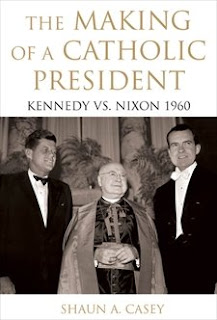
The Making of a Catholic President


Today's guest post comes from my graduate student Brad Hart, who blogs at American Creation. Brad reviews Shaun Casey's book about religion and the election of 1960. Thanks to Brad for taking this on and guest-posting for us! For more of his work, see his great recent post about Puritan laws against "seed-spilling."


Shaun Casey's new book, The Making of a Catholic President: Kennedy v. Nixon 1960, examines how religion -- in this particular case, Catholicism -- became the predominant issue in the presidential election of 1960. In addition, Casey explores how both Nixon and Kennedy used the "religion question" to their benefit, and how a plethora of prominent religious figures took to the stage of national politics, in an effort to "protect" the American democratic process.

From the beginning, Casey attempts to resurrect the anti-Catholic sentiment that permeated American politics during the early part of the 20th century. By invoking the "Ghost" of Al Smith, Casey effectively recreates the tumultuous political environment that Kennedy was to face head-on during his bid for the White House. With Kennedy emerging as a front-runner to the presidency, Protestant organizations, leaders, and media outlets embarked on a collaboration to shed light on the perceived "dangers" of a Catholic at the head of a democratically elected government. As Casey states:


Two substantive considerations were feeding their fears. First, the traditional teaching of the Catholic Church was at variance with American conceptions of religious liberty and of church-state relations. Might a Catholic president be used by a politically powerful church? Second, there were policy issues on which there was a Catholic position, and a Catholic president might steer national policy in those directions (55).
As debates over issues like birth control, funding for private schools, and a possible American ambassador to the Vatican began to rise, so did the fears of Protestants, who were quick to remind the American populace of past papal declarations (specifically those of Leo XIII), which had "decried the separation of church and state as a shibboleth of doctrinaire secularism" and "called for Catholics to penetrate wherever possible into the administrations of their countries' civil affairs" (138). As a result, the efforts of organizations like Protestants and Other Americans United for Separation of Church and State (POAU), ensured that the anti-Catholic sentiment that had led to the demise of Al Smith's political ambitions was again positioned to strike a fatal blow at Kennedy's run for the White House.

Despite the obvious hostility to a Catholic president, Casey points out that the Kennedy camp made a concerted effort to reach out to Protestants, in the hopes of gaining understanding and support. Casey writes:


Kennedy displayed a nimble and sophisticated grasp of the anti-Catholic forces he faced. The emerging strategy contained many elements that had served him well and would be sorely tested in the general election. Kennedy showed a willingness to admit his vulnerability regarding his Catholicism, to reach out to anti-Catholic Protestants...and to learn more about them. The listening sessions produced some direct public dividends, but they also gave the campaign insights into just how serious they had to take the threat (79).
On the flip side, the Nixon camp faced its own share of problems on the religion issue. To take advantage of the anti-Catholic sentiment by attacking Kennedy's faith out in the open would have proven fatal, but to ignore it entirely would be foolish. As a result, Nixon instead chose to work covertly with prominent Protestant leaders, in an effort to use their positions and status to attack Kennedy's Catholicism. Casey points out that Nixon relied heavily on the efforts of former Missouri congressman Orlando Armstrong, who "outlined a series of steps that the campaign could take in order to exploit Kennedy's Catholicism" (102). Paramount to his plan was to enlist the involvement of notable Protestant leaders and organizations like Billy Graham, Gerald Kennedy, Norman Vincent Peale, the National Association of Evangelicals, the Masons, and the POAU. By gaining their support, Nixon was able to leave the "dirty work" of attacking Kennedy's religion to Protestant leaders, who were more than willing to go to battle against a Catholic candidate.

One particular example used by Casey to illustrate the powerful impact of religion on the presidential race was the August, 1960 meeting of Protestant ministers at the Mayflower Hotel in Washington D. C. It was here that several prominent religious leaders met to "put a public face on Protestant opposition to Kennedy's candidacy" (123). However, as Casey points out, the meeting (which had been organized primarily by Billy Graham and Norman Vincent Peale) turned out to be a public relation's nightmare for Nixon, who, despite having no official ties to the meeting or the Protestant leadership, was forced to disavow the meeting's pronouncements. Instead of shedding light on the "religion issue" as being a "a real and vital issue that must be handled in the spirit of truth, tolerance and fairness," as Peale had hoped, the meeting portrayed the Protestant opposition to Kennedy as a "bigoted" demonstration of ecclesiastical arrogance (143-144). For Casey, this was a "defining moment" in the final weeks of the election.

It was these last minute mistakes that allowed Kennedy to capitalize of the religion issue. In his final chapters, Casey outlines how the Kennedy campaign turned the issue in their favor by suggesting that the Protestant opposition was what the American people really needed to fear. Casey writes:


Here, Kennedy took the separation of church and state, the most powerful tool being used against him by Protestants, and turned it in his favor. He affirmed it categorically and proceeded to show how his detractors were in fact violating this principle in their attacks on him. He stated that he believed in a country that was not officially Catholic, Protestant, or Jewish. No public official should request or accept instructions on public policy from the pope, the National Council of Churches, or any other ecclesiastical source. No religious body should seek to impose its will directly or indirectly upon the populace or public officials. Religious liberty should be so inviolable that an act against one church should be treated as an act against all (165-166).
By reversing the religion argument against his political opponents, Kennedy was able to successfully portray the pro-Nixon Protestant leadership as being guilty of the very same charges they had leveled against his campaign, and in the waning hours of the election, this provided all the momentum that Kennedy would need to emerge victorious.

In a nation where politics are literally saturated with religious overtones, Shaun Casey's The Making of a Catholic President serves as a poignant reminder of how the "religion question" can be better served when politicians seek understanding rather than public support from the ecclesiastical community. As Casey states in his conclusion:


Kennedy was not satisfied to accept that Protestant leaders were mostly against him. He and his brother Robert took the time to try and find out why this was the case. They did not seek formal endorsements from Protestant leaders; instead, they sought understanding. It would be a good thing for the U.S. polity if people seeking public office spent less time pandering for public support from religious leaders and more time listening to religious leaders talk about the concerns and aspirations of their organizations' members. If the United States is to make any progress in transcending the current political gridlock, conducting civil discourse across religious divides will be critical to that progress (204).

Wednesday, February 25, 2009

Pro-Choice Evangelicals, and Religious Scientists.

Paul Harvey

Just a couple of links for further discussion on topics that have been bandied about here recently.

First, The Edge features a colloquium on Jerry Coyne's piece in The New Republic, "Seeing and Believing: The Never-Ending Attempt to Reconcile Science and Religion, and Why It is Doomed to Fail," which I mentioned in my post on Darwin's anniversary. Respondents include the two authors (Kenneth Miller and Karl Giberson) whose books Coyne was reviewing (and attempting to refute), along with a host of others. Historians will recognize how much of this discussion dates back to arguments during the Enlightenment which have been ongoing since. Miller warns that Coyne's stark answers will "divert those of us who cherish science from a far more urgent task, especially in America today. That is the task of defending scientific rationalism from those who, in the name of religion would subvert it beyond all recognition. In that critical struggle, Jerry, scientists who are also people of faith are critical allies, and you would do well not to turn them away."

Second, Blake Ellis, a PhD candidate at Rice, offers up his thoughts on "Can Evangelicals Be Part of a Pro-Choice Consensus." His thoughts come from his dissertation research "Texas Baptists and the Rise of the Christian Rights, 1975-1985," based on the extensive oral history collections at the Institute for Oral History at Baylor. Ellis explores the history of Texas Baptist progressive figures such as Foy Valentine and suggests why it is that "despite substantial evidence that government-funded birth control reduces the number of abortions, white evangelicals have been among its fiercest opponents." It goes nicely along with Historiann's question: "why do conservatives oppose publicly funded contraception"? Her answer: because it works.

Tuesday, February 24, 2009

The Exorcist

John G. Turner

While watching Bobby Jindal's Republican response to the unofficial State of the Union address tonight, I was reflecting on the joys that many of us might have writing about his religiosity during the 2012 campaign (having just started to recover from Jeremiah Wright and Sarah Palin). Fortunately, it's a long way off. However, today I stumbled upon an evidently somewhat well-known piece about Jindal's early years as a Catholic convert. Since it was new to me, it might be new to you as well. It's an excerpt of an essay Jindal published in the 1994 New Oxford Review. Evidently, the entire article is only available for a small fee; however, CBN's David Brody published an extended excerpt.

In the essay, Jindal describes a prayer session for a cancer-stricken friend, Susan, who has been behaving oddly. The prayer session occurs at a meeting of University Christian Fellowship at Brown University. Here is an excerpt of the excerpt:

A senior in UCF (University Christian Fellowship) and a leader of my Bible study group had once asked me if I believed in angels, spirits, and other such apparitions ... After I related my doubts, the se­nior proceeded to describe recent incidents involv­ing mutual acquaintances -- e.g., a woman who claimed demons inflicted physical scars on her arms. I remained polite, but incredulous. The issue of spirits did not affect me, and I was thus content to leave its resolution to others. I had no opinions or feelings on the subject ...

After a period of group prayer, a student made a movement to end the meeting. Suddenly, Susan emitted some strange guttural sounds and fell to the floor. She started thrashing about, as if in some sort of seizure. Susan's sister must have recognized what was happening, for she ordered us to gather around and place our hands on Susan's prostrate body. I re­fused to budge from my position and froze in hor­ror. I will never forget the first comprehensible sound that came from Susan; she screamed my name with such an urgency that the chill still travels down my spine whenever I recall this moment.

Maybe she sensed our weariness; whether by plan or coincidence, Susan chose the perfect opportunity to attempt an escape. She suddenly leapt up and ran for the door, despite the many hands holding her down. This burst of action served to revive the tired group of students and they soon had her restrained once again, this time half kneeling and half standing. Alice, a student leader in Campus Crusade for Christ, entered the room for the first time, brandishing a crucifix ... Surely Crusade's experienced leader would be able to rescue us and reaffirm our faith in Christ, the Bible, and everything good ...

While Alice and Louise held Susan, her sister continued holding the Bible to her face. Almost taunting the evil spirit that had almost beaten us minutes before, the students dared Susan to read biblical passages. She choked on certain passages and could not finish the sentence "Jesus is Lord." Over and over, she repeated "Jesus is L..L..LL," often ending in profanities. In between her futile attempts, Susan pleaded with us to continue trying and often smiled between the grimaces that accompanied her readings of Scripture. Just as suddenly as she went into the trance, Susan suddenly reappeared and claimed "Jesus is Lord."

With an almost comical smile, Susan then looked up as if awakening from a deep sleep and asked, "Has something happened?" She did not re­member any of the past few hours and was startled to find her friends breaking out in cheers and laugh­ter, overwhelmed by sudden joy and relief...

I left that classroom with a powerful belief in Mary's intercessions and with many questions about spiritual warfare; I also learned a lasting lesson in hu­mility and the limits of human understanding. Was the purpose of that night served when so many indi­viduals were inducted into the Church? Did I witness spiritual warfare? I do not have the answers, but I do believe in the reality of spirits, angels, and other re­lated phenomena that I can neither touch nor see.

Wish I had gotten this into my Campus Crusade book, though my sense is that only a minority of Crusade leaders go about combating demons with crucifix in hand. [They usually brandish the Four Spiritual Laws]. I know the good folks at Daily Kos and Huffington Post would enjoy analyzing this sort of material during a 2012 Jindal campaign. However, I also reckon that a healthy percentage of Americans would affirm Jindal's final sentence.

Monday, February 23, 2009

This Beautiful City

Paul Harvey

O little town of Colorado Springs/how unstill we see thee lie.

My little town certainly draws its fair share of attention nationally. In just the past few years, documentaries such as Jesus Camp and Friends of God, journalistic works such as The Jesus Machine, pieces by Jeff Sharlet in Harper's featuring Colorado Springs as "the new Jerusalem," Ted Haggard's recent appearances on Larry King and elsewhere, and many other cultural productions have featured the city's religious landscape, and I don't mean Pike's Peak or our great rock formations, Garden of the Gods. And the freewheeling village that blends into us just to our west, Manitou Springs, remains blissfully off the national radar, its citizens free to attend Wicca meetings without encountering many "prayer walkers." Remarkably, a number of these documentaries and films arrived here just at the very end of Ted Haggard's reign at New Life Church, and so there's a "before" and "after" aspect that runs through many of them -- or perhaps better put, let's do the time warp again.

Theater hasn't ignored us either. Today's New York Times features a review of "This Beautiful City," a sort of oral history/theater piece put together by "The Civilians," a New York troupe who came to Colorado Springs for ten weeks and conducted numerous interviews with locals on the religious scene here. Like Jesus Camp and Friends of God, the troupe timed its stay with uncanny good fortune, perfectly to coincide with the Haggard scandal. Not surprisingly, then, the production focuses on issues of religion and sexuality.

Based just on the review, it appears the troupe has left behind obvious chances for snark and, to its credit, given full voice to a range of characters not normally associated with my new Jerusalem, including a black minister who comes out to his congregation and a transgendered ex-New Life member. (Pictured is Marsha Stephanie Blake, who plays a preacher who comes out to his congregation in the Civilians’ “This Beautiful City").

Here's an excerpt:

The glazed, slightly crazed smile of Ted Haggard, the leader of a megachurch in Colorado who was ousted in a jiffy after a sex and drugs scandal, makes a cameo appearance in “This Beautiful City,” the latest work of cultural anthropology from the Civilians, which opened Sunday night at the Vineyard Theater. But Pastor Ted’s supersize fall from grace is a story no stranger than many others in this engaging, inquisitive and evenhanded work of theater about the transformation of an American city and many American lives.

The burg of the title is Colorado Springs, just at the foot of Pikes Peak, home both to Mr. Haggard’s former empire, the New Life Church, with thousands of members, and Focus on the Family, the conservative organization run by James Dobson that has been a leader of the charge against gay rights initiatives for years. The Civilians, a troupe of theater artists who construct much of their work from interviews, spent 10 weeks in the city before and after the Haggard scandal broke, collecting impressions from citizens ranging across the social and religious spectrum, from church leaders to embattled
atheists in full bunker mode.

You might assume that members of a hip New York theater company would descend on the country’s epicenter of evangelism like a swarm of junior Michael Moores, wielding tape recorders like rapiers, backpacks stuffed full of snark. But the Civilians, known for the long-running revue “Gone Missing” and other documentary shows, have generally used humor to illuminate our follies rather than to sneer at our frailties. And that is certainly the case in “This Beautiful City,” which presents its collage of human experience without commentary, with a loose focus on the clash between religious orthodoxy and freedom of sexual expression.


Now of course, if this goes to a movie version, the obvious question that everyone will be asking is: who is going to play Paul Harvey? And so, I will ask for you: who is going to play ME? As you know, college religious history professors are hot stuff for theater and movie productions. So, I'm thinking Johnny Depp, or George Cloony, or perhaps Matt Damon. Any other ideas?

[NO, CAPTAIN KANGAROO, MICKEY ROURKE, AND SHELDON FROM "BIG BANG THEORY" HAVE ALREADY TURNED DOWN THE ROLE!].

Sunday, February 22, 2009

Niebuhr v. Niebuhr

Paul Harvey

John Fea has beaten me to the punch in pointing to Obama's Theologian, a recent Speaking of Faith radio interview about Reinhold Niebuhr with E. J. Dionne and David Brooks. It's an interesting conversation, and far be it from me to deny the recent Niebuhr revival its just due. If economists are all Keynesians now, religion and social policy thinkers seem to be all Niebuhrians, from Obama on down. Aside from Lincoln, and maybe M. L. King, it's hard to think of anyone Obama channels in his addresses more than Niebuhr.

With all that in mind, perhaps it's a good time to take a cold bath and feel a little uncomfortable chill from all this necessary but sometimes impoverishing realism. I felt a little bit of that chill yesterday evening as I was just cracking open Kip Kosek's Acts of Conscience, which I just mentioned here at the blog a couple of days ago. I'm no further than the introduction, but the author grabbed my attention immediately with this passage:

". . . the tough liberals of the mid-twentieth century [ignored] the Christian nonviolent tradition's most profound insight. The problem of the twentieth century, the pacifists contended, was the problem of violence. . . . It was, above all, the fact of human beings killing one another with extraordinary ferocity and effectiveness. . . Pacifists certainly failed to solve the problem of 'permanent war,' but the uncomfortable truth is that everyone else failed, too, even the liberal realists. Recent estimates put the total number of people killed by oranized violence in the twentieth century between 167 million and 188 million, which works out to some five thousand lives unnaturally ended every single day for a hundred years. Of course, the deaths came not at regular intervals, but rather in concentrated spasms unprecedented in their destructive power. . . We should take radical Christian pactifists seriously not because they were always right, but because they force us, as they forced their contemporaries, to confront these terrible truths. They insisted more emphatically, more sanely, than Niebuhr and the realists that the elimination of violence was not mere tilting at windmills but the most urgent modern project. "

Kosek focuses his book on the Fellowship of Reconciliation, a group with which Niebuhr was intimately involved during his time at Union Seminary. In researching Freedom's Coming, I encountered Niebuhr as an inspirational professor who sent a remarkable number of idealists on projects (I was focusing on civil rights) that must have seemed quixotic at the time. Discovering the inspiration for the likes of Howard Kester, James Dombrowski, Myles Horton, and others was exhilarating, and Niebuhr was central to the expansive dreams of this lot. The liberal realists of that era had no answer to American apartheid; the dreamers did.

Later, Niebuhr moved out of the religious left of the day and into a vision of liberal realism;that's the Niebuhr primarily that is celebrated today. Kosek has a less celebratory take: "the decline of the Fellowship's strain of radical Christianity has not led to enlightened secularism, but rather to an impoverishment of political discourse about violence."

More to come on this, but listening to the Niebuhr program in conjunction with just a short survey of Acts of Conscience has been a rich treat already.

Rituals of Resistance

Rituals of Resistance
by Paul Harvey

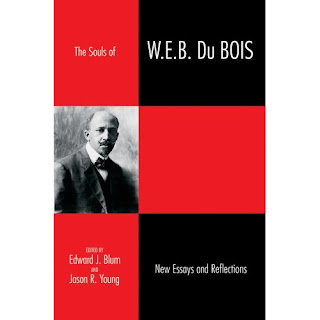
Phil has just posted on the new collection Souls of W. E. B. DuBois, edited by our own Ed Blum and Jason Young. As it happens, I was just finally getting to Professor Young's book, published by LSU Press in 2007, Rituals of Resistance: African Atlantic Religion in Kongo and the Lowcountry South in the Era of Slavery.

Young's work is part of a larger trend towards placing African American religious history within the larger context of the Atlantic world, or the African Atlantic. The excitement of this scholarship comes from its promise in moving behind stale debates and paradigms (such as the old Frazier versus Herskovits debate, or the "resistance" or "accommodationism" paradigms) by investigating the transmission of religious ideas and practices with geographic, cultural, and chronological specificity. John Thornton's work has been instrumental in this wave of scholarship, as has (from a very different, indeed conflicting, perspective) Michael Gomez's. What is most compelling about this scholarly discussion is placing African ideas of Christianity squarely into the mix that went into the making of the Atlantic religious world, which just gets more complicated and interesting the more it has been investigated in the last generation of scholarship. As Young puts it:

the prior exposure that some Kongolese captives had with Catholicism colored the subsequent encounter that New World slaves had with the mandate of Christian conversion in the Americas, thus complicating the ulimate meaning of Christian conversion. In Kongo, many converts believed that baptism offered a spiritual protection against not only death but also against the very real threat of being taken as a slave . . . others reinterpreted Christian theology to argue that Jesus was Kongolese and that Jerusalem was located in the capital of Kongo.

Here's a description of Young's book, from its webpage:

In Rituals of Resistance Jason R. Young explores the religious and ritual practices that linked West-Central Africa with the Lowcountry region of Georgia and South Carolina during the era of slavery. The choice of these two sites mirrors the historical trajectory of the transatlantic slave trade which, for centuries, transplanted Kongolese captives to the Lowcountry through the ports of Charleston and Savannah. Analyzing the historical exigencies of slavery and the slave trade that sent not only men and women but also cultural meanings, signs, symbols, and patterns across the Atlantic, Young argues that religion operated as a central form of resistance against slavery and the ideological underpinnings that supported it.

Through a series of comparative chapters on Christianity, ritual medicine, burial practices, and transmigration, Young details the manner in which Kongolese people, along with their contemporaries and their progeny who were enslaved in the Americas, utilized religious practices to resist the savagery of the slave trade and slavery itself. When slaves acted outside accepted parameters—in transmigration, spirit possession, ritual internment, and conjure—Young explains, they attacked not only the condition of being a slave, but also the systems of modernity and scientific rationalism that supported slavery. In effect, he argues, slave spirituality played a crucial role in the resocialization of the slave body and behavior away from the oppressions and brutalities of the master class. Young's work expands traditional scholarship on slavery to include both the extensive work done by African historians and current interdisciplinary debates in cultural studies, anthropology, and literature.

Drawing on a wide range of primary sources from both American and African archives, including slave autobiography, folktales, and material culture, Rituals of Resistance offers readers a nuanced understanding of the cultural and religious connections that linked blacks in Africa with their enslaved contemporaries in the Americas. Moreover, Young's groundbreaking work gestures toward broader themes and connections, using the case of the Kongo and the Lowcountry to articulate the development of a much larger African Atlantic space that connected peoples, cultures, languages, and lives on and across the ocean's waters.

Thursday, February 19, 2009

Du Bois and Religion

by Phillip Luke Sinitiere

Today I received in the mail the much anticipated The Souls of W.E.B. Du Bois: New Essays and Reflections. It was well worth the wait. While I have not yet read every essay, I poured through many of them and want to highlight several points about this seminal collection.

First, kudos to Ed Blum and Jason R. Young. This is a stout collection of essays that unveils a spiritual Du Bois who—as we all know from Ed’s work was an American prophet—but from the new work also a scholar whose interest in things spiritual included commentary on the history of Islam, writing about Zionism, and reflections on the religious traditions of India.

The editors organized the essays into four segments: the first around the question of Du Bois’s religious inspiration, a section that analyzes Souls of Black Folk, another on the social and cultural history of Du Bois and religion, and a final section on Du Bois’s engagement with Islam, Judaism, and Buddhism.


In section one readers will find a revised version of Dwight Hopkins’s chapter on Du Bois from his great book on Black theology titled Shoes That Fit Our Feet, and an interesting essay on the (religious) pragmatist tradition of Du Bois—an important topic that Jonathon Kahn will expound upon in Divine Discontent: The Religious Imagination of W.E.B. Du Bois, due out in July. Most importantly, Phil Zuckerman adds a keen challenge to Du Bois as a religious figure and claims he was decidedly “irreligious.” Zuckerman piles the quotes and the evidence quite high, and makes good points about Du Bois’s social scientific worldview as well as his extreme distaste for religious hypocrisy. Although I am not fully persuaded by his claims, Zuckerman nevertheless remains a very thoughtful voice in the growing body of work about Du Bois and religion.

The second section on Souls of Black Folk adds yet more texture to the multiple studies of this key work. So far my favorite part of the collection is section three. Ed’s contribution here comes from ch. 4 of W.E.B. Du Bois, American Prophet, one of the strongest chapters of his biography. (For more on this chapter see this post from my interview with Ed.) David Howard-Pitney’s essay ties Du Bois’s religious meditations to America’s civil religion and therefore contextualizes his work in new ways. Another very strong contribution in this section comes from Michelle Kuhl, whose essay studies Du Bois’s conception of manhood as reflected in his lynching/crucifixion tales published in The Crisis. Here Kuhl makes use of some of Du Bois’s understudied writing while editor of the NAACP’s magazine, and shows that Du Bois’s fictional work and creative writing is crucial for understanding his overall religious outlook.

The final segment of this collection takes Du Bois and religion in an entirely new direction by focusing on his understanding of Islam (Jason R. Young), his relationship to Zionism (Benjamin Sevitch), and the literary and religious depth of Du Bois’s Darkwater and Dark Princess (Ronda C. Henry).

Put this on your to-be-read list. It will be well worth your time. Here's what others have to say (from the jacket). James Cone describes this new book as "a thoughtful collection of essays," and Anthea Butler writes that it is an "excellent volume." Manning Marable says that the book contains "fresh insights" and "extraordinary essays." Finally, the BlogMeister recommends the essays as "wonderfully interesting" as the volume is "unusually coherent and cohesive."

Wednesday, February 18, 2009

Acts of Conscience

Paul Harvey

I've just had the pleasure of receiving a book derived from a dissertation that won the 2005 Allan Nevins prize (given annually to the best-written dissertation in American history): Joseph Kip Kosek's Acts of Conscience: Christian NonViolence and Modern American Democracy. It's on my spring break reading list, so I hope to post further thoughts on this new work in April. In the meantime, the author has an engaging post here at the Columbia University Press blog, which I recommend.

A brief excerpt:

Everyone admires nonviolence when it remains safely in the past, but it looks a little too exotic, too effete, and perhaps even too religious to be much help in our present moment. Does nonviolence really have anything to offer amid the violent crises exploding around the world today? Seventy-five years ago, an American pacifist named Richard Gregg confronted an essentially similar question. His 1934 book The Power of Non-Violence was the first substantial attempt by an American to imagine nonviolence as a formidable strategy in the modern world, not simply as a virtuous allegiance to high-minded ideals. Many years after its initial publication, Martin Luther King, Jr. read The Power of Non-Violence and brought its central ideas into the nascent civil rights movement. King frequently cited the book as one of his most important intellectual influences, alongside the writings of Mohandas Gandhi and Henry David Thoreau. Gregg forced King, as he forces us, to realize that nonviolence is not merely admirable or historically interesting, but fundamentally necessary.

Tuesday, February 17, 2009

The Wrestler and Religion

Where's the meat?
Kelly Baker


Over at Religion Dispatches, S. Brent Plate wonders why didn't movie reviewers pick up on religion in Darren Aronofsky's film, The Wrestler. In "Pop-Eye: Meat the Wrestler," Plate argues that secular and religious reviewers overlooked religion because religion was material in the film. The spirit-body dualism that many take to be at the heart of some religions obscured obvious religious symbolism. Randy is meat. The body is where his religious suffering and devotion occurs. Plate writes:

More specifically, it’s curious how few religious-oriented reviewing outlets were able to see possible symbolic references to, say, Abraham and Isaac, Jesus, or others. So, I’m left wondering, did the reviewers blink their eyes, reach down for another bite of popcorn, at the images of a tattooed Jesus Christ on Randy’s back? Or the “Job” (pronounced with long “o”) inked into the skin of his middle finger? Or the white fleece vest he wears on his entrance into his final fight?

A couple of reviewers did pick up on Cassidy’s heated endorsement to the blissfully-ignorant Randy of Mel Gibson’s The Passion of the Christ, exclaiming, “Dude, ya gotta see it! They throw everything at him: whips, chains…” to which a confused Randy replies, “tough dude.” Cassidy sees Jesus as a real wrestler, showing both her investment in the fiction of the violence, but equally her invested belief in Randy as a tough dude. Theirs is a physical Jesus, a body that could take it, á la Gibson’s Christ; unlike Gibson, Aronofsky’s tale is disinvested of tacky teardrops falling from the sky and cheap-trick resurrections.

The reason reviewers passed over the religious is not simply, I suspect, because of religious illiteracy, but because of the received wisdom of late-modern culture that continues to dwell on a body-soul dualism, with the soul in power, the body a mere marionette. Several of the religious-oriented review sites described Randy’s body in metaphorical terms: Randy’s heart attack was really a comment on his loneliness, a broken heart over his daughter’s estrangement and the utter lack of any other community. Reviewers persisted in maintaining this dualism, that the double identities Randy and Cassidy both share ultimately want to get to some core non-physical identity, some materially transcendent spirit, some individuality that is more about the myth of modern individualism than about anything religious. Therein they miss the (religious) point.

Monday, February 16, 2009

Southern Masculinity and Religiosity

Southern Masculinity and Religiosity
Paul Harvey

A new anthology collection for those of you interested in all things southern: Southern Masculinity: Perspectives on Manhood in the South Since Reconstruction. This new volume, a successor to a companion work about masculinity in the Old South, continues and develops further gendered studies of the South, pioneered by works such as Ted Ownby's Subduing Satan and Laura Edwards's Gendered Strife and Confusion. Most notable for the new volume is a really outstanding essay by our contributing editor Ed Blum, " A Subversive Savior: Manhood and African American Images of Christ in the Early Twentieth Century South." Duke University scholar Seth Dowland contributes this piece, which I'm anxious to read: "A New Kind of Patriarchy: Inerrancy and Masculinity in the Southern Baptist Convention, 1979-2000." As well, Joe Creech's "Violent Masculinity: Learning Ritual and Performance in Southern Lynchings," will draw much attention.

For my money, Robert Duvall's portrayal of Sonny in The Apostle captures the contradictions of white southern religiosity and masculinity as well as it has ever been done; as a character, he seems to stride right out of the pages of Wilbur J. Cash's Mind of the South. Black southern versions of the same have been a theme of some recent scholarship, including Ed's essay for this volume and a host of takes on the bluesmen as performers; my favorite there still remains Jon Spencer, Blues and Evil, a work that never got all that much attention but is a short and profound exploration of blues theology.

Some of the contributors to this volume are readers of this blog, so please, ya'll, feel free to add here in the comments section, or throw me a guest post on your essay.

Saturday, February 14, 2009

Luxury Condominium Catholicism

MICHAEL PASQUIER

Every Saturday I drive my daughter to swimming lessons in a town on the outskirts of Boston. And every Saturday I pass what was once St. Theresa Catholic Church and what is now Bell Tower Place Condominiums. St. Theresa’s was one of 65 Boston-area churches shuttered by Archbishop Sean P. O’Malley in 2004. The decision to close so many churches came in the aftermath of an $85 million legal settlement with 552 victims of sexual abuse in 2002. Crucial to the plaintiffs’ case was Cardinal Bernard F. Law’s admission that he covered up allegations of sexual abuse by reassigning accused priests to other parishes around the archdiocese. Law knew about John J. Geoghan’s attacks on young people as early as 1984, just a year before a small-town investigative journalist uncovered what he called “the veil of secrecy that surrounds the case of Gilbert Gauthe,” a priest who later admitted to similar actions in the Diocese of Lafayette, Louisiana. News of Gauthe’s guilt reached the pages of the New York Times and Time. It also received coverage in a 1985 issue of the National Catholic Reporter, which included the editorial comment that “the tragedy and scandal is not only with the actions of the individual priests—these are serious enough—but with church structures in which bishops, chanceries and seminaries fail to respond to complaints, or even engage in coverup.”

Since the mid-1980s theologians, historians, lawyers, journalists, teachers, parents—just about everyone—have thought about the behavior of priests and the institution of the priesthood. Scott Appleby, a historian of American Catholicism at the University of Notre Dame, told American bishops in 2002 that they were accomplices in “a betrayal of fidelity enabled by the arrogance that comes with unchecked power.” Eugene Kennedy, a professor of psychology at Loyola University in Chicago, accused American bishops of suffering from “Pontius Pilate Syndrome, that unwillingness to learn, that fatal paralysis of judgment, that preferential option for passivity.” Indeed, “the real subject,” according to Kennedy, “is not the sex abuse scandal but the bishops themselves.” Historian Jay P. Dolan made a similar assertion in a postscript to the second edition of his book In Search of an American Catholicism, writing that “a celibate, male, clerical culture impervious to outside scrutiny has created the worst scandal in the history of American Catholicism.”

The statements of Appleby, Kennedy, and Dolan have not gone without criticism. I distinctly remember watching and listening to EWTN commentators reduce Appleby’s 2002 remarks at the Dallas conference of bishops to some kind of feminist rant laced with a liberal homosexual agenda. Read for yourself. That being said, the debate over the present crisis in the Catholic Church does seem to have escaped the scrutiny of most historians with the analytical tools necessary to unveil the many faces of the priesthood. To put it another way, historians have the ability to take what they’ve learned by studying “the people” and retrain their eyes on the priests. Case in point: Francois Raymond, diocesan priest of Opelousas, Louisiana, accused of raping a girl in 1862. Archival sources reveal a scared assortment of priests in the Archdiocese of New Orleans scurrying to cover up reports of Raymond and a pregnant girl, his regular meetings “in the woods with other women of bad reputation,” and his affair with an enslaved woman of African descent. Such "great scandals," according to a priest close to Raymond, produced a negative effect on the reputation of priests and threats of physical violence. The threats were so great, in fact, that one priest suggested that “for his health, to renew his morale, [and] to let dissipate all the commotion in its entirety,” Raymond should “take a retreat, that he go on a little trip,” and then return to another area of Louisiana when things had settled down.

But if history isn’t your thing, then look more closely at today’s changing Catholic landscape and tone of Catholic voices in urban, suburban, and rural America. Learn about how Catholic laypeople have held vigils in 5 “suppressed” (that’s canon law speak for “closed”) churches in the Archdiocese of Boston since their official closures in 2004. Think about the impact of widespread church closures throughout the United States just as the overall Catholic population rises, largely as a consequence of the growing number of Hispanic parishioners. And take seriously the words of laypeople who react to bishops acting like bishops. In response to the resignation of Cardinal Law, one woman had this to say: “This should teach a lesson to the people in charge, to someone like him. I think the church was really protecting themselves and they didn’t really care about the children. A lot of children got hurt because of that.” And in response to a visit by Archbishop O’Malley to a suppressed church in Boston, another woman had this to say: “That was utter hypocrisy to have him here to speak about the importance of having a community of worship in the very building he’s shutting down.”

Perhaps Luxury Condominium Catholicism isn’t the right way to describe the current state of American Catholicism after all. Maybe it’s a euphemism for Angry Catholicism. Either way, or in completely different ways, the deep historical and cultural roots of the Catholic priesthood are losing their mysterious qualities. Mystery is bound to fade as long as people like Father Donald McGuire of the Archdiocese of Chicago go to prison for the abuse of minors. McGuire, supposedly a respected confidante of Mother Teresa, admitted during sentencing earlier this week that “Tears are frequent for me these days.” A father of two boys had this to say: “Give me 30 minutes in a locked room with him and a baseball bat—with no repercussions in this or the next life—and I’m ready to call it a day.”

Friday, February 13, 2009

Public History and the Pueblo Revolt of 1680


Religious Intolerance and Public History
Kelly Baker


On this blog recently, we have posted quite about religious intolerance. This does my heart good because not only is this one of central areas of interest but also because I am teaching a course in religious intolerance this semester. One of my main claims is that Americans have a hard time recognizing intolerance, or even hatred, in public culture, so some prefer histories of collegiality to histories of conflict and colonization. However, I am teaching this course in New Mexico, which has a long history of colonization and my students seem more keen to histories of conflict and repression. Moreover, the topics I lectured on for my second class actually occurred in New Mexico, which means that I have the benefit of pointing out local sites that our central to these case studies.

Last weekend (I teach on Saturdays), I presented the Pueblo Revolt of 1680 in which Pueblo peoples successfully revolted, and thus, were free from Spanish rule, military and spiritual, for twelve years. My students were pretty familiar with the story, except I provided more detail to what happened to Franciscans who decided to stay at their missions. Suffice to say, their fates tended to be fairly gruesome. The revolt is a brilliant case study of both Catholic and Pueblo intolerance. Franciscan friars attempted conversion by removing indigenous religious praxis, and the Pueblo, involved in the revolt, inverted Catholic ritual and tortured Franciscans who stayed behind. The history of this religious encounter is bloody and tragic. What makes this case study unique is that I can point to the places of this encounter, and these places are more tangible because they are so nearby.

Moreover, many of my students have visited the Cathedral Basilica of Saint Francis of Assisi in Santa Fe and the Acoma Pueblo at Sky City. These sites present a narration of this dramatic event and the larger history of colonization in what is now New Mexico. Tourists visit these sites each year and imbibe in the visions of Catholic-Pueblo encounter. They consume cultural artifacts as well as stories. I have also been a tourist at these cultural sites, and what becomes clear is that the Catholic vision and the Acoma Pueblo vision of the revolt and Spanish missions are starkly different. The Catholic vision focuses upon the benefit of the missions and glosses over the revolt (the twelve years of Pueblo autonomy is missing). In addition, the cathedral sponsors an event every year that retraces the flight of the Franciscans from Santa Fe. At Sky City, an Acoma tour guide leads hapless tourists through the village of the mesa and tells tales of encounter that vary depending on the audience. Our tour guide told me at the end of the tour that she has to decide how pro-Pueblo her tour can be based on her audience. Thus, I get to hear the story of "flying lessons" for priests privately. Most tourists, generally middle to upper class white men and women, seem to prefer their tour free of conflict and colonization. Intolerance still makes us uncomfortable, it seems.

This week, Historiann posted "Never mind the slavery, have you dipped a candle yet?" and pointed out the desire for conflict-free tourism at historical sites, particularly in regard to slavery. She writes:
Now, it would be easy for all of you groovy, liberal, non-Southerners to roll your eyes and chuckle and slap your foreheads in mock disbelief at the racist fools who run North Carolina house museums. But I think that the problem diagnosed so accurately by Professor Alderman is a problem in many house museums and historic sites all over the country. This story raises the important question of what historic sites and house museums are for: are they opportunities to dip candles, admire high-style material culture, and imagine our (white) selves playing dress-up? Or are they opportunities to learn more broadly about the lives of all people in a given period of history and how they related to one another?

As a professional historian, I’d say that the latter is a worthier goal than the former. But let’s be clear: it’s not just southern public history sites that “whitewash” history. Something I’ve observed in my travels across the country, stemming from my interest in borderlands warfare in the colonial Americas, is that some of the most wretched and/or totally hapless European or Euro-American forts or missions–the fort at Pemaquid, Maine, for example, or Fort No. 4 in New Hampshire, or Jemez Mission in New Mexico–have been excavated and/or lovingly (and sometimes imaginatively) re-created in the twentieth century, whereas the Indian villages or forts that laid them to waste and and long outlasted them have not been. (Jemez Mission includes some reconstructions of the foundations of Indian dwellings outside the mission, however.) Jemez Mission was reconstructed by the Works Progress Administration, and reflects in many ways the prejudices of history as it was practiced in the 1930s. It seems like it’s time to revisit the assumptions that undergirded these public history projects from thirty, fifty, and eighty years ago.

I agree with Historiann that we need public history to be revisited at these sites, so we can reflect on the unpleasant and the intolerant in our histories. Moreover, how different would tourists find the history of the Pueblo Revolt if the Catholic and Pueblo narratives rested side-by-side rather than separately presented? Would tourists appreciate the unflinching presentation of colonization and the violence of the revolt? Or would we rather "dip candles" and consume Pueblo artifacts than encounter the unseamy side of American history?

Wednesday, February 11, 2009

Evolution and Wonder

The Wonder of Darwin
Paul Harvey

My local public radio station KRCC recently switched its Sunday programming, moving "my" show Speaking of Faith to an annoyingly inconvenient time; so I've missed the program most of the time lately. By chance I caught it Sunday, and it (along with a plethora of recent book titles and reviews that I've been reading) reminded me to celebrate the wonder of Charles Darwin on his 200th birthday. The program, Evolution and Wonder: Understanding Charles Darwin, can be heard and explored further here.

Many times now I've read a statement to the effect that most biologists have never read On the Origin of Species, and that, if/when they do, they are startled by its literary power. I know biologists have plenty of other things to do, but I would hope more of them would pick it up, as I did as a high school student.

Here I have to give a shout out to Mrs. Hinton, my rigidly conservative, Church of Christ attending high school biology teacher. She was stern and no-nonsense, and that included the precious time she had with us in science class. She didn't waste time with any apologies for modern evolutionary theory, or circumventing the obvious difficulty it raised with the Genesis account, or with prevarications such as "this is just a theory that some people believe" or any of the other vapid cliches that creationists periodically try to sneak into science standards. Instead, she focused on science, because she knew that's what science class was for, and she knew that if our parents wanted us to understand religion, we would get that in the appropriate places as well. By the way, this was in small public school in rural Oklahoma where we still said school prayer and were required to attend "devotionals," sometimes led by the same Mrs. Hinton. She knew her religion, and she also knew how to teach us that evolution was the entire basis of all modern biology, and was a "theory" akin to the "theory" of gravity.

Then again I encountered Origin as an aspiring biology-major-to-be. That was before Clio kidnapped me for history, roundabout my junior year of college; or perhaps more realistically, when I discovered that laying about the library reading history books was to be my destiny, and besides that left more time for afternoon basketball while my former fellow students in 2nd year Organic Chem were slaving away in the lab.

The famous end passage of Origin speaks most eloquently to Darwin's wonder, and to me always has read as a biological psalm:

(F)rom the war of nature, from famine and death, the most exalted object which we are capable of conceiving, namely, the production of the higher animals, directly follows. There is grandeur in this view of life, with its several powers, having been originally breathed into a few forms or into one; and that, whilst this planet has gone cycling on according to the fixed law of gravity, from so simple a beginning endless forms most beautiful and most wonderful have been, and are being, evolved.

Yesterday's New York Times Science section featured an rich set of pieces on Darwin, both what he got right and anticipated (which was a lot) as well as what he could not possibly have gotten right (the role of genetics, molecular evolution, and so on). The end result, for me, was that Darwin still towers over modern understandings of life, even while "Darwinism" is a most unfortunate phrase, since an "ism" rigidifies into an ideology rather than the supple set of ideas so beautifully expressed in Origin of the Species.

Mendel, Watson and Crick, Gould, and many others have shaped contemporary scientific understandings and advanced, naturally, far beyond Darwin's conceptions. The evolutionary geneticist Jerry Coyne's recent summary text, Why Evolution is True, presents in clear layperson's terms a good deal of this history of the evolution of the scientific idea of evolution since Darwin, pointing out the deep truths in Darwin as well as some points that he either did not or could not understand or get right. Coyne also discusses scientific points about evolutionary theory still under investigation, and questions still to be answered. Another beauty of Darwin's dangerous idea is precisely its power to fuel generations of scientific investigation.

(Coyne also has recently laid aim, in The New Republic, to those, including Karl Giberson's fine work Saving Darwin: How to Be a Christian and Believe in Evolution, and for that matter Stephen Jay Gould's idea of "non-overlapping magisteria," who find religion and evolution compatible in the sense that science and religion speak ultimately to different questions, and certainly do not have to be mutually exclusive. I ultimately am not persuaded by Coyne's critique, but he does write a tough-minded essay, one well worth reading.)

Nonetheless, at a deep level Darwin's decades of careful observations and meticulous recordings led him to get something fundamental about the development of life forms right, intuitively and almost religiously. Moreover, as his biographer James Moore discusses on the Speaking of Faith program, Darwin mulled deeply over the realization that his notions upset static notions of the fixity of life on earth.

The Origin of Species was not the first classic scientific text to break from such [creationist] beliefs. It was, rather, the last to fully engage them. Darwin waited two decades before he published. His observations and conclusions were painstakingly belabored. He anticipated religious questions and objections at every turn and responded carefully to them. Darwin's theory of natural selection was borne, James Moore asserts, of "theological humility."

This insight alone would place our culture's contentious battles over Darwin on a different footing. My own suppositions have been radically changed by this program. . . .
Darwin saw creation as an unfolding reality. Once set in motion, as he saw it, the laws of nature sustained a self-organizing progression driven by the needs and struggles of every aspect of creation itself. The word "reverence" would not be too strong for the attitude with which Darwin approached all he saw in the natural world. There is a great intellectual and spiritual passion and a touching sense of wonder evident in the writings included in this program and on our Web site, from his private notebooks and correspondence as well as the Beagle Diary and The Origin of Species.

Darwin's deep engagement with the moral struggles of his era have been the subject of a number of recent books, as well. One especially notable one: Darwin's Sacred Cause: How a Hatred of Slavery Shaped Darwin's Views on Human Evolution.

I've often asked my students why "evolution" or "Darwinism" causes such controversy in America -- from the Scopes Trial to later "creationism" to the recently updated version of creationist nonsense, "Intelligent Design"-- while no such bitter culture wars seem to preoccupy Christian believers elsewhere. That has changed a bit in recent years, as some of the "ID" propaganda has found its way across the pond. Nonetheless, America has a very peculiar history with the idea of evolution, and it always has puzzled me that other well-known and well-established recent scientific ideas haven't pushed the culture wars the same way. For example, the random nature of the distribution of proteins in DNA structure hardly speaks to a biblical view, yet I'm sure creationist evangelicals have little trouble watching CSI, and some of them who would recoil in horror at Origin of Species can read Watson and Crick, or perhaps even Brian Greene's explanation of "string theory," and not think about how their entire cosmology has just been disrupted. Coyne has a nice passage on this in the review quoted above:

The resistance to evolution in America has little to do with populism as such. Our ornery countrymen do not rise up against the idea of black holes or the proof of Fermat's Last Theorem.

Ronald Numbers (Darwinism Comes to America) and Edward Larson (Summer for the Gods) probably come as close as anyone to explaining how Darwinism has fed into a long-running culture war in American religious history. Still, sometimes it just makes me wanna holler: On the Origin of Species is beautiful. Just read it, and feel the wonder!

Monday, February 9, 2009

God and the Modern American Presidency

Several months back I interviewed Randall Balmer on his then-new God in the White House: A History: How Faith Shaped the Presidency from John F. Kennedy to George W. Bush, Historically Speaking (Jan 2009). The book is now out in paperback and has grown new legs. Balmer is making the rounds, talking to reporters and pundits about the lessons to be learned from how candidates and presidents have spoken about faith and related to the faithful. (See the Daily Show interview below from Feb 5. Can't believe I figured out how to embed this and change some of the coding a bit. Let me know if it's all scrimble-scrambled.)

Since Johns Hopkins UP has Historically Speaking up and running on Project Muse, the issue, and this interview, are available in full here.

... Stephens: Did Richard Nixon's Quakerism have a significant impact on his political career and later life? Did commentators note that link?

Balmer: That came up in the 1960 campaign. One hundred and fifty Protestant leaders gathered at the Mayflower Hotel in Washington, D.C., to discuss Kennedy's Catholicism. After this meeting Harold John Ockenga, pastor of Park Street Church in Boston, and Norman Vincent Peale of Marble Collegiate Church in New York City, held a press conference and called on Americans to think very carefully and very seriously before they elected a Roman Catholic to be president of the United States. His faith, they argued, might affect the way he would govern. A reporter asked Peale if those who attended this meeting discussed Nixon's Quakerism. Peale replied with what I'm sure was an unintentionally hilarious comment that turned out to be quite prophetic: "I don't know that he ever let it bother him." . . .

Stephens: Could you comment on the perceptions that voters have about the religiosity of politicians?

Balmer: One of the great mysteries of presidential politics over the last half-century is why it was that evangelicals who helped propel Jimmy Carter into office turned so dramatically against him. As far as I can tell, there were several things going on. . . .

(For more on Balmer's book, see Ed Blum's review from last year.)

Some other essays in this issue of HS that might be of interest:

Teaching American Abolitionism and Religion

Bertram Wyatt-Brown

Evangelicals, the End Times, and Islam
Thomas S. Kidd

Witch-hunting in the Western World: An Interview with John Demos

Donald A. Yerxa

Cabeza de Vaca and the Problem of First Encounters
Andrés Reséndez

Displaced from Zion: Mormons and Indians in the 19th Century
Jared Farmer

Sunday, February 8, 2009

Betrayal of Faith on the CBC

Paul Harvey

Just a quick addendum to the post below, on Emma Anderson's Betrayal of Faith: here's an interview with the author, conducted by Mary Hynes, on the CBC radio show Tapestry.

Friday, February 6, 2009

Religion and Profit: An Interview with Katherine Carte Engel

Editor's note: It's raining early American religious history here at our blog! To go along with our previous interview a few days ago with Emma Anderson, today we feature an interview with Kate Carte Engel, author of the outstanding new work RELIGION AND PROFIT: MORAVIANS IN EARLY AMERICA. Kate teaches together with her husband at Texas A & M, and has previously guest blogged for us from the conference she recently attended on "Markets and Morality." Below she discusses how she came to study the Moravians, and how she conceptualizes religion and economics in American history.
______________________________________


1) I’ll start with a variation of a question I often ask students when introducing a subject: “Who are the Moravians, and why should I care?”

That’s a great question. Because the Moravians are not as known today as they were in the eighteenth century, they often get confused with other small denominations, particularly the ones with a Pennsylvania connection, such as the Amish or the Mennonites. They have a very unique heritage, though. What we call the Moravian church today is more formally known as the “Renewed Moravian Church,” because the group traces its routes to the followers of fifteenth-century Czech martyr Jan Hus. Their history took a dramatic turn, however, in the eighteenth century, when a small group of refugees moved to Saxony and came under the leadership of an aristocratic German Pietist, Count Nikolaus Ludwig von Zinzendorf. Under Zinzendorf’s guidance, they became some of the most important early evangelicals, and they are best understood within the German Pietist tradition. Most famously, they had a strong influence on John Wesley. They’re important for historians because of the pivotal role they played in the birth of Atlantic evangelicalism, and also because of their widespread and highly successful missionary projects.

2) How did you become interested in the Moravians, and the larger
issue of religion and economics, in the first place? Take us through your process, from initial conceptualization to finished book.


I actually came to the question of religion and economics before I found the Moravians. I had always been left hollow by the idea that religion somehow used to matter in the past, but doesn’t have an impact on the modern economy. It assumes a macrohistorical conflict between faith and the market that tends to steamroll the intricacies of the past. This narrative has been particularly strong in early American history because of the influence of Perry Miller. I think most early Americanists today have a gut feeling that the premise is flawed, or perhaps limited only to New England, but no other paradigm has really replaced it. If you look at a survey text, the section on New England will usually talk about Puritan religion, then talk about how they were (contrary to what students assume) actually good at business and quite engaged in trade and speculation. The larger idea that one should be surprised to find devout faith and entrepreneurialship in the same place is left unchallenged. But historical methods have changed a lot in the decades since Perry Miller wrote (and the century since Max Weber did), so I wanted to find a new way into the question.

As for the Moravians, that was profound good luck. First, I fell in love with the Mid-Atlantic and the eighteenth century. Then, I looked for a good way to explore my sense that religion and economy intersected in much more complicated ways than other historians seemed to argue, and I found the Moravians. The initial appeal was that Bethlehem, Pennsylvania, was, between 1741 and 1762, one of the largest communal settlements in colonial America. Then, in 1762, the communal household was dissolved with almost no social distress. But the story got much more interesting from there. I had the wonderful experience of having my sources point me to a larger narrative than I realized was there. My little case study of a communal town turned out to be at the nexus of evangelical awakening, Atlantic trade, and imperial warfare. I think the Moravians’ importance to the question of religion and economics is ultimately that it forces one to recognize how contingent and changing both religious culture and economic choices are. They can’t really be investigated separate from a larger historical context.

3) It seems like the Moravians have been the subject of a lot of
scholarship in recent years -- from Jon Sensbach to Aaron Fogelman and many others. Are the Moravians, indeed, “hot,” and if so, why?

Well, I guess I hope they’re hot! One reason is that there has been such a needed resurgence of interest in religion among early Americanists, and in evangelicalism by scholars of American history. Then there’s the fact that the Moravians were in all the right places at the right times in the eighteenth century. They had missions literally all around the Atlantic rim, and they were active throughout British North America. They were creative and energetic, and they knew many important figures, from Benjamin Franklin and John Adams to John Wesley and George Whitefield. But most important, they kept AMAZING records. They wrote everything down (though, they wrote it in old German script), and they saved it all, often more than one copy. The Moravian archives in Bethlehem, Pennsylvania, Winston-Salem, North Carolina, and Herrnhut, Germany, are overwhelming in their completeness. The Moravian community is also very supportive of research on a wide variety of subjects. They do not try to control the work done in their archives the way some religious communities do.

4) Your larger theme is religion and economics. What are the most
important issues you think religious historians need to understand/grapple with when thinking about economics?


The biggest hurdle, I think, is how we conceptualize the two areas of religion and economics. There’s long been an presumed separation between the two that grew out of what is ultimately an intellectual construction of the religious and the secular. As people like Tisa Wenger, Talal Asad, and Joel Chidester push us to think about the concept of religion in more historically contingent ways, we have to confront the implications of that for the intersection between the religious and the economic. The biggest challenge is to get beyond these categories and find ways to uncover interactions that were more subtle than a simple conflict between “religion” and “capitalism,” or the idea that religion is always a conservative force acting on the economy. On the other hand, we cannot lose sight of the fact that much religious teaching--certainly Christian teaching--is about right economic action. I believe the negotiation between religious ideals and economic choices was almost always an intimate one, specific to a transaction and the individuals who were engaged in it, even as it was also inextricably linked to the wider web of history. Our challenge is to find ways to see those moments.

5) Many groups in American history have struggled with a perceived
contradiction between “piety” and “profit.” Others, like the recent spate of prosperity gospel advocates, have provided facile answers to the possible disjuncture between religious altruism and the self-interest inherent in capitalism. How did the Moravians deal with this issue so (apparently) successfully?

The short answer is that I think modern people have created the conflict. The loaded word here is “capitalism.” As it’s commonly understood, it is dependent on self-interest. With this taken as a given, we interrogate how people managed it. (In other words, when we find “capitalism,” we assume the presence of an economic culture based on self-interest, at least in some measure.) But is self-interest necessary for any particular kind of transaction to function? If we come at it from another perspective, are the dangers of greed, theft, and dishonesty inherently different in a post-modern economy than they were in a “pre-capitalist” economy? You can cheat or lie in a face-to-face transaction just as easily as in a long-distance one, though the consequences and likelihood of being found out may be different.

I should note here that my primary concern is not categorizing the nature of the early American economy in the way an economic historian might. I’m concerned with how religious actors engaged economic choices.

The Moravians understood economic action to be like any other kind of action -- requiring of constant moral supervision. It was incumbent on a seller to help an ignorant buyer make a good choice, even if he could have gotten away with more. That principle held true in international commerce and in face-to-face transactions. To be honest, the Moravians would have been quite surprised to find that historians believed they were engaged in a losing battle against the rise of capitalism. They thought international trade, manufacturing, even distilling liquor, were all good ways to support missions. They also thought communalism was a good means to do that, and they saw no inherent conflict between communalism and international commerce. Greed, whether it came from a journeyman cobbler who worked without a salary or a wealthy merchant who earned commissions, was the problem.

6) You’re working now, I believe, on a project about religion and the American revolution. Can you say something more about your current work, and what directions you intend to take in the future?

I’m really excited about the American Revolution these days, and not just because I love teaching it in the American history survey. The Moravians in Bethlehem did their best to ignore it or avoid it. Reading records from those years sometimes made me want to shout: read a newspaper, folks! Of course, they did read the papers and they had good reasons for what they did, and I tried to write about that faithfully. But now I want to look at the era’s big events. More specifically, I’m interested in how the American Revolution forced international Protestant networks to remake themselves. The “Protestant International” of the seventeenth and eighteenth centuries was replaced by a system much more structured by denominations. I’m interested in how those shifts were accomplished, and what their consequences were for Atlantic religion. Right now I’m having fun being back in archives, looking at new records and spinning out where it will all go.

7) Who are some of the early Americanists -- religious historians or
otherwise -- that you most admire or emulate, and why? Who have been your primary intellectual influences?

I’ve been inspired by lots of folks--its hard to think of just a couple. Of course, there are the brilliant writers like Perry Miller and Edmund Morgan who can make us laugh aloud and remake the field in the same sentence. I’ve also had the privilege to work with some fantastic scholars and really generous mentors. But at the moment I think I should mention Jeanne Boydston, a wonderful scholar, teacher, and human being who had an enormous impact on me and on most of the people who graduated from Wisconsin in the last twenty years. She is, and long will be, sorely missed.

Thursday, February 5, 2009

The State of the Humanities

MICHAEL PASQUIER

The American Academy of Arts & Sciences recently released the Humanities Indicators Prototype, which is the result of a decade-long collaborative study of the state of the humanities in the United States. In a nutshell, the Academy “hope[s] that the Humanities Indicators Prototype will equip researchers and policymakers, universities, foundations, museums, libraries, humanities councils and other public institutions with better statistical tools for answering basic questions about primary and secondary humanities education, undergraduate and graduate education in the humanities, the humanities workforce, levels and sources of program funding, public understanding and impact of the humanities, and other areas of concern in the humanities community.”

Here are a few of the findings based primarily on 2004 statistics:

Overall, between 10% and 12% of all B.A. degrees are in the humanities, behind the social sciences and business.

2.6% of B.A. degrees in the humanities fall under the category of Religion. English was the highest with 31.7%. History posted 17.7%.

Over 70% of all B.A. degrees in the humanities go to “white/non-Hispanic” students.

Over 60% of all B.A. degrees in the humanities go to women.

Over 40% of all undergraduate students take U.S. History survey courses. 15% take General/Comparative Religion courses.

Average GRE scores for humanities majors: 554 verbal/567 quantitative. For Religion majors: 556/594. For History majors: 542/554. Classics and Philosophy majors posted the highest scores.

Less than 5% of all master’s degrees are in the humanities. Less than 9% of all doctoral degrees are in the humanities, the second from last among all fields ahead of the arts.

Of all master’s degrees, 3.4% are in Religion, 11.8% in History, and 36% in English (high); approximately 65% go to white/non-Hispanic students.

Of all doctoral degrees, 5.1% are in Religion, 20% in History, and 28% in English (high); approximately 65% humanities doctoral degrees go to white/non-Hispanic students (2,384 white/non-Hispanic, 156 African American, 175 Hispanic, 138 Asian or Pacific Islander, 222 Other/Unknown, and 594 Temporary Resident).

Just over 60% of all master’s degrees in the humanities go to women. Just over 50% of all doctoral degrees go to women.

9.7 years is the median number of years for completion of doctoral degrees in the humanities (highest overall). All Fields is 8 years.

Over 28% of humanities graduate students rely on their own resources to pay for education, compared to Physical Sciences at 5.3% (lowest) and Education at 60.3 (highest).

4% of humanities-related jobs are in post-secondary education, compared to 37% in primary/secondary education.

56% of all those awarded Ph.D.’s in the humanities leave university with a definite job commitment.

Humanities faculty has increased 24% since 1999. History faculty has seen a slight but steady increase over the last decade, while Religion and Philosophy faculties have seen a slight decrease in the last 5 years.

Roughly 5% of humanities faculty are categorized at Hispanic, 5% as African American, and 5% as Asian or Pacific Islander, all substantially lower than most other fields.

40% of tenured humanities faculty are women.

Humanities full-time faculty receive the lowest salaries of all fields with a median income of $61,852, compared to overall median of all fields with $70,414 and Engineering (highest) with $89,878.

I could go on. Suffice it to say that this is a highly informative study that everyone in the academic profession should consider. For graphs and explanations and much, much, much, much more, go to http://www.humanitiesindicators.org/. To read the press release, click here.

Religion in American History on Facebook

Kelly Baker

Our blog now has its very own facebook page. So, if you have a facebook presence, consider becoming a fan and telling others about it. The page gives facebook users direct access to our wonderful posts and the ability to see other fans.

Of course, one could just read our blog here as well. (For facebook addicts, the new page might satisfy the need to do everything through facebook.)

Tuesday, February 3, 2009

Liberty to the Downtrodden

John Turner

I've been looking forward to the appearance of a new book by Matthew J. Grow, an incoming YSAR and historian of nineteenth-century American religion.

Yale University Press has just released (available today on amazon.com) Grow's "Liberty to the Downtrodden": Thomas L. Kane, Romantic Reformer. Kane, a diminutive hypochondriac, is most renowned as the friend of the Mormons who negotiated a peaceful solution to the 1857-58 Utah War. While drawing on rich archival sources to illuminate Kane's friendship with the Saints, Grow also uses Kane's varied career to reevaluate antebellum social reform:

Kane is representative of reformers who combined an allegiance to the Democratic Party, anti-evangelicalism, and romanticism. The antebellum Democratic Party, though usually depicted as antireform because of its general support of southern slavery, had a significant reform wing, driven by the party's egalitarian impulses and more inclusive vision of American religious and ethnic pluralism ... The ethos of these anti-evangelical, Democratic reformers also resonated with romanticism. The emphasis that Jacksonian Democrats placed on liberty, by which they meant removing barriers to individual progress and freedom, corresponded with romanticism's emphasis on the individual and its belief in the perfectibility of mankind ... A romantic impulse impelled these reformers to sympathize with those on the margins of society, declare war on human suffering, and create a self-identity rooted in protecting the oppressed -- including slaves, prisoners, the poor, Catholic immigrants, and Mormons. (xvi)

I anticipate Liberty to the Downtrodden will reach the wide audience it deserves. Not only does Grow enrich our understanding of social reform, romanticism, and antebellum religion, he also writes eloquently and has constructed a lively narrative fitting of Kane's own unusual path through life.

Writing Betrayal of Faith: An Interview with Emma Anderson

Editor's Note: In December I posted a blog entry about BETRAYAL OF FAITH: THE TRAGIC JOURNEY OF A NATIVE COLONIAL CONVERT, winner of the Best First Book in Religion award from the American Academy of Religion. The author of this work, Emma Anderson, has graciously consented to an interview with her about her work, which I'm posting below. I hope to feature more of these blog interviews as we continue, as they provide a chance for authors to speak more informally about the process of researching and writing their books. I commend BETRAYAL OF FAITH to all as a deeply affecting work that places us within a very distant time and place and allows us to see something of the world that the Jesuits and the Innu of Canada saw. Our next "interview" will be with Katherine Carte Engel, about her new work RELIGION AND PROFIT. Also, here's a very brief online biography of Pastedechouan, giving a basic summary of the life that Emma Anderson has fleshed out. And, here's an interview with the author on the CBC's radio show Tapestry.

The author would be glad to hear from anyone interested in her book; she may be contacted at Emma DOT Anderson AT UOttawa DOT ca, or click on the link to her name provided above.
_______________________________________________

PH: How did you become interested in the topic of your book BETRAYAL OF FAITH? Take us through your process, from initial conceptualization to finished book.

Emma A.: Well, as weird as it may sound, I feel like I didn’t really find Pastedechouan, he found me. Because of the unique circumstances of his life, which unfolded on two continents, and because of his interactions with the leading Recollet, Jesuit, and secular leaders of his day, we have an unusually large and varied number of sources about Pastedechouan, some of which offer considerable insight into his actions and worldview. While I was researching in the general area of missionary-aboriginal encounters, I kept running into references to him, some of them in highly colourful language (Le Jeune’s outburst “he is a heretic, a renegade, an apostate, and a slave to his brother, the sorcerer” comes to mind!). I was intrigued by this reappearing figure and surprised by the richness and interpretive promise of these sources, given the conventional wisdom which suggests that the extant sources are often simply too fragmentary and biased to allow us to reconstruct the lives of early modern native peoples. When the full dimensions of Pastedechouan’s religious journey became apparent to me – that he was among the first native children to voyage across the Atlantic from Canada to France and back again – I was hooked. Perhaps even more intriguingly, for a religious studies scholar, was his interior journey from conversion to ambivalence to apparent apostasy. I knew that this was a story that I wanted to try to uncover, so I began the process of finding and piecing together the bits and pieces of Pastedechouan’s life.

Not all of this process was textual. Fairly late in the project, I went to France to try to see whether any of Pastedechouan’s letters or other writings were lying around waiting for me in French archives (we know that Pastedechouan was literate, writing in both French and Latin, and that he had a “clear and steady” hand). In this quest I was ultimately unsuccessful (though I did get to see his baptismal certificate, which appears in the book). But in visiting the sites in which the French chapter of Pastedechouan’s saga unfolded, the stunning cliff-top convent of La Baumette (now a private residence) and Saint-Maurice Cathedral, where he was baptized, and in viewing the same religious tapestries and frescos that he would have seen, I was able to understand new aspects of his religious education and better able to envision how disruptive this European interlude would have been to his sense of self.

PH: You're obviously dealing with a topic that has enormous, and very emotionally fraught, present-day consequences, particularly in the treatment/schooling of native peoples. To what degree did these kind of more present-day concerns impact or influence your research and writing?

Emma A.: The contemporary context, particularly the modern history of aboriginal suffering in assimilative residential schools designed to convert and “Europeanize” them had an enormous impact on the writing of this book. Though I address the contemporary scene only in the last chapter, Pastedechouan’s Legacy, one of my strongest motivations in trying to tell the story of this young 17th century man was to highlight the prominent place that assimilative education has played in aboriginal-European relations since early contact. Here in Canada, the federal government has recently apologized for its complicity in founding a system of education which had as an explicit aim the disappearance of aboriginal religions, languages, and cultures, an act which has been accurately termed cultural genocide. But many continue to dismiss assimilative schooling in Canada as a peripheral and fairly recent phenomena. I wanted to show that the European impulse to remake aboriginal children in their own Christian image went right back virtually to the founding of Quebec in 1608.

On a more historical note, it has always bothered me enormously that we are able to read nuanced, book length analyses of key European figures of Pastedechouan’s time, such as Samuel de Champlain or Paul Le Jeune, yet we still lack parallel treatment of aboriginal actors. While, as I noted earlier, many scholars have suggested that the available sources are simply too fragmentary to permit the same in-depth biographical treatment of aboriginal subjects, I hope that my book will show that we are able to do a lot even with relatively little. When we imagine the encounter between Europeans and aboriginal peoples in the distant past, our goal should be to recreate individual relationships between equally finely-drawn historical actors, both European and aboriginal.

PH: In an appendix to your book, you provide something of a defense for using conflicted European sources such as the Jesuit Relations forstudying Native peoples and religions of the early contact era. Can you say something more about how you thought through the difficulties of using these sources?

Emma A.: It is true that using European sources to try to uncover the lives, behaviour, and perceptions of aboriginal people is tricky. There are even some scholars who take what is to my mind the extreme stance that, as these sources are not everything we would like them to be, they are useless in revealing to us anything other than the European mentality of their authors. With these scholars I respectfully disagree. My perspective is, both pragmatically and methodologically, far more optimistic. I would argue that we must use these sources as one of the tools in our archaeological took kit as we try to uncover the distant past (along with oral history, ethno-historical techniques such as back-streaming, the use of visual evidence, etc) simply because it can give us information unavailable elsewhere. But these sources are useful on more than simply a pragmatic basis. They are also layered, textured, and nuanced sources which can be carefully “read against” themselves. The Jesuits in particular wrote so much and in such detail that we can use their own writings to uncover even those things which they may have wanted to hide or underplay.

Perhaps the best example of this addressed in the book is the Jesuit Superior Paul Le Jeune’s showdown with Pastedechouan’s brother Carigonan, who was a shaman. In presenting his relationship with the medicine man to his Jesuit superiors back in France, Le Jeune attempts to make it appear that Carigonan was violently opposed to his presence in the family’s hunting band right from the start. But Le Jeune’s own copious writings contradict this contention, presenting us with another Carigonan - one who is frankly curious about Le Jeune’s religious claims and open to utilizing Christian paradigms and rituals to solve his own existential and physical problems. Le Jeune’s “spin” of their relationship as one blighted in the bud by the shaman’s primordial hostility can thus be shown to be untrue by counter-evidence he himself presents. While this evidence is perhaps not as ideal as having a counter-history of their encounter penned by Carigonan himself, it nevertheless reveals important information about how aboriginal traditionalists perceived Christianity and its European representatives.

PH: Many historians have tended to see the Jesuits as sort of proto-pluralists, less perhaps by intent than simply by the ample and detailed discussion they provided of various Native religiousceremonies, some of which you rely on considerably in your book. But you dispute the interpretation of Jesuits as "relativists," and portray them more in line with how we often view Protestant missionaries and perhaps the Franciscans in that era. How did you come to have a view of the Jesuits that differs considerably from much other scholarship of this era?

Emma A.: What I discovered about the Jesuits of 1620s and 30s Canada in the process of writing this book surprised me as much as anyone. Being, like many, familiar with the famous Jesuit accomodationists in China and India, Matteo Ricci and Roberto de Naboli, I was initially startled to learn that initial Jesuit missionary protocol in Canada differed very little from that of their Franciscan Recollet predecessors in its staunch exclusivism. I think that this discrepancy can be explained in two different ways: Jesuit Canadian missionaries’ initial lack of appreciation of the cultural and religious sophistication of their host cultures, and the influence of their first Superior, Paul Le Jeune, a convert from Protestantism. When Jesuit missionaries went to India and China, they immediately appreciated the equivalencies which existed between European and Asian cultures, and saw their host societies as sophisticated cultures with which they could “do business.” By contrast, Jesuit missionaries to North America took longer in coming to appreciate the cultural, religious, and linguistic sophistication of their hosts. In looking around for the familiar bulwarks of European society (which they had seen mirrored in the social and religious institutions of Asia), they saw, in their words “ni foi, ni loi, ni roi.” In the initial flush of their missionary enthusiasm, then, the Jesuits, like their Recollet predecessors, saw aboriginal cultures only in terms of what they did NOT possess. Because they assumed that “civilization” would have to accompany or pave the way for conversion, Jesuits were less motivated to engage in the kind of “meet you half-way” accomodationism that had characterized their missions in Asia (and would later take more mitigated form on North American soil).

I also am convinced that the personal views and perspectives of Paul Le Jeune, as their influential first Superior and the instigator of that early modern publicity machine, the Jesuit Relations, are key to this initially puzzling Jesuit exclusivism. In the book I argue that Le Jeune’s own experience of religious conversion from Protestantism had given him a particularly exclusivist, “my way or the highway” vision of aboriginal religious change in North America. In short, I would argue that early (i.e. before the mid 1640s) Jesuit missionization in Canada was orthodoxic, child-focused, and individualistic in its model of conversion, whereas later Jesuit missionaries, learning from this model’s inadequacies, moved to an orthopraxic, adult-focused, and more communitarian model.

PH: In my blog entry on your book, I mentioned that it reminded me of Allen Greer's biography of the famous "Mohawk saint" Catherine Tekakwitha, in the sense that it was sort of a dual study of Catherine together with her Jesuit mentor. Much the same could be said of your subject and Paul Le Jeune. Can you compare your book to Greer's, both in terms of their similarities as well as their differences?

Emma A.: I am very flattered by the comparison of my work with Allan Greer’s as he is a historian whom I particularly admire for the depth and nuance of his analysis and the lucidity and imagination of his prose. I would agree that there are indeed similarities between the two projects in their overall conception – we have, after all, two aboriginal subjects, both in seventeenth century Canada, seen largely through the lenses of Jesuit sources - but some differences exist as well. Allan Greer’s book is much more symmetrically and intentionally dyadic than mine: as well as presenting the unique, tragically short life of Catherine Tekakwitha, he also illuminates the lives of her Jesuit chroniclers, who self-consciously framed her life for the world. My book is more focused on a single individual – Pierre-Anthoine Pastedechouan. While the reader will meet a wide range of other historical figures in the work: Pastedechouan’s trio of brothers, one of them a shaman and the other, like Pastedechouan, a convert to Christianity, the maurading Kirke brothers, who briefly take Pastedechouan prisoner before taking over Canada in 1629, and Paul Le Jeune, the Jesuit Superior who would prove to be Pastedechouan’s nemesis, Pastedechouan stays at the heart of the book. Moreover, though both books explore the nature of aboriginal conversion, the theoretical and historiographic problems which they tackle are different: Allan Greer, in examining Catherine Tekakwitha’s conversion to Christianity (and her later beatification by the Catholic church), ponders to what extent traditionalist Iroquois paradigms continued to influence her worldview, whereas my research on Pastedechouan has led me to ponder in a different way the inadequacies of our current conception of “conversion,” which is often implicitly envisioned as a one-way process. Pastedechouan’s experiences demonstrate that, to the contrary, aboriginal conversion in seventeenth century Canada was a process filled with ambivalence, if not apostasy.

What kinds of future plans/writing projects do you have in mind?

My next book is going to examine the cult of the famous missionary Jean de Brebéuf, one of seven Jesuits (or Jesuit affiliates) killed in colonial North America during the 1640s, who were collectively beatified in 1925 and canonized in 1930. In this project, I will both re-examine Brebeuf’s much-celebrated “martyrdom” (he was tortured to death during the intra-aboriginal wars which were endemic to this period), trace the history of his cult from the immediate aftermath of his death to the present-day, exploring the way in which his image was transformed from generation to generation, from colonial protector to “founding father,” and explore the shadow side of his veneration on the lives of North America’s native peoples.

Religion and Politics in the Twentieth and Twenty-First Century

by Phillip Luke Sinitiere


Jonathan Walton, assistant professor of Religious Studies at the University of California, Riverside, has just published Watch This! The Ethics and Aesthetics of Black Televangelism with NYU Press.

Here's more:

Through their constant television broadcasts, mass video distributions, and printed publications, African American religious broadcasters have a seemingly ubiquitous presence in popular culture. They are on par with popular entertainers and athletes in the African American community as cultural icons even as they are criticized by others for taking advantage of the devout in order to subsidize their lavish lifestyles.

For these reasons questions abound. Do televangelists proclaim the message of the gospel or a message of greed? Do they represent the “authentic” voice of the black church or the Christian Right in blackface? Does the phenomenon reflect orthodox “Christianity” or ethnocentric “Americaninity” wrapped in religious language?

Watch This! seeks to move beyond such polarizing debates by critically delving into the dominant messages and aesthetic styles of African American televangelists and evaluating their ethical implications.

With an early focus on Rev. Ike and initial versions of the prosperity message, Walton places the contemporary phenomenon of black religious broadcasting in historical perspective, demonstrating that the types of syncretic and sensational black Christian practices witnessed on today's airwaves have been brewing within African American storefronts and on black religious radio for the majority of the twentieth century. He goes on to illumine the diversity of theology and social thought among popular black religious broadcasters in order to delineate the differences among figures often lumped together as monolithic.

In so doing,
Watch This! provides a principled ethical analysis that situates televangelists against a larger cultural backdrop, evaluating them according to their own self-understandings and ecclesial agendas. From T.D. Jakes to Bishop Eddie Long to Pastor Creflo Dollar, Walton argues that despite their emphasis on social and economic advancement in the African American community, these leaders ministries frustrate their own liberatory aims and unwittingly reinforce class, racial, and gender injustices in America.

Such a nuanced examination of black religious broadcasting is certain to enrich our understanding of this prevalent and pervasive form of popular and political culture.


A regular writer for Religion Dispatches, you should check out his blog as well.


In other news, Billy Graham is the subjct of a new book by Steven P. Miller. Published by University of Pennsylvania Press, Billy Graham and the Rise of the Republican South situates the noted evangelist in the South in order to explore his role in the politics of the region and the nation as a whole.


Here's more:

While spreading the gospel around the world through his signature crusades, internationally renowned evangelist Billy Graham maintained a visible and controversial presence in his native South, a region that underwent substantial political and economic change in the latter half of the twentieth century. In this period Graham was alternately a desegregating crusader in Alabama, Sunbelt booster in Atlanta, regional apologist in the national press, and southern strategist in the Nixon administration.

Billy Graham and the Rise of the Republican South considers the critical but underappreciated role of the noted evangelist in the creation of the modern American South. The region experienced two significant related shifts away from its status as what observers and critics called the "Solid South": the end of legalized Jim Crow and the end of Democratic Party dominance. Author Steven P. Miller treats Graham as a serious actor and a powerful symbol in this transition—an evangelist first and foremost, but also a profoundly political figure. In his roles as the nation's most visible evangelist, adviser to political leaders, and a regional spokesperson, Graham influenced many of the developments that drove celebrants and detractors alike to place the South at the vanguard of political, religious, and cultural trends. He forged a path on which white southern moderates could retreat from Jim Crow, while his evangelical critique of white supremacy portended the emergence of "color blind" rhetoric within mainstream conservatism. Through his involvement in the Eisenhower and Nixon administrations, as well as his deep social ties in the South, the evangelist influenced the decades-long process of political realignment.

Graham's public life sheds new light on recent southern history in all of its ambiguities, and his social and political ethics complicate conventional understandings of evangelical Christianity in postwar America. Miller's book seeks to reintroduce a familiar figure to the narrative of southern history and, in the process, examine the political and social transitions constitutive of the modern South.

Monday, February 2, 2009

Religion Link and Religion Newswriters Association

Religion Link and Religion Newswriters Association
Paul Harvey

Recently I received a query from Kimberly Winston of Religion Link and the Religion Newswriters Association, a professional association of reporters who cover religion in the secular media. She explains,

We publish story ideas and sources on the intersection of religion and public life so that reporters can compose well-balanced and better-informed stories in that field. Our publication appears about every two weeks - sometimes more frequently - and is free to all our subscribers, the majority of who are reporters in the secular press. You can see a recent example of our work, on the subject of the upcoming Darwin anniversary, here http://www.religionlink.org/tip_090113.php.

I wasn't familiar with these, so am posting here mostly to let you know about these sources, which will be added to our resources and blogroll. The query regarded the upcoming Abraham Lincoln bicentennial; the results have now been posted here.

Sunday, February 1, 2009

Body Art Religion in Historical Perspective

Editor's Note: I'm delighted to post a contribution from my former student Sue Ann Marasco, who has recently completed her PhD at Vanderbilt and been a Visiting Scholar at Northwestern University. Sue was one a group, including some of our own contributing editors here, who participated in a Roundtable On Religions Along the Mississippi River: Region and Space in American Religious History, which we blogged about below; Sue's paper there was entitled "Mapping the Gods and Monsters of the River: Sovereignty, Cosmology, and Contact along the Mississippi, 1680-1743." Sue also contributed the article "Cosmology" to the textbook that Phil Goff and I put together, Themes in Religion and American Culture (University of North Carolina Press, 2004).

Here, Sue describes and analyzes some eighteenth-century body art that she encountered in doing her research.
I expect ya'll to demand further contributions from Sue in the future.
____________________________________________________

Tattoo You
Sue Marasco


I had the opportunity to research a project that brought the religious aspects of tattooing to my attention. In this case, it was French descriptions of tattooing practices of Native Americans along the lower Mississippi River c1700. In particular, I was intrigued by the description of the Akansa (also know as Arkansas or Quapaw) people tattooing a French soldier Jean-Bernard Bossu in the 1750s.

He wrote:

The Akanza have adopted me; they have acknowledged me as a warrior and a chief, and have given me the mark of it, which is the figure of a roebuck imprinted on my thigh. I have willingly undergone this painful operation, which was performed in the following manner: I was seated on a tyger’s skin; an Indian burnt some straw, the ashes of which he diluted with water; he made use of this simple mixture to draw the roe-buck; he then followed the drawing with great needles, pricking them deep into the flesh, till the blood comes out; this blood mixing with the ashes of the straw, forms a figure which can never be effaced. I smoked the calumet after that…they danced before me crying out for joy; they told me afterwards, that I could go to all the people who were their allies, present the calumet and show my mark, and I would be well received; that I was their brother and that if any one killed me, they would kill him; now I am a noble Akanza. (M. Bossu, Travels through the part of North America… 1 vol of 2 vols, [London: T. Davies 1771], 107-108.)

I read this process as very carnal and visceral. It is a painful ceremony that results in Bossu’s irrevocable and very public connection to the Acansa. It was a ceremony literally, “of the flesh.” Yet, there is a less tangible aspect of this ceremony that suggests a religious dimension to this tattooing. The smoking of the calumet can be read as a signaling of the Frenchmen’s adoption to the Acansa’s deities. There is arguably an aspect of the associated pain and mingling of ash that suggests a mortification of the flesh that is seeking for a transcendent state of being or consciousness.

There is also the permanent marker of belonging to a specific group. In his recent article, “Tattooing and Its Role in French-Native American Relations,” Arnaud Balvay describes a tattoo given to French officer Dumont de Montigny’s tattoo as a cross of St. Louis. An essentially French symbol delivered by Native American technique that tied de Montigny to the French monarchy rather than any North American tribe. Like Bossu, de Montigny’s tattoo is a marker of group identity, but I wondered if the experience of the tattoo created a bond with the group that marked him. Is it the experience or the symbol that makes the tattoo significant? (French Colonial History, Vol. 9, (2008)).

These descriptions of tattooing along the early Mississippi necessarily evoke a larger question about tattoos and religion. In her article on contemporary tattooing practices among Native Americans, Maureen Trudelle Schwarz interviewed Native Americans and non-natives about their tattoos and found that both groups, “ Find their tattoos a suitable medium for marking and expressing spirituality. It is worth noting, however, that the spirituality of non-Natives tends to be more individualistic and self-defined than that of Native American consultants, which tended to be firmly grounded in the established religious cosmology of the Native Nation from which they descend.” (Visual Anthropology, 19, 2006)

I am not arguing that all tattoos have a religious connotation, but when they are religious in nature, are tattoos earthly practices, marking the body to an earthly community? Or, are tattoos a signposting to some larger cosmology? Is a cross tattoo a commitment to the community of a church on earth or an individual relationship with God in heaven? Do they link the corporeal with the supernatural or the eternal? Are they infusing the body with some other power through the experience of pain, and the mixing of ink with skin? I continue to seek a means of interrogating tattooing in my present work because tattoos were an important marker of identity along the Mississippi River. However, their persistence throughout history and their prominence in popular American culture makes me pause and wonder if I am not missing a larger narrative about their significance to the person and the world(s) around them.