Thursday, January 31, 2008

Phoenix Bound?

BY JOHN FEA

I hope to get some time soon to work up a response to this meme on teaching American religious history. But in the meantime, is there anyone who needs a place to stay in Phoenix for the Super Bowl?

Wednesday, January 30, 2008

Why I Teach, Entry # 4

BY JOHN TURNER

My reasons for teaching and studying American religious overlap with those mentioned by Ed, Kelly, and Kathryn: I want to know what's going on underneath the surface of sainthood; I'm sometimes frustrated by historians who ignore the obvious centrality of religion in various aspects of American history; and simply because it's fascinating! For both drama and colorful detail, it's hard to top the formation of the Church of Jesus Christ of Latter-day Saints, for instance.

However, to be more honest and less academic about this meme (and that's the first time I've ever employed that designation), I became interested in American religious history through my own Christian faith. As a child, I was fascinated by the historical narratives of the Bible. I would sit in church, not terribly interested in the service, and read the pew Bible, especially the historical books of the Old Testament (we didn’t call it the Hebrew Scriptures), the Gospels, and Acts.

Although I wouldn't have articulated it at the time, I wanted to understand how the church (and ultimately, my church) got from Acts to the suburbs outside of Rochester, New York. So at some point in high school, I started reading church history, focusing especially on the Reformation. Roland Bainton's biography of Martin Luther remains one of my favorite history books. The reformers, especially Luther, became my historical heroes.

At some point, I realized it would be too expensive and difficult to travel to Europe to do research, so I switched to American religious history. In a nutshell, then, I'm cheap! More academically, I was fascinated with evangelicalism's role in contemporary American politics and wanted to understand the historical developments that had shaped American evangelicalism. I started graduate school intending to study Jonathan Edwards and the Great Awakening. [Fortunately, I wasn't wedded to that notion since my advisor, George Marsden, was just completing his biography of Edwards and one of his other students was laying the groundwork for a refreshing new overview of the Great Awakening]. Instead, I ended up studying Campus Crusade for Christ, probably because parachurch groups like InterVarsity and Young Life had been so formative in my own spiritual life and because my sister had been heavily involved in Campus Crusade and had met her husband on a Crusade mission trip to Estonia.

I am relieved to be at least temporarily done studying my own tradition, partly for the some of the issues that Kathryn raised. Now I'm satisfying my curiosity about other traditions, feeling out of my depth but enjoying the journey!

Tuesday, January 29, 2008

Why I Teach Religious History, Entry # 3

BY ED BLUM

Why do I teach American religious history? It begins with what I cannot or will not do. John Cusack put it best in the 1980s cinematic marvel Say Anything: “I don't wanna sell anything, buy anything, or process anything as a career. I don't wanna sell anything bought or processed, or buy anything sold or processed, or process anything sold, bought, or processed, or repair anything sold, bought, or processed, you know, as a career, I don't wanna do that.” Cusack’s character chose instead to spend time with a beautiful woman and to practice kickboxing. Both of those are marvelous, but American religious history is pretty fantastic too.

I was drawn to teaching American religious history because I am fascinated by the fact that even today – amid modernity and postmodernity, amid industrialization and de-industrialization, amid colonialism and postcolonialism – the sacred continues to invade the perceptions, choices, and worldviews of so many humans. It is there in rituals – from baptisms and funerals to weddings and Bar Mitzvahs. Religion is there when people make choices to vote, choices to date, choices for a career, choices to spend their time. And religion is even there in places we often miss – like pop music from the 1980s or novels about the Great Depression. I am drawn to American religious history because it touches every element of our world, our society, our economics, our politics, our sense of selves and community. Of all the disciplines, moreover, it is one (and not the only one) where the individuals under study looked for something more than this world. They looked for realities beyond what we can see or touch or taste; they looked for more than oppression or enslavement; they looked for more than power or might. Sure, many of them ended up, in their search for the more, oppressing others, disempowering others, attacking others. But that is what tragedy is all about – good intentions gone wrong; beautiful concepts dirtied and sullen in their application.

So, if I refuse to buy anything bought or processed or process anything bought or sold, then it’s American religious history teaching for me.

Monday, January 28, 2008

Who are the Puritans? Or Why I Teach American Religious History


BY KELLY BAKER


As I sit at my desk between classes, this meme preoccupies my thoughts. Unlike Katie, people don't often ask why I picked (as if from a hat) religious history as a field of specialization, but rather I usually get the deseperate "why?" with furrowed brows and quizzical mouthes. Perhaps, this is because I am surrounded by scientists and mathematicians, deep materialists, who cannot sometimes fathom why the realm of the immaterial, the intangible, holds such appeal. We function in different realms of knowledge (eigensolvers and C++ versus sacred texts, theologies, and devotional practice), and I feel that I must appear to something of a novelty, a strange changeling, who does not quite fit classification. A historian of people motivated by the immaterial. The study of religious Americans. What does that mean anyway? (see Katie's previous post.)


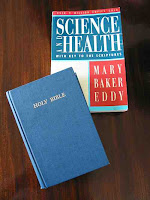
What the furrowed brows don't understand is I can't help myself. Religious peoples, ideas, and practices are fascinating. I am loathe to admit that I took one "Religion in the U.S." class, and it was love. From Science and Health with Key to the Scriptures to Puritan sages to devotional Catholicism to the Social Gospel to the contemporary white supremacist movement, I was hooked. My fascination drove my study. The novelty and ingenuity of ideas and people made we want to know more. Yet fascination is not enough. The warm, fuzzy glow eventually tempered some. Then, I was confronted with students, sometimes seventy or thirty, who looked at me as to why they were taking my class. Glazed, bright, and indifferent eyes watching my every clumsy move and my attempts to explain the centrality of American religious history.


The reason I teach American religious history is that I am committed to the study of the place of religion in American history. For many of my students, religion has been conveniently excised from their history courses, and some don't even know the Puritans, much less about immigration of Jews and Catholics in various times and places or the religious arguments for and against slavery. I am committed to injecting religious opinion, practice, and ideals in our history, so that students can see the power, positive, negative or ambivalent (I prefer ambivalent), on American life. Awareness of religion in lives of Americans seems to be crucially important, especially as the presidential election rolls around (as the many posts on this blog attest).


Additionally, the history of religious encounter proves complicated and fraught with tension, and often violence. This reveals larger currents in our history, which have weight on our present, and I cajole students into this study to get them to understand motivations and actions (contradictory and seamless) of these encounters. I want these students to examine narrativity and why some stories are told and others occluded. In my own research, I question why certain historical actors have greater impact in our narratives, and with fervish hope, I analyze whether students ferret this out themselves Perhaps, I am activist or just naive, but this is why American religious history matters to me, and why I teach it with such devotion, fascination, and purpose.

Sunday, January 27, 2008

Why I Teach Religious (Not Environmental Or Naval Or Actuarial) History

BY KATHRYN LOFTON

Waylaid for a later moment is my planned report on LDS film shorts, Sundance festival fun wear, and Daniel Day-Lewis’ living genius. Obama’s latest push toward hope and Gordon Hinckley’s sad demise lead one to the bigger questions, questions asked by this latest meme. The very frame of the question tempts long rambles into anecdote and personal reference. After all, exceptionalist narratives aren’t just needed by nations. Academic disciplines, too, rely on an exclusivity of import. Most military historians believe military history means most, most economic historians imagine theirs is the insight that matters. Everyone who writes or thinks about something (thinking about something perhaps more than healthy, more than makes any logical sense at all) must eventually create a tale that elects their humble isolation to global consequence.

Religion makes easy such subject sainthood. I used to say that I became a historian of religions (rather than a history of legislation, battleground, or plumbing principles) because it was the only subject that actively hated its observer (I’ll leave the question of the observers’ taste for the subject to other commentators). Although it would be delusion to presume that presidents savor their biographies or that unions love their labor histories, in an analytic loathe-off religions would win as those objects most inherently irritated by the sheer observation. The act of making history (placing in some sort of chronologic process the layers of human activity) is a heresy, making archival plot of divine dreams. We historicize against their immanent imminence, ritual presence, iconographic earnestness, and faith in the propositional constancy (it is as it shall be as it was) that our subjects assert. We offend them even as we footnote, even as we fly.

Which makes it seem all the more important to do it, and do it well. What other field of inquiry fights harder within stormy currents of counter-narrative and co-narrative, with scriptures, canons, and sacred histories outpacing our every interpretive hiccup. What we do is so obviously invasive as to be perverse, telling people time and again how the magic of the sacred was man-made, and how the miracle of divine encounter might be mere meteorology. These nitty gritty hermeneutics (as Anthony Pinn has termed them) are not so antithetical to religious experience. But they are (we must accede) a wicked posture from which to begin. The act of connecting the categories (“religious” and “history”) is just profane enough to keep us all (even as we do sin the subjects) fighting for our dignity, fighting for our professional practice, fighting for our analytic lives.

Sex and Religion


PAUL HARVEY

Besides being my two favorite subjects, they are also the heading for Tracy Fessenden's analysis at Immanent Frame of the campaign to canonize, but also completely depoliticize, the message of Dorothy Day. This also answers, in part, Art's query below about the presence, or not, of Catholics in progressive public politics. The post begins:

The current campaign within the Archdiocese of New York to canonize the radical activist Dorothy Day (1897-1980) offers a good example of what Elizabeth Povinelli in her December 13 post (“Can Sex be a Minor Form of Spitting?”) calls the “mutual conditions and secret agreements” that tie the sexual revolution and Catholic teaching together behind the scenes. It isn’t simply that the candor with which Cardinal O’Connor and now Cardinal Egan have described Day’s sexual agency, single motherhood, and presumed abortion signals the Church’s accommodation to new, post-1960s norms of frankness. Nor that the hagiographical plotline of Day’s renunciation of sex on her way to becoming a Catholic nicely embodies the paradox familiar to any schoolchild catechized in the sanctity of virginity— the sexual knowledge required of those being schooled to avoid it. Rather, by promoting Dorothy Day as a penitent Magdalen first and foremost—and not, say, a blistering critic of a war-making government and the depredations of capital— the Church furthers the ideological shift by which sexuality, with its attendant possibilities and dangers, comes to trump every other way that human flourishing might be imagined or pursued. In the case put forward by both O’Connor and Egan for her sainthood, Dorothy Day is upheld as the patroness of all who would (or should) repent of sexual quests gone gravely awry, with the result that the militarism and corporate greed that Day was relentless in calling to account are reduced to comparatively lesser infractions—as it were, to minor forms of spitting.

Later she asks:

Surely the Catholic Church learned something from the Reformers—surely they have had much to teach each other—about the ways institutional power might be augmented in the appearance of being relinquished. . . . . If “religion” no longer serves to define the reigning regime of modernity, then “morality”—sexuality—will have to do. And where sex is, can religion be far behind?


Read the rest here.

Saturday, January 26, 2008

History Meme -- Why I teach Religious History

PAUL HARVEY

Dear Blog readers and Contributing Editors: We've been tagged! And tagged again! This history meme started here, at Free Exchange on Campus, where academic bloggers were invited to respond to the query "Why Do You Teach, and Why Does it Matter?" Or more specifically:

So I am challenging faculty to tell us why they teach and do the work they do and why academic freedom is critical to that effort.

Several historians have taken this up, including Historiann, History and Education (linked above), Tenured Radical, and Clio Bluestocking.

The above (and more) have answered the more general question: why do I teach history? I'd like to invite you all -- readers, religious historians, my contributing editors - to take a stab at the question: why do I teach American religious history (or religious studies, if that's your thing)? And hey, you Young Scholars in American Religion out there, from the present class or any of the previous ones -- give me your responses!

I'll put up something in the near future, but here's your opportunity to respond. Contributing editors can post their own responses, but I'm inviting anyone else who's interested to send me their response, and I'll consider posting it -- send to pharvey AT mail DOT uccs DOT edu.

Poor Richard and God's Profits


PAUL HARVEY

Sarah Posner, author of God's Profits: Faith, Fraud, and the Republican Crusade for Values Voters, follows the machinations of the "Word of Faith" theologians -- James Hagee, Kenneth Copeland, et al. -- whose over-the-top fundraising techniques and other questionable practices have drawn scrutiny from Congress. An excerpt from the book can be found here (showing that "Word of Faith preachers often give lip service to their church's community service projects yet worship at the altar of hyperindividualism and unregulated capitalism" -- sound familiar?).

Unlike Ted Haggard, gay sex scandals from some insiders have not been able to bring these guys down. Why? Health and wealth theology is just too deeply interwwined with the American religious fabric. Every evangelical generation throws its heroes up the pop charts.

While listening to Posner being interviewed on the radio, I was, conveniently for thinking about blog entries, reading Jill Lepore's latest essay in the New Yorker: "The Creed: What Poor Richard cost Benjamin Franklin." Franklin's irrepressibly punning and scatological humor fed right into the health and wealth gospel of future generations. Americans missed the joke and took the moral. Lepore writes:

Franklin finished his little essay ["The Way to Wealth"} at sea, on July 7, 1757. When he reached England, he sent it back on the first westbound vessel. It was published as the Preface to “Poor Richard Improved, 1758,” although it was soon reprinted, in at least a hundred and forty-five editions and six languages even before the eighteenth century was over, usually with the title “The Way to Wealth.” “It long ago passed from literature into the general human speech,” Carl Van Doren wrote in 1938, in an extraordinarily elegant biography of Franklin. This year marks the two-hundred-and-fiftieth anniversary of “The Way to Wealth,” among the most famous pieces of American writing ever, and one of the most willfully misunderstood. A lay sermon about how industry begets riches (No Gains, without Pains), “The Way to Wealth” has been taken for Benjamin Franklin’s—and even America’s—creed, and there’s a line or two of truth in that, but not a whole page. “The Way to Wealth” is also a parody, stitched and bound between the covers of a sham.

How's this for a TBN Special: A Frankin re-enactor delivering Franklin's iconic, and ironic, morals to an audience just divested of wallets.

He could start with: Serving God is Doing good to Man, but Praying is thought an easier Service, and therefore more generally chosen.

Or: He that lives upon Hope, dies farting (or "fasting," depending on whether you think it was a printer's error -- either one will do).

Friday, January 25, 2008

Spiritual Politics


PAUL HARVEY

The Greenberg Center for the Study of Religion in Public Life has a new blog for discussion of religion and the 2008 election (what K. Lofton called here before the "spastic clatter" of politics -- what junkie can resist?). Today's entry, for example, features a discussion of Focus on the Family's candidate guide:

Focus on the Family's new online candidate guide is must-see for anyone following religion and the campaign. As Michael Scherer points out on Time Magazine's Swampcast blog, the thing amounts to a kick in the rear for Mike Huckabee and a covert endorsement of Mitt Romney . . .

To go along with that, the Center's latest Religion in the News newsletter features a number of pieces on religion (including "Men in Green," on faith-based environmentalism), and the (rapidly dwindling number of) candidates.

Mark Silk and company (who previously directed the 8-volume Religion by Region series, which we've blogged about before) run the newsletter and the blog; here's Mark explanation for liveblogging religion and the election:

These days, when the going gets tough, the tough go blogging, so that’s what we’ve decided to do. Since the beginning of December, a Greenberg Center blog, Spiritual Politics, has been following religion and the campaign. For those of you who wish to check it out—and we hope you do—it can be found at http://www.spiritual-politics.org.

The idea is to provide daily tracking of the way religion seems to be enhancing, disturbing, and otherwise interacting with the 2008 election cycle. As is our wont, we are trying to do this in a reasonably non-partisan way, though not without attitude. Most of the posts are by your editor, aided and abetted by trusty undergraduate fellow Reid Vineis.

From time to time, however—and we hope more frequently as time goes on—there will be posts from such learned commentators on religion in American public life as John Green, Jan Shipps, Gary Dorrien, Richard Wood, and Jerome Chanes. With any luck, Spiritual Politics will become must-read commentary on the state of religious play in the campaign, and perhaps beyond.

Thursday, January 24, 2008

Providence and the Invention of the United States


BY JOHN FEA


Last June thousands of conservative evangelicals and fundamentalists gathered together in Virginia for an event called the Jamestown Quadricentennial: A Celebration of America’s Providential History, 1607-2007, sponsored by an organization called Vision Forum Ministries. The eight day celebration included “Faith and Freedom Tours” of Williamsburg and Jamestown, seminars on America’s providential history, worship services, children’s programs, and a host of other patriotic commemorations. It was a showcase of the 400th anniversary of the first English colony in America--Christian Right style.

I am assuming that most of the readers of this blog would agree that this event is disturbing on so many levels. I have blogged on topics like this before and will probably blog on topics like this again. But one cannot deny that the folks at Vision Forum Ministries, in their promotion of the providence of God in history, have tapped into a longstanding tradition in American politics and intellectual life. This is the theme of Nicholas Guyatt’s great new book, Providence and the Invention of the United States, 1607-1865 (Cambridge UP, 2007).

In historicizing the notion of providence, Guyatt shows that this idea “played a leading role in the invention of an American national identity before 1865." The depth of his research and the breadth of his scope are quite impressive. He packs this book with so much information that at times it became a burden to work through it all. But Guyatt writes well, and as a result this will be the standard text on the topic for many years to come. Even if you never get around to reading all 300+ pages it is a book worth having on your shelf as a reference tool for when one of David Barton's young and eager disciples takes that front row seat in your lecture hall.

For Guyatt, providentialism is more than just a “belief that God intervenes in human history.” It is a rather complex system of theological ideas that have manifested themselves in a variety of different ways in our nation's past. Throughout American history providence has been promoted in terms of the covenantal belief that nations rise and fall based upon their obedience to God, the idea that some nations—like the United States-- are chosen to play a special role in human history, and the practice of interpreting current events through the grid of biblical prophecy. Throughout the period between Jamestown and the Civil War, providence was used over and over again as a tool to achieve political ends. Guyatt explores the role that providence played in European colonization, the English Civil War, the American Revolution, the British response to the American Revolution, early national historiography, anti-slavery movements, pro-slavery ideology, Indian removal, the rise of nationalism in the early republic, the American Civil War, and Reconstruction.

Guyatt does not have an axe to grind. As tempting as it might be to draw contemporary lessons from the history of providentialism in early America, he remains a true historian, leaving it up to us to tease out the implications of his work. Yet the implications are there, and they are easily discovered. One cannot read this book without seeing the serious problems that providentialism has caused in America. With this in mind, the argument of Guyatt’s entire study is probably best summed by a quote he uses from Ambrose Bierce’s 1911 satire, The Devil’s Dictionary. Bierce defines “providence” as an idea that is “unexpectedly and conspicuously beneficial to the person so describing it.” At least that is how it has usually played out in United States history.

The Contemporary Catholic Left? or, Will the Catholic Jim Wallis Please Get Noticed?

BY ART REMILLARD

When people picked up Time magazine’s December 12, 1960 edition, they saw the penetrating eyes of Jesuit John Courtney Murray looking back at them. The feature article, “U.S. Catholics and the State,” centered on his book, We Hold These Truths. “In months to come,” the article’s author predicted, “serious Americans of all sorts of conditions—in pin-stripes and laboratory gowns, space suits and housecoats—will be discussing [Murray’s] hopes and fears for American democracy.” Murray was one of a handful of highly visible American Catholics—such as Thomas Merton, Dorothy Day, and Fulton Sheen—who helped bring the faithful from margins to the mainstream. Murray in particular was, indeed, a thinker and theologian who “serious Americans” took seriously.

This leads me to Randall’s mention of Jim Wallis. For the sake of argument, let me suggest that Wallis is something of a current evangelical version of John Courtney Murray. In their respective times, both earned fame and attention for their ability to clearly articulate their faith and relate it to prominent political concerns. But I wonder: Is there a Catholic version of Murray today? Sociologist, author, and political commentator Andrew Greeley may fit the mold. Consider his recent book, A Stupid, Unjust and Criminal War: Iraq, 2001-2007 (“Now tell us what you really think, Father?”). While I haven’t read it, the book appears to be a timely rebuke of the war and a challenge to Catholics to forthrightly oppose it. Despite his prolific writings, I don’t know that Greeley is as recognizable as Wallis, or for that matter, his conservative counterparts Pat Robertson and James Dobson. Do presidential candidates court Greeley in an attempt to secure the “Catholic vote”? Perhaps they do. But I haven’t seen it. The only other examples I have come from the realm of popular culture. In a Frontline documentary on the AIDS crisis, U2 front-man Bono discussed the relationship between his faith and activism. “I put Catholic guilt to work,” he quipped. Speaking to Rolling Stone, however, Bono called himself a “Christian,” but offered the following qualifier. “I don't use the label, because it is so very hard to live up to. I feel like I'm the worst example of it, so I just kinda keep my mouth shut.” His humility is refreshing. But unlike many noteworthy religious figures, Bono isn’t tossing tons of theology into the public mix. How about Martin Sheen? Having been arrested over 60 times at various protests, the actor often expresses admiration for Catholic social teaching. He once speculated, “I don't think you can be Catholic and not have some frame of reference for social justice.” I suspect, though, that more people know Sheen for his acting than his activism. So I’m going to withhold his “J.C. Murray Trophy” for the time being.

From Newsweek to Comedy Central to this blog, Jim Wallis et al. are hard to avoid. Yet, the Catholic equivalent is nowhere in sight. I’ll admit that I don’t closely follow trends in contemporary Catholicism. So I might simply be out of the loop. But I also don’t spend prodigious amounts of time following the evangelicals either. So please, dear blog readers, educate and correct me. Who is the current John Courtney Murray and/or Catholic version of Jim Wallis? And if there isn’t one, what does this say about American Catholicism today?

Wednesday, January 23, 2008

Jim Wallis on Jon Stewart


BY RANDALL STEPHENS

On Tuesday night, January 22nd, Jim Wallis, evangelical author and editor of Sojourners, appeared on "A" Daily Show with Jon Stewart. Wallis plugged his new book The Great Awakening. He emphasized the role of social ethics in forming a new moral consensus. "God's Politics called on people to take back their faith after it had been 'hijacked' by the Religious Right" writes Wallis. "Millions of Christ­ians have done just that, and now the question is what are we going to do with our faith, now that we have it back? My new book, The Great Awakening: Reviving Faith and Politics in a Post-Religious Right America, addresses that question."

The bubbling up of a new Christian politics is not just the wishful thinking of a few blue-state evangelicals. It's evident in the emerging church movement, the recent pronouncements of Rick Warren, and in publications geared toward born again twenty somethings like Relevant Magazine. The politics of personal and sexual morality are not exciting the masses like they used to.

Stewart questioned Wallis on the prospects of the "religious Left." There may be some who fear that a hegemonic religious Left will be as off-putting as the much pilloried Christian Right is now. (This is a point that historian Stephen Prothero has recently made.) With so much attention being paid to the evangelical crackup, the future of evangelicalism, Left and Right, seems surprisingly uncertain.

Culture and Redemption Reviewed

PAUL HARVEY

When the right book meets the right reviewer, intellects spark. Case in point: Kathryn Lofton's review of Tracy Fessenden's Culture and Redemption: Religion, the Secular, and American Literature (the link may or may not work, depending on whether you have library access) -- published in the Journal of the American Academy of Religion. A key passage to chew on:

. . . . if by the end you have not learned to read again (to think again) about such lofty suspects as democratization, feminization, and, yes, even that old warthog, secularization, then you have missed an opportunity to read, to read intensely, something that truly earns such reading. . . .

Fessenden's tough task is to show where and how this process of entrenchment takes place over and against increasing squeals of secularity. Social scientists and political observers have made easy mush of the secularization thesis, using twentieth-century fundamentalisms and new religious movements to mock the anticipated apocalypse of religion in the wake of science and social freedom. Students of history have had a harder fight with secularization, noting again and again that the success of orthodox religions within modernity is no trump to the postulated end of public practice. Any description of the post-industrial world requires an awareness of religion's uninterrupted endurance alongside (and within) the astounding cornucopia of competing ideologies, capitalist consumer practices, and celebrations of radically atomized selfhood that early modern observers would have rendered positively pagan. "Secularization" did not happen, precisely, but it also did not
not happen, as talk of a spiritually divested public sphere lingered in political debates and sociological prognostications.

Tuesday, January 22, 2008

Deg's Uncoverage Course, Part III

Dispatches from LeConte Hall 323 – Part III
Darren Grem

This week we studied “Religious Encounters.” To start us off, I dropped the students into the middle of Black Robe, a film that details the fictional journey of a French Jesuit priest to a Huron mission in the 1630s. Aside from certain inaccuracies and oversimplifications, this Hollywood portrayal does a decent job of presenting both the complete and incomplete conversions that often resulted in the “middle ground” of post-contact America. Hence, I asked the students to take “field notes” of what they saw, listing the specific beliefs and practices of the Jesuit missionaries and the Algonquin, Iroquois, and Huron. Then, they had to explain why conversions did or did not take place.

Documents from Gaustad and Noll’s A Documentary History of Religion in America complicated matters further, but also, I think, offered more perspective. The tendency (honestly come by, to be sure) to see the result of religious encounters as a historical given faded for most students after reading these documents, each of which presents a more complicated – but no less disturbing – portrayal of religious encounters in New France and New Spain. Their papers on the documents showed a greater willingness to consider why religious encounters unfolded as they did, instead of merely restating their initial reactions to Black Robe, which mostly simplified those encounters into a one-way history of inevitable conquest.

After our discussion of these documents, I reiterated their conclusions via a lecture and slideshow, but also reminded students that going overboard with some of their conclusions wasn’t advisable either. Just because we noted that “religious encounters” were often unpredictable and messy didn’t make the history under study any less unsettling. We must strive, I reminded them, both to understand why religious encounters in colonial American unfolded as they did, but also why they resulted in more religious deletions than religious accommodations and adaptations. Given that our next section will deal with all sorts of religious conflicts and collusions between colonial Christianities, I stressed the point more than I initially intended, and I believe they grasped it. I suppose I’ll find out next week and down the road when they’re working on their final assignments.

This was the first “graded” week of classes, as well as the first week where students encountered the “uncoverage” pedagogy in full force. Fortunately, I was able to speak with a few students as the week went on and gather some initial impressions from them. One described the class as “interesting,” while another assured me that the pedagogy was a “refreshing” way to look at history. I had a longer discussion with another student, however, who wanted more context for the documents we studied. Her concerns were apt and well placed, and, frankly, I sympathize with them. Historians often start with documents first and use them to form conclusions about the economic, cultural, and/or political context second. But is that the best way to teach history? Admittedly, it gets students to “do history” as we do it, with all the fun and frustration thrown in. But should we grant more context up front, or let them come to their own conclusions – within appropriate limits – about that context via the “raw” history under study? That’s an issue I’m glad the student raised for me, and one that I will no doubt continue to consider.

MLK the Preacher

PAUL HARVEY

Jenny McBride reviews the latest volume of the Martin Luther King, Jr., Papers Project here. A brief excerpt:

In addition to such diverse documents as sermon outlines, full drafts, seminary papers, facsimiles, and photographs, Volume 6 also includes transcripts of tape recordings of King's most famous sermons, documents from King's file "Sermons Not Preached," a chronology of sermons preached through 1959, a sermon file inventory listing all the folders discovered in 1997, a list of selected works relevant to King's sermon preparation, letters received after King's 1958 stabbing, and a calendar of documents including materials not printed in this volume. While the scope of the volume may seem daunting, the accessibility of the documents invites scholars and lay readers alike to benefit from this remarkable discovery. As a volume dedicated to King's preaching, Volume 6 arguably best conveys the life and work of the man who said of himself in 1965, "I am many things to many people but in the quiet recesses of my heart, I am fundamentally a clergyman, a Baptist preacher. This is my being and my heritage, for I am also the son of a Baptist preacher, the grandson of a Baptist preacher and the great-grandson of a Baptist preacher."

For more on the denuding of King into a meaningless saint-for all, and an attempt to recapture his prophetic message, also check out
Baldblogger on "A King for Our Times," and Christopher Phelps, "The Prophet Reconsidered," which in addition to the Vol VI of the Papers also discusses the following books:

From Civil Rights to Human Rights: Martin Luther King, Jr., and the Struggle for Economic Justice
, by Thomas F. Jackson (University of Pennsylvania Press, 2007)

Going Down Jericho Road: The Memphis Strike, Martin Luther King's Last Campaign, by Michael K. Honey (Norton, 2007)

Monday, January 21, 2008

Vernon Johns Day


PAUL HARVEY

On this MLK day, it's high time to high-five Vernon Johns, courtesy of Civil War Memory and Ralph Luker. From Ralph's introductory essay:

There was a time when John the Baptist was better known than the obscure man of Gallilee who came after him and there was a time when Vernon Johns was better known than Martin Luther King, Jr. When King became the pastor of Montgomery, Alabama’s Dexter Avenue Baptist Church, he identified himself as Vernon Johns’ successor. Subsequent events made it inevitable that Johns would ever thereafter be known as Martin Luther King’s predecessor.

Vernon Johns and Martin Luther King differed in remarkable ways. Johns was born in the rural South and found city life distasteful; King was born in the urban South and won his greatest victories in its cities. Johns was of the generation of King’s father and died in the midst of the civil rights crusade; King’s generation gave the movement its leadership in large numbers and some historians date its end at his death. Johns was an enthusiastic spokesman for black capitalism; King was a critic of capitalism’s economic disparities. Johns advocated armed self-defense of communities of color in the South; King hoped the South could become a peaceable kingdom via aggressive nonviolent protest. Vernon Johns’ congregations sometimes drove him from their pulpit, only subsequently to rehire him; either of Martin Luther King’s congregations would happily have made him their pastor into eternity. . . .

Read the rest here.

Welcome, Historiann


PAUL HARVEY

A hearty welcome to my fellow Coloradoan and newish blogger Historiann, author of Abraham in Arms: War and Gender in Colonial New England (the link goes to a discussion of reviews of the work -- the book on Amazon is here). She adds to our discussion of Drew Faust's Republic of Suffering here -- previously discussed on our blog here.

From the description of Abraham in Arms:

In 1678, the Puritan minister Samuel Nowell preached a sermon he called "Abraham in Arms," in which he urged his listeners to remember that "Hence it is no wayes unbecoming a Christian to learn to be a Souldier." The title of Nowell's sermon was well chosen. Abraham of the Old Testament resonated deeply with New England men, as he embodied the ideal of the householder-patriarch, at once obedient to God and the unquestioned leader of his family and his people in war and peace. Yet enemies challenged Abraham's authority in New England: Indians threatened the safety of his household, subordinates in his own family threatened his status, and wives and daughters taken into captivity became baptized Catholics, married French or Indian men, and refused to return to New England.

In a bold reinterpretation of the years between 1620 and 1763, Ann M. Little reveals how ideas about gender and family life were central to the ways people in colonial New England, and their neighbors in New France and Indian Country, described their experiences in cross-cultural warfare. Little argues that English, French, and Indian people had broadly similar ideas about gender and authority. Because they understood both warfare and political power to be intertwined expressions of manhood, colonial warfare may be understood as a contest of different styles of masculinity. For New England men, what had once been a masculinity based on household headship, Christian piety, and the duty to protect family and faith became one built around the more abstract notions of British nationalism, anti-Catholicism, and soldiering for the Empire.

Sunday, January 20, 2008

National Religious History Week -- Not


PAUL HARVEY


Quite possibly much ado about nothing, likely an election-year stunt to fire up the base rather than some grave evidence of the theocrats on the march. But still -- courtesy of Tenured Radical, here's a discussion of a House Resolution to establish a National Religious History Week -- aka "America is a Christian Nation" week. Here's an excerpt from the resolution:

"Whereas political scientists have documented that the most frequently-cited source in the political period known as The Founding Era was the Bible" and "Whereas the United States Supreme Court has declared throughout the course of our Nation's history that the United States is 'a Christian country', 'a Christian nation', 'a Christian people', 'a religious people whose institutions presuppose a Supreme Being' and that 'we cannot read into the Bill of Rights a philosophy of hostility to religion....'"

Apparently the bill's sponsors have not talked to John Fea, among others.

Here's the best portion from The Radical's take:

The bill clips a fistful of historical "facts" that link American political institutions to Christianity, including the presence of a Gutenberg Bible in the Library of Congress. These facts are stripped of their historical context, and strung together in chronological order, to "prove" that the United States is, and was intended to be by its founders, a Christian nation . . . Curiously, it also suggests that religion really has no history as such -- only a timeless present that can be used to re-order a political past in the interests of a contemporary interest group, a charge often aimed at leftist academics by cultural conservatives who want to minimize the importance of race and gender to national history.

UPDATE:
Another History Blog looks under the hood of the "facts" stated in the resolution, briefly; Chris Rodda does so, more extensively, here. Truthiness reigns in this regiment of the right.

One presumes this will collapse of its own absurdity.

Saturday, January 19, 2008

You Know You’re The Only One That Can Really Help

BY KATHRYN LOFTON

I stopped getting into scraps after a fourth-grade tussle regarding Potawatomi Indians. So it was surprising when I found myself getting heated recently on the California coast, sparring with a reasonably genteel gent about vocabulary. Not because I don’t make fetish of word (clearly) but because Midwestern pleasantry has, over the slow advance to adulthood, trumped cracker instinct. Save the squabble for righteous spaces, I tell myself. Funnel the fight into better productions.

Yet there I was, raging about the use of the word “cult.” “Why can’t we use it?” my interlocutor gently (genteel, after all) pressed. “I mean: they are cults.” He deployed the usage card, pointing to excellent ongoing application by observers intent upon venerated saints and ancient Gnostics. Moreover (he pressed) some things just are clandestine and weird, like Shakers and Henry Jaglom films. My resistance to the word “cult” is, under such a preponderance of cheery evidence, a well-intentioned but patronizing cling to political correctness, parallel to my relinquishing of “retarded” and “gay guy.” C’mon, already, (my discussant cajoled) the word is useful.

There are days when the words are on your side, and there are days when you sound like Porky Pig. This day, this important day of argument and defense, was a Porky day. I couldn’t lasso together what I wanted, which was, of course, a rehearsal of the history of this category, the way academicians eschewed its deployment because they realized, simultaneously, that it (a) wasn’t generative to classification, (b) relies on an antagonistic relationship between a (presumed to be) minority faction against a (presumed to be) dominant mainstream, (c) expects an exclusive spiritual adherence amidst sociological reality of the buffet believers and (d) was being enjoyed as an epithet—to truly destructive ends—by way too many people. (Note: For a recent rehearsal of this history and the nouveau resuscitation of “cult”, see the 2006 JSSR review essay by Marion Goldman, "Cults, New Religions, and the Spiritual Landscape.")

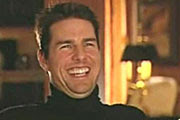
But my words weren’t with me, so I came off tinny and small (a perpetual condition for liberals and word whiners). If only I’d had patience. If only I’d merely say, “hey friend, let’s save the argument. Bide our time. And wait for the release of Tom Cruise: An Unauthorized Biography.”

Then, I would have experienced the pleasure of non-argument exhibition. Anyone who thinks we can reclaim “cult” (like those who thought, hipster-like in the mid-nineties, that “Negro” would be fun to revive), do take a break and check out the responses to Morton’s religious history of Cruise, as well as the frightening replies to Cruise’s commitment video spinning throughout the web.

Don’t get me wrong: the video is something to see. (And something to use: religionists never had it so good). The man knows his way around onomatopoeias and crazed laughter. But, after all the chuckles at his gauntlet glee (“You’re either in, or you’re out.”) and the frets about Ms. Holmes’ captivity narrative, one does just have to say: “He believes.” Or, as the wise observers at Slate have it, this is only “moderately strange.” We’ve seen this all before. Impassioned faith should hardly be new to anyone awake on this here planet Earth yet off the bloggers soar, screaming and laughing and shaking with pleasure that this obviously “gay guy” is such a total “cult freak.” So now I, post-Pork, have my words to face my cultic foe: “we are the authorities,” and we say "no" to cults. Save that sort of devotion for (the oh-so-deserving) Dr. Frank-N-Furter.

Friday, January 18, 2008

Godstock

Our contributing editor John Turner's "The Christian Woodstock," appearing in today's Wall Street Journal, takes on the question "How did Mr. Huckabee become a hip evangelical politician." His answer takes us back to "Explo '72." Check it out here. A brief excerpt:

Looking back, it is hard to appreciate just how revolutionary these steps were for evangelicals in 1972. Crusade's Mr. Bright, one of the most influential evangelicals of the post-World War II generation, had long rejected rock music -- along with long hair and dancing. Less than a year before Explo, he told a reporter that rock 'n' roll "wasn't for us . . . because of the complaints of ex-addicts." At the time, conservative evangelicals strongly associated rock music with drug abuse. Mr. Bright's son Zachary remembers telling his father: "You can have a conservative view of music and keep what worked for you, or you can win [young people to Christ]." "I'd rather win," Campus Crusade's president responded.

Thursday, January 17, 2008

Dirt, Order, and HGH

BY ART REMILLARD

“Dirt offends against order,” wrote the recently deceased anthropologist Mary Douglas in Purity and Danger. “Eliminating it is not a negative movement, but a positive effort to organize the environment.” Douglas’s complex book makes a simple point. For the sake of social order, societies enact various means to purge their symbolic pollutants.

With this in mind, consider the current swirl of attention surrounding the “dirty athlete,” the great American Pigpen guilty of using performance enhancing drugs. Recently, leaders in Washington performed a civic cleansing ritual known as the congressional hearing. Bud Selig, the commissioner of Major League Baseball, was among those called before the committee. Blame and shame were in no short supply. In his opening remarks, the committee chairman remarked, “everyone in baseball is responsible: the owners, the commissioner, the union and the players.” The hearing went on to confirm what we already know, that players are taking performance enhancers and have been for at least a decade. The political spectacle was ultimately a demand (plea?) to MLB to bleach this stain. The question of “how” remains. Blood tests, suspensions, and heavy fines may work. One sportswriter called for Selig’s resignation, labeling him “the guy who brought us better baseball through chemistry” and made the sport “a toxic waste dump” filled with “polluted record books.” The commissioner, the author concluded, could not be trusted to “clean up” baseball.

The problem of performance enhancers extends far beyond baseball, into practically every sport to include—oddly enough—professional golf. If sport is a reflection of society, what does this say about contemporary America? Obviously, as the congressional hearing indicates, we take our games seriously. But this is nothing new in history. In his classic Homo Ludens, Johan Huizinga argued that the “play element” in any society provides inspiration for civilization, and is therefore anything but frivolous. “The player can abandon himself body and soul into the game, and the consciousness of its being ‘merely’ a game can be thrust into the background.” He continued, noting that true play demands true purity, and cheating “spoils it altogether, because for us the essence of play is that the rules be kept.”

In professional sports, the rules have clearly been broken (many times over). Like many, I’m upset with dirty athletes and blame them and the corrupt system they belong to. I also blame myself. No, I didn’t inject players with HGH. But I love watching brutish batters bash a few dingers. And what a great story it makes when an aging pitcher rediscovers his 90-plus mile-per-hour fastball. Put simply: I want superhuman performances. But I also want virgin-like athletic purity. It seems I can’t have them both. Perhaps I should take a step back and assess both why I love sports, and how I love it. Without checking the latter, the dirt will continue to fly.

Doc Watch and Secularism in America


BY RANDALL STEPHENS


I've gotta confess. I'm a documentary junky. Youtube's staple of obscure clips and Netflix's ever-expanding catalog have only fed my habit. (I enjoyed reading about the Jewish Americans doc here on the blog and caught most of one episode last week.)

Two films recently came to my attention. Though, I have seen neither of them. The first was a big hit at the 2007 Sundance Festival. The second should be in theaters this spring.

For the Bible Tells Me So:

Winner of the Audience Award for Best Documentary at the Seattle International Film Festival, Dan Karslake's provocative, entertaining documentary brilliantly reconciles homosexuality and Biblical scripture, and in the process reveals that Church-sanctioned anti-gay bias is based almost solely upon a significant (and often malicious) misinterpretation of the Bible.

Praying With My Legs The Radically Amazing Life and Legacy of Abraham Joshua Heschel
:

Filmmaker Steven Brand and Rabbi David Lieber, President Emeritus of the University of Judaism, will view 30 minutes of the proposed 90-minute documentary. “Praying With My legs” is about the life, times, and teachings of Abraham Joshua Heschel, who counted the UJ’s esteemed Dr. Lieber among his students.

(Several weeks ago Paul wrote an entry on Heschel here.
)

Another fairly recent item of interest: Wilfred McClay's Pew-sponsored lecture in December 2007 on religion and secularism:

Religion and Secularism: The American Experience:

Some of the nation's leading journalists gathered in Key West, Fla., in December 2007, for the Pew Forum's biannual conference on religion, politics and public life. Given the recent popularity of several high-profile books on atheism, the Pew Forum invited Wilfred McClay, a distinguished professor of intellectual history, to speak on the historical relationship between religion and secularism in America.

Wednesday, January 16, 2008

Sacred Mission, Worldly Ambition


PAUL HARVEY

Here's a book that should be appearing in about a month or two, keep your eye out for it: Sacred Mission, Worldly Ambition: Black Christian Nationalism in the Age of Jim Crow. I first became interested in this as a Ph.D. dissertation from Columbia some years back. It's now coming out as a book focusing on the world of black Christians in Savannah from the 1890s through the Depression. It's one of the richest local studies of African American religion that I've read, full of fascinating detail but also productive of big (and sometimes controversial) ideas about the role of the church in the community. I'll blog about this more in the future once it's available. Here's some more on it:

Using Savannah, Georgia, as a case study, Sacred Mission, Worldly Ambition tells the story of the rise and decline of Black Christian Nationalism. This nationalism emerged from the experiences of segregation, as an intersection between the sacred (religion and church life) and the secular world of business. The premise of Black Christian Nationalism was a belief in a dual understanding of redemption, at the same time earthly and otherworldly, and the conviction that black Christians, once delivered from psychic, spiritual, and material want, would release all of America from the suffering that prevented it from achieving its noble ideals. The study’s use of local sources in Savannah, especially behind the-scenes church records, provides a rare glimpse into church life and ritual, depicting scenes never before described. Blending history, ethnography, and Geertzian dramaturgy, it traces the
evolution of black southern society from a communitarian, nationalist system of hierarchy, patriarchy, and interclass fellowship to an individualistic one that accompanied the
appearance of a new black civil society.

Although not a study of the civil rights movement, Sacred Mission, Worldly Ambition advances a bold, revisionist interpretation of black religion at the eve of the movement. It
shows the institutional primacy of the churches giving way to a more diversified secular sphere before an overtly politicized struggle for freedom could take place. The unambiguously political movement of the 1950s and 1960s that drew on black Christianity and radiated from many black churches was possible only when the churches came to exert less control
over members’ quotidian lives.

“Oltman’s recovery of a fascinating union of business and religion, in rise and decline, illuminates the history of Savannah and underscores the complexities, opportunities, and tensions that typified early twentieth-century African American communities across the nation. Clearly written and skillfully researched, Sacred Mission, Worldly Ambition leaves indelible impressions of struggles that mattered to communities and individuals alike.”—Jon Butler, author of Awash in a Sea of Faith

Tuesday, January 15, 2008

Republic of Suffering


Paul Harvey

Drew Gilpin Faust's new book This Republic of Suffering: Death and the American Civil War is drawing much interest and comment. Jon Wiener's appreciative review is reprinted here. He begins:

Amazon.com lists more than 36,000 books on the American Civil War, and my guess is that most of them depict battles and heroes, and describe wartime deaths as noble and tragic. Drew Gilpin Faust's "This Republic of Suffering" does something different. It's a shattering history of the war, focusing exclusively on death and dying -- how Americans prepared for death, imagined it, risked it, endured it and worked to understand it.

Here's a brief roundup of other reviews, with thanks to Ralph Luker: Edward Ayers, "Dead Reckoning," CHE, 11 January (subscriber only); Richard Wightman Fox, "National Life After Death," Slate, 7 January; Adam Kirsch, "Among the Dead," NY Sun, 9 January. Also, Terry Gross interviews Faust about her book for NPR's "Fresh Air."

UPDATE: In the comments section, Bland Whiteley mentions Eric Foner's review of the work in The Nation. And I will add Adam Gopnik's in the New Yorker.

Foner has the most critical words:

Like Faust's book, Upon the Altar of the Nation (2006), a work by the Yale scholar of religious history Harry Stout, condemns the Civil War clergy for justifying slaughter. It is hard not to see the shadow of Iraq--a prime example of senseless carnage cynically overlaid with exalted rhetoric--hovering over these books. And at a time of the increasing militarization of our society and politics, any reminder of the true costs of war is certainly welcome.

Yet on the question of whether the Civil War had any larger meaning, This Republic of Suffering is oddly agnostic. At one point, Faust does refer to "a war about slavery." But overall, the war's meaning for her lies in death, not life; in destruction and suffering, not any other outcome. The Civil War was, indeed, a terrible tragedy. But because of her unrelenting preoccupation with death, Faust strips the war of political meaning. She never steps back to ask what the price of avoiding war might have been.

Gopnik has this fascinating take:

Faust is tracing a true fault line in modern consciousness. In these years, and despite much conventional religious piety, there’s a nascent sense that the deaths of the young men will never be justified in the eyes of a good God, and never compensated for by a meeting in another world. Their deaths can be made meaningful only through a vague idea of Providence and through the persistence of a living nation. Lincoln’s address at Gettysburg, through the dignity of near-Biblical expression, elevated sordid nationalism to a shimmering ideal of popular government; and it resonated because it said what a lot of people already felt. Fewer people found comfort in the promise of eternal life; more found it in the idea of a new world worth making.

It wasn’t a small shift. For most of history, ordinary people lived their lives vertically, with reference to a Heaven above and a Hell below. Now we live our lives horizontally, with reference to a past that we can repair or extend, and to future generations for whom our sacrifices and examples may make a better life. (We live horizontally, too, in the knowledge of sex and death as shaping principles.) The Civil War was one place in which this change got made. At the end of the war, the rituals that Faust catalogues were not merely secular but in their quiet way anti-religious, grounding the meaning of the war entirely in the sublunary realm of gains and losses. It is as if the scale of death and suffering had vitiated the idea of a good God not so much by outright rejection as by forcing another rhetoric and language of explanation.

Dating and the Synagogue


BY KELLY BAKER

In my earliest years of graduate school, I was absent from one problem that many of my colleagues were not: dating. I got married to my spouse before we entered graduate school, so I did not have balance the dating scene with the crushing schedule of classes, reading, and researching. For many of my colleagues, this was a nightmare. For others, they found novel ways to date by their own terms. One colleague signed up for JDate, a website for Jewish singles. At the time, I was surprised that such a site existed, much less survived against dating giants, like Match.com, but this site filled a particular niche. It provided Jewish singles with the ability to meet other Jewish singles, so they could possibly avoid intermarriage. A subscription to JDate also held the appeal of other forms of internet dating, one could screen potential dates from the confines of one's home.

In his aptly titled, "Sex and the Synagogue," Newsweek reporter Tony Dokoupil points the sensitivity that many American Jews have to the rise of interfaith marriage. Thus, JDate has now partnered with rabbis to face the challenge. JDate now offers a bulk membership for rabbis for their congregants. Dokoupil writes:
According to Gail Laguna, JDate's vice president of communications, singles who sign up through their congregation get a slight discount on the site's $149 six-month subscription fee. "This is a way for us to break down the walls of the synagogue," said Rabbi Michael Cahana, who leads the Congregation Beth Israel in Portland, Ore. "We should use all the technological tools that are available to us."

Technology that might lead to more Jewish marriages. Interestingly, some rabbis are paying from their own pockets to secure subscriptions for congregants, and some synagogues are using their discretionary funds for the expense of JDate. Dokoupil continued:
The rabbis say they felt compelled to act because of the gradual dilution of the faith through marriage. Almost half of American Jews marry non-Jews, a rate of exodus that has more than tripled since 1970. "This is about creating an opportunity," says Cahana. Sometimes even Cupid needs a nudge.

Internet dating becomes another supposedly secular, technological tool to be absorbed in the religious realm. Rabbis can help their congregants find love, but also perpetuate Jewish instead of interfaith marriages. So, how can we understand how internet dating can fit into religious practice? Dating is already fraught with various tensions, and religious belief and practice can often be one of these. Thus, JDate diffuses this tension for subscribers, but I wonder how different this dating site is from Match.com any way? Are there surveys that allow one to proclaim undying devotion to long walks on the beach? How are the logistics similar to more secular sites? Does Match.com allow someone to screen by religious preference? Has anyone explored the place of internet dating in the religious lives of Americans? Am I the only one interested? (Any suggestions would be more than welcome in the comments section.) I never found out if my colleague found love on JDate, but I wonder if her rabbi subsidized her subscription.

Monday, January 14, 2008

Darren's UnCoverage Course, Part II


Dispatches from LeConte Hall 323 – Part II, BY DARREN GREM

The first week’s set of classes focused on two questions: 1) What is religion? and 2) How should we go about doing religious history? Since our answers to both of those questions shape how we approach America’s religious past, I thought it pertinent to begin with them.

Regarding the first question, I asked my students to list reasons for why UGA football should or shouldn’t be considered a religion. I was pleased with the results from both the morning and afternoon classes. They thought hard about the matter and presented apt reasons for both sides of the matter. UGA football, most concluded, had both qualities of a religion and of more “secular” enterprises. It didn’t have a central deity, but it certainly deified legendary running back Herschel Walker, head coach Mark Richt, Uga VI, and Larry Munson (the radio “Voice of the Dawgs” for over four decades now). It didn’t encourage “worship” of a supernatural figure or appreciation for supernatural events, but it had venerated spaces, icons, rituals, and rites of passage. Its sense of ethics was fuzzy at best (or temperamental, depending on like or dislike of particular referees, plays, coaches, etc.), but it taught what was anathema and taboo (Steve Spurrier, the Florida Gators, all things Georgia Tech).

All in all, the students seemed reluctant to call UGA football a “religion” in any definitive sense, primarily because it didn’t deal in metaphysics (what one student called “the big questions of life”) or in the supernatural, inexplicable, eternal, and divine. When I pushed my first class to reflect on how, say, a Christian or post-Enlightenment view of certain notions – like “the eternal” and “the inexplicable” – shaped their perspective on religion proper, I had to lead the class a bit more. As such, I’m not sure how well I illustrated my points about how a Huron’s or Buddhist’s definition of religion might result in a different narrative about religious history (they seemed confused), so I dropped the points for the second afternoon class, seemingly with no harm done.

Regardless, I think they enjoyed the exercise and were especially attentive when I suggested how we define “religion” shapes what we study as religious historians. Should UGA football – or sports in general – be included in a text on American religious history? Sadly, we didn’t have enough time to deal with this question as much as I would have liked, but they got it in their notes.

If the first question drew the students in, the way I taught the second one – how do we do religious history? – seemed to leave a few behind. I wanted us to focus on how historians write about the “unseen,” and I thought a provocative essay would help (Grant Wacker’s “Understanding the Past, Using the Past,” in Bruce Kuklick and D. G. Hart, eds., Religious Advocacy and American History, Eerdmans, 1997). The essay isn’t an easy read, but it’s an important one, providing models for writing religious history as well as suggestions on how to interpret sources, recreate historical settings, and draw moral meanings from the past. To prep for this class, the students wrote short paragraphs (ungraded) about what they envisioned the discipline of religious history to be about. They also had to take some guesses about the types of challenges historians face in the archives and afterwards. In general, they saw our jobs as a mix of the following: categorizing religions, describing the development of religions, explaining denominational splits, detailing theological conflicts, and showing how religious groups shape politics and popular culture. Most of the challenges they detailed would make any post-modernist proud. How to know if a subject actually had religious experiences? How to determine bias in documents? In the researcher’s methods? What if the documents provided don’t tell the whole story? Can any history of religion be objective? I was impressed. I never knew they carried so much existential baggage.

They were along for the ride as we worked through their results. But when we turned to Wacker’s essay, I undoubtedly lost a few of them. It didn’t help in the first class that I myself mixed up Wacker’s categorizations and suggestions (it was a light moment as we all laughed at my fumbling of the ball, but still a bit embarrassing). But more importantly, the lines between Wacker’s concerns and our own were not drawn clearly enough by either the students or, frankly, by me. The end result, I think, was a more conceptual than concrete set of conclusions about how we should and shouldn’t “do religious history.”

This week we’re going to study religious encounters in New Spain and New France, and hopefully some of the past week’s lessons carry over. I’m editing the course as we go along, and I’ve decided that, for as much as I like Wacker’s article, I’ll probably exchange it in future go-rounds for something that teaches the interests and challenges of the field in more direct ways (making sense of religion in this election season, perhaps?) For now, however, I was pleased with the first week’s set of classes. Despite some bumps and bruises here and there, I think we made our way through a conceptual forest that has lost a few students – and even a few of us – along the way.

Sunday, January 13, 2008

National Museum of American Jewish History


PAUL HARVEY


Alongside some of the most historic landmarks in the United States, a building is rising that will tell the story of the national immigration experience through the life of the Jewish people.

The new National Museum of American Jewish History, scheduled to open on July 4, 2010, is an effort to add to the historical narrative traced by the cultural icons of Independence Mall: Independence Hall, where the Declaration of Independence was signed; the Liberty Bell, which was rung on July 8, 1776, to summon the people of Philadelphia for the reading of the Declaration; and nearby , the National Constitution Center, housing a permanent exhibition on the Constitution.

The $170 million building under construction will trace the lives of American Jews since their first arrival in New Amsterdam from Brazil in 1654, focusing on how they influenced, and were influenced by, their new home.

The full story is here.

Saturday, January 12, 2008

A Tale of Two Randalls


Editor's Note: Ed Blum is back in the house again -- this time as our newest permanent contributing editor! I assured him he wouldn't have to learn html, and he agreed to contribute periodically as the spirit moves -- we'll call that a bargain, the best we ever had (with apologies to Pete Townshend). He begins with a comparative reflection on two seemingly dissimilar recent books, including one by our contributing editor Randall Stephens.


A Tale of Two Randalls
BY ED BLUM

It is hard not to love a good pair. Two socks are always better than one; I still hope that Sonny and Cher will reunite in the afterlife; and who can imagine Clyde without Bonny. I guess this makes me a little like Noah; not the last righteous man or drunk and naked under a vine, but having a propensity for twos. So today I want to draw your attention to two Randalls: Stephens and Balmer. Both have recently published incredible books in American religious history – one on presidents, the other on Pentecostals; one of friends in high places, the other, well, with friends that traffic with Garth Brooks. Interestingly, Stephens’s The Fire Spreads and Balmer’s God in the White House may have more in common than at first glance.

Randall Balmer is a name we all know. I first encountered him in the summer of 1999; I was babysitting at the pool and reading Mine Eyes Have Seen the Glory. It was great vacation reading then, and is still today. His sensitivity and insight for religious people often misunderstood is amazing. Balmer fashioned himself then as the grand critic and insider of evangelical America, and everyone seemed to agree he was ideal for the role. Now, with God in the White House, Balmer has taken up a prescient task – explaining the relationship between religion and the American presidency over the past four decades.

God in the White House is a book we desperately need. Balmer has studied and thought deeply about what is on everyone’s mind: religion and the modern presidency. Whether we’re trying to figure out Romney’s chances as a Mormon or Obama’s connection to African American Christianity, God in the White House helps us to understand the possibilities and perils of linking religion and politics. Balmer shows, hilariously at times, sadly on other occasions, a sweeping change over the past four decades. In 1960, John F. Kennedy urged Americans to disregard a politician’s faith when making a choice. By 2008, personal faith is ubiquitous in American politics. Balmer narrates how this happened. He takes the reader through the presidencies of Kennedy, Johnson, Nixon, Ford, Carter, Reagan, Bush, Clinton, and Bush; through the streets of Dallas, the hallways of Watergate, the tax status of Bob Jones University, and the prayer meetings of Bill Clinton. This is a remarkable book. It is much about the American present as it is the past.

It’s also funny. I laughed riotously when Jacqueline Kennedy faulted John’s critics about his faith when she commented, “I think it’s so unfair of people to be against Jack because he’s Catholic, … He’s such a poor Catholic.” There are bunches of quotes just like this.

Those vying for the White House should rush off, buy God in the White House, and read it immediately (or at least they should have an aide look into it). Jon Stewart, Bill Maher, and Stephen Colbert should line up Balmer (and heck, other political news anchors, such as Tim Russert, should court Balmer’s time too). This is certainly the type of religious literacy we need far more than knowledge about the New England Primer. Balmer has an outrageous idea that Americans should consider, one that might make politicians shudder: we, the people, should hold our politicians accountable for the religious rhetoric they use. Say Jesus inspired you most, for example, then you better prize the humble, the poor, and the downtrodden. If not, then expect the wrath of the people.

Some scholars may dislike Balmer’s penchant for moral criticism, especially of conservative politics and politicians. It is true, Balmer tends to believe Bill Clinton while distrusting George W. Bush. Dissenters might say that Balmer is too political, too much of a presentist. But I think this type of criticism is misguided. Howard Zinn shouldn’t have had to tell us almost forty years ago, nor now, that history is political. There is no getting around it. And Balmer shouldn’t have to remind us, as Sydney Ahlstrom always said (so I’m told, I never met him) that one of the offices of the religious historian is to look at the moral world she sees and to tell the narrative of how we arrived there. Rather than lambast Balmer for being too political, his opponents should write honest moral histories of the Bush clan, of Ronald Reagan, and of Richard Nixon. Show Balmer, prove to him and others, that these men led Christian lives that translated into policies that supported Christian aims of love, mercy, forgiveness, honesty, compassion, and caring.

In 2008, it is almost impossible to stand aloof from politics. It would have even been hard for the people discussed in Randall Stephens’s The Fire Spreads: Holiness and Pentecostalism in the American South. But I’m sure they would have managed. The Fire Spreads isn’t as funny as Balmer’s book, but it contains its share of chuckles. Remember John Ashcroft’s “Let the Eagle Soar” song (if not, check it out on youtube; uproarious)? Who would have known that it stemmed, in part, from his Pentecostal roots? Or how about when those who think they have the gift of speaking in foreign tongues trek out to those foreign lands. Surprise, surprise, they really couldn’t speak Swahili. Stephens, too, narrates a story of how religious ideas moved from outside of the political realm into the mainstream. But instead of focusing on elite figures, he focuses on the grassroots. This is truly history from the bottom-up, and done at its best.

The Fire Spreads tells the tale of how first the holiness crusade crept into the South and then the Pentecostal movement swept in. Both, he suggests, were imports. Holiness descended from the North, while Pentecostalism went against the grain, moving West to East. Stephens is at his best when discussing holiness/Pentecostal battles with established Protestant denominations. He finds, for instance, that theological battles with the mainstream led holiness adherents to adopt pessimistic worldviews and premillennialism. Perhaps their internal church battles led Pentecostals to avoid politics, Stephens conjectures. In his final chapter, Stephens shows how a coterie of white Pentecostals joined the American mainstream by hitching their wagon to conservative politics. These may be some of the people with whom Randall Balmer is so upset.

I was fascinated by the role of holiness in sectional reconciliation after the Civil War. As Stephens shows brilliantly, holiness advocates and Pentecostals in the South really didn’t care about the Lost Cause or issues of race or making a whole lot of money. Their apolitical stance – toward the Civil War and toward southern identity – may have aided in the process of national reconciliation, at least by not stirring up the pot. Stephens directs us to spend more time thinking about the relationship between religion and regional relationships.

These two Randalls not only deserve our congratulations, but they merit our attention. Both books speak to the importance of religion in American politics. Both books teach us so much about the state of our world. Maybe they’ll help us pick a better president. Maybe they’ll help us understand the worlds we inhabit both politically and spiritually. I know they did for me.

Friday, January 11, 2008

Superhero Scholars and Manhattan Mormons

BY KATHRYN LOFTON

Some days it feels like all I do is monitor Mormons. I thought for sure I’d stay on the fray with this one, leaving to smarter, more expert voices the daily LDS crime watch. But then Frank Rich had to make the compare and contrast maneuver, blessing Mademoiselle Oprah while mocking Mormon Mitt, and it was over: them was fighting words. It was perhaps unsurprising (for us, historians of U.S. religion) that Rich found a way to condemn Mormons as racist and applaud Oprah Winfrey as beneficent in the same column; the religiously observant have always been the source for uninformed censure. Likewise, African American entertainers have long enjoyed condescending white applause. Now, Romney and Winfrey had something in common: the prejudicial presumptions of their cultured despisers.

With this silly mid-December rant, Rich ripped me into action. Hours lost checking blogs for easy bigotry and tracking presidential candidates’ adjectival inferences about marriage and family. Someone (somewhere) is wounding a religious subject, and now we (students of religion, custodians of sectarian self-esteem) are superheroes to the cause, using pluralist slogans and large explanatory reference works (rather than invisibility or shifts in the space-time continuum) to protect Gotham from prejudicial talk.

We’ve made some friends along the way. Noah Feldman showed up with a lovely, if somewhat derivative, defense of religious freedom. The New Yorker, too, has patronized (patronizingly) the LDS back story, paralleling it in other issues with the Scientology Celebrity Center and the ironic development of New England megachurches. Sunday magazines and weekly cultural reporters alike have tuned in to watch, raptly, devotions done for the divine in this, our bright new un-secular America. Key tonal and topical shifts in such articles include the pursuit of the ironic contrast (they claim to love family but look at those divorcing Osmonds!), ironic invocation of capital (does God really want them to own hotel chains?), and the suspicious (paranoid, really) stare at familial portraits (how can anyone look that good all the time?). Sure, counterfeits and confidence men define the American experience, but c’mon: take a break. Just let the brothers (and sisters) believe.

But how can we, when they’re always up to hilarious self-contradiction? Gawker (evil beast) turned me to yet another anthropological tour of Mormonia. This time, the Mormons take Manhattan. Or, as the wily minds at the New York Observer put it: “Mormons of Manhattan!” (As a sidebar, I’ll just say: I’ve missed the headlining exclamation point. Glad to know that punctuation, once saved for murderous scandal and the sinking Lusitania, has returned in service of urban legends like, you know, Christians in Gotham.)

The article, posing as ethnographic report, is so deliciously self-satisfied that it should become required reading for classes on nativism (classes on anything, really: critical thinking never had such easy mush). This is how hate sneaks in: under the guise of charmed observance. See the young Mormon lass (Nobu waitress and stand-up comic) talk marriage to the unmarried, wear vintage over secret undergarments, trade Converse kicks for suede pumps! See the young Mormon lass talk loneliness and her Harvard education over fries and a (let us hope decaffeinated) diet Coke! See young Mormons seek other young Mormon singles! See young Mormons buy a pre-war classic six! See them never drink! Organize effectively! And taste the pleasures of our pleasure-soaked city without once (never once) breaking monetary stride. “If there’s one theme you hear over and over again from young Mormons, it’s that the Word of Wisdom ultimately gives them a leg up in the ultra-competitive New York business world—they’re never hung over, after all, and they never have to worry about STDs or being pregnant or blacking out and knocking their teeth out.” (As another sidebar, may I just beg young non-Mormon Manhattan to be wary of dental damage? Fun isn’t really fun that necessitates Novacaine.)

Finally (as climax) the article ends with a teaser quote, taking a turn every young bigot needs to make the cause go from potential to real. I speak, of course, of sexing the subject. “Then again, dating non-Mormons isn’t easy either, Ms. Baker said. ‘I’m a decently attractive girl, and guys immediately go to—well, they see it click in their head: Oh, my God, I’m talking to a virgin'.” All across the isle that morning, young boys (some young lasses) found a new fantasy, one to replace (temporarily, till someone else so tantalizes with their sultry oppression) faded pin-ups of Maria Monk and Sally Hemings. “Mormons Take Manhattan!” and our hearts, too. I just need to find my cape.

Thursday, January 10, 2008

Children, Mormons, and Renderings of African American Religion: American Religious History in _Church History_

BY KELLY BAKER

In the December 2007 (print) issue of Church History, there are three articles on interest for our blog. First is E. Brook Holifield's "Let the Children Come: The Religion of the Protestant Child in Early America." Holifield noted that there have been many quality studies of adult understandings of children, and he, instead, looks to the voices of children and how they understand their religious world views. It is delightful to see how Louisa May Alcott, Harriet Beecher (Stowe), and Charlotte Grimke grappled with religion as younger selves. Drawing from diaries of children, who lived between 1770-1861, he describes their poignant concerns over death, living a good life, and their focus on sermons.

Next, Thomas W. Simpson's "Mormons Study 'Abroad': Brigham Young's Romance with American Higher Education, 1867-1877" examines the how American Mormons were sent to American universities for specialized training in law, medicine, and other fields. Mormons believed that higher education would help them maintain their civilization as well as make non-Mormons envious of their advances.

The third essay, "Urbanization and the End of Black Churches in the Modern World," is by Curtis Evans (two mentions in one day!). This essay tackles the historiographical understandings of African American religion, and Evans argues, "What strikes me about the history of interpretations of African American religion is the way in which interpreters have asserted that peoples of African descent were 'naturally religious,' which meant that their religion was a product of biology and nature rather than of the 'supernatural'" (p.799). Evans presents the fascination of with 'natural' religiosity as well as calls for the end of "the Negro or Black Church as it has been historically constructed" (p. 822)

Evans' on Blum's _W. E. B. Du Bois: American Prophet_


BY KELLY BAKER

Curtis Evans of the University of Chicago Divinity School provides thoughtful analysis of Blum;s book (mentioned quite frequently at this blog). Evans' current work is The Burden of Black Religion: Representing, Vindicating, and Uplifting the Race, which is forthcoming from Oxford , and it "focuses on cultural images and academic interpretations of black religion and their relation to ongoing debates about the place of blacks in the nation." His review pushes the question of how to interpret Du Bois pressing against previous narratives and urging new interpretations that take into account Du Bois's critical reflections on religion as well.


I have posted this H-Amstdy review in entirety for all to enjoy.

Edward J. Blum. _W. E. B. Du Bois: American Prophet_. Philadelphia: University of Pennsylvania Press, 2007. viii + 273 pp. Notes, index, acknowledgements. $39.95 (cloth), ISBN 0-8122-4010-3.

Reviewed for H-Amstdy by Curtis J. Evans, University of Chicago Divinity School

W. E. B. Du Bois: A Spiritual Prophet and Religious Sage?
Edward J. Blum's book is one among many recent books that have sought to restore the towering W. E. B. Bu Bois to his rightful place in American intellectual and cultural history, except that Blum is critical of those works that de-emphasize the religious and spiritual aspects of Du Bois's life and writings.[1] Blum argues that Du Bois was "one of America's most profound religious thinkers" (p. 11). He insists that an "irreligious" Du Bois has been created by historians for the purposes of a secularized academy (a major criticism that Blum merely asserts, but does not demonstrate). Blum defines religion as "an ideological system that explains and orders events, behaviors, and ideas in terms of concepts perceived to be sacred, supernatural, divine, or eternal" (p. 12). By adopting this understanding of religion, he is able to examine Du Bois's writings and reflections within a new framework.

Blum rightly notes that there were "multiple religious selves" warring within Du Bois. One was a religious critic who urged black and white churches to incorporate racial fairness, justice, morality, and a critique of the social and political injustice of society into their religious practices and theology. There was also Du Bois the "apostate" who disregarded traditional religious dogmas and Du Bois the "priest" who authored prayers and hymns for oppressed peoples (p. 12). By paying attention to the performative aspects of Du Bois's autobiographies and writings, Blum is able to avoid traditional biographical questions such as whether or not Du Bois "believed" in God, the psychological and social bases of his belief or unbelief, and how his personal religion changed over time (pp. 15-16).

Blum astutely provides a genre-based approach to Du Bois to highlight what these disclose about him and his religion in various social contexts. Each of his five chapters focuses on a separate topic or corpus of Du Bois's writings: his autobiographies; _The Souls of Black Folk_ (1903); historical and sociological studies; creative poems and fiction; and the turn to Communism and political struggle. Most effective, in my judgment, are Blum's probing analyses of Du Bois's autobiographies and fictional works. He notes that through his "numerous autobiographical acts, Du Bois produced didactic mythologies of self to reveal the many sides of his soul and to speak sacred truths to the world" (pp. 24-25). Drawing on the theories of literary theorist and psychoanalyst Joseph Campbell, Blum presents Du Bois as a folk hero with a "black face" whose personal journeys and struggles acquired a mythical significance in his autobiographies, allowing Du Bois to portray himself as a hero-priest and prophet-teacher who disclosed the divine and black America. According to Blum, Du Bois's personal story was scripted as a way of opening up the spiritual state of African American communities and thereby subversively exposing the false claims of white supremacist mythologies that demonized black people and denied their connection to the divine (pp. 24-26).

In his excellent analysis of Du Bois's religious vision, Blum alerts his readers to manifestations in Du Bois's literary works of black Christs, apocalyptic visions, and retranslations of Jesus' teachings into the American scene. By situating Du Bois's work and thought within a historical tradition of African American autobiographical reflections on the pervasiveness of racism and white imaginings of the divine, Blum convincingly presents Du Bois as an articulate religious critic whose writings evince a persistent struggle with the problem of evil and suffering in black America. Blum provides an unvarnished portrayal of how Du Bois unflinchingly wrestled with the religious meaning of white violence against blacks, even as he reworked and reimagined a black God who was on the side of African Americans. In my view, chapter 4 of Blum's work will no doubt make the greatest contribution, while his painstaking analysis of the black religious imagination through Du Bois's literary works will surprise and enlighten many readers.

Although Blum successfully makes the point that most historians and biographers have been too eager to depict Du Bois as a dogmatic atheist or agnostic, I am not sure that Blum appreciates why Du Bois has been regarded as an atheist or agnostic. Blum's own analysis indicates the persistent criticisms of religion that Du Bois uttered throughout his long life. Although, he accounts for this by making a few remarks about Du Bois's normative or idealized conception of "true Christianity," I do not think this will persuade most specialists that this is the best way to understand Du Bois's animus against religion as it existed during his lifetime (not as "religion" may have been in some idealized ahistorical realm). At one point, Blum comes close to getting at a better description of Du Bois and his religious sentiments when he briefly notes that Du Bois regularly minimized the supernatural in his reimagining of religion and should therefore be seen as a religious modernist (p. 160). I have always felt that this is a much more fitting description of Du Bois in light of his constant criticisms of black churches for their alleged backwardness and puritanical prohibitions, and his scathing critiques of white churches for their failure to treat blacks fairly.[2] Du Bois's emphasis on ethics at the expense of traditional doctrines and theology places him firmly in the religious modernist or Protestant liberal camp.

If Blum
had set out to argue that Du Bois was a religious modernist rather than an atheist or agnostic, I think his book would have been richer and this approach would have taken the unnecessary edge off the book in its strong stance against those who reportedly have underappreciated Du Bois's religiosity. Du Bois as the religious modernist also elucidates Blum's own description of Du Bois's positive relationship with white liberal Protestants such as John Haynes Holmes, pastor of Community Church in New York, and John Howard Melish, pastor of Holy Trinity Episcopal Church (pp. 187-189). That Du Bois attended these churches during the late 1940s and early 1950s, when he was most critical of religion and moved leftward politically (until he joined the Communist party), provides the kind of evidence that Blum needs to substantiate his claims about the meaning and importance of religion in Du Bois's life. Attention to Du Bois's literary works, his "religious imagination," and religious sentiments and descriptions expressed by those at his funeral and admirers of his books, while important and enlightening, does not satisfactorily demonstrate that he was a religious prophet (not to mention the problem of gaining any consensus on this ambiguous and highly personal term). After all, religious language and rhetoric are enormously difficult to link to personal behavior and religious practice (as modern-day elections and campaigning clearly indicate).

This is a very important work and it will surely raise a host of questions about scholarly bias and social location as powerful factors in shaping how we represent historical figures and what we deem as important motive forces in their lives. Blum's book is a welcome addition to our expanding knowledge of Du Bois and the cultural study of race and religion in American history.

Notes
[1]. Recent examples would include David Levering Lewis, _W. E. B. Du Bois: Biography of a Race, 1868-1919_ (New York: Henry Holt, 1993); idem, _W. E. B. Du Bois: The Fight for Equality and the American Century, 1919-1963_ (New York: Henry Holt, 2000); and Shamoon Zamir, _Dark Voices: W. E. B. Bu Bois and American Thought, 1888-1903_ (Chicago: University of Chicago Press, 1995).

[2]. Curtis Evans, "W. E. B. Du Bois: Interpreting Religion and the Problem of the Negro Church," _Journal of the American Academy of Religion_ 75 (June 2007), 268-297.

Copyright (c) 2007 by H-Net, all rights reserved. H-Net permits
the redistribution and reprinting of this work for nonprofit, educational purposes, with full and accurate attribution to the author, web location, date of publication, originating list, and H-Net: Humanities & Social Sciences Online. For other uses contact the Reviews editorial staff:
hbooks (at) mail (dot) h-net (dot) msu (dot) edu.

Mainstream Versus Mainline; or, Does Class Identification Work Against Racial Integration -- from Guest Poster Carolyn Dupont!


I'm pleased to guest post this dispatch from the recent meeting of the American Society of Church History, which meets together with the AHA. Our guest poster today is Carolyn Dupont, author herself of an outstanding study ("Mississippi Praying: White Religion and Black Equality, 1954-1966) on race and religion during the civil rights era. Dupont reports on an engaging panel she attended at the ASCH meeting.


BY CAROLYN DUPONT

If, as Kathryn Lofton suggests, our primary task as religious historians is one of comparison and classification, then a set of papers at the recent meeting of the American Society of Church History suggests that religious historians are profitably engaged in that task. A panel of four very strong papers demonstrated a great deal of creativity and underscored the need for historians to produce "tough categorical anatomies" (also Lofton's phrase; see this blog, "Spirituality, Smirituality," August 26, 2007).

Julie Byrne, Brendan Pietsch, Elesha Coffman and Catherine Bowler, all graduates of or current Ph.D. students at Duke, presented papers that were highlights of my experience at the annual AHA (of which the ASCH is an affiliate) meeting in Washington, D.C. last weekend. Two of the papers had special interest for me.

In "Mainline versus Mainstream," Coffman demonstrates the pitfalls that result from sloppy and undifferentiated descriptors in her examination of two words frequently interchanged in scholarly dialogue about American Protestantism—mainline and mainstream. Not only is there a sort of division (between moderates and liberals and between core and periphery groups) within the mainline, membership in the club has evolved a bit since the early twentieth century. Most importantly for Coffman, however, mainline has a strong class connotation that ties it to upper-class, old Protestant northeasterners, whom she argues "can never be mainstream." Scholars ought to have caught the inherent contradiction, as since about 1970 mainline is nearly always associated with decline, yet mainstream is " wherever the majority of Americans want to go—which for the past several decades has been into conservative and, increasingly, Pentecostal churches. The mainline, by contrast, is tethered to a past and a social location . . . Conflating mainline and mainstream simultaneously transforms Riverside Drive bureaucrats into just plain folks and pushes anyone who would dissent from the mainline to the “extremist” fringe."

Bowler's paper, "Thriving on Azusa Street: Word of Faith within and without Pentecostalism," offers an analysis of a sector of that mainstream—the "Word of Faith" movement in neo-Pentecostal churches. Typified by names familiar to any channel-surfer with curiosity about contemporary Christianity—T.D. Jakes, Creflo Dollar, and Kenneth and Gloria Copeland—this movement often appears so this-worldly oriented as to render false its claim to the mantle of the 1906 Azusa Street revival. But Bowler asks us to take this genealogy seriously, seeing the Word of Faith message as an expansion and redefinition of the four major traditions that have shaped Pentecostalism. Power for service becomes understood as faith—a power that enables the believer to "get results from God;" the tradition of entire sanctification that once meant freedom from sin is now demonstrated by prosperity and health ("a perfecting process that unfolds from the use of Faith"); and divine healing has assumed an increased importance as an expression of the believer's faith. Finally, the premillenialism that traditionally looked for God to rescue believers out of their problems by taking them to heaven has become "victorious living." "God takes the problems from the believers, bringing a bit of heaven to them."

Bowler's explanation of this branch of neo-Pentecostalism helps with the project of defining a group that resists easy classification because of its organizational fragmentation and its theological pluralism. Primarily, understanding the Word of Faith movement as an expression of traditional Pentecostalism "anchors Pentecostalism in the language of experience," the only agreed upon way of defining this group, and one consistent with their own self-definitions. While the historic experiential marker of Pentecostalism used to be tongues (an experience), "prosperity is a new ability to demonstrate a spiritual membership" in the Pentecostal community. Additionally, such an understanding helps us to anchor Pentecostalism in the "new realities" of world Pentecostalism. Since the vast majority of Pentecostals live in developing countries, "poverty has becomes an increasingly Christian problem," says Bowler, and "the Faith Movement allows scholars to examine how people are searching for a Christian solution for it."

I could say a great deal more about these two fine papers, but in the interests of provoking discussion, I'd like to join my own research interests in religion and race to this summation and offer a few observations. I can't help but be struck by the irony that, though mainline churches in the 1950s and 60s ardently championed the civil rights cause, most contemporary mainline congregations have very few black members. Coffman's reminder that these churches are strongly anchored to a class identity suggests why this may be the case—their class identification has worked against racial integration.

On the other hand, the white Pentecostal denominations were largely uninterested in advocating black equality during the civil rights years, yet Word of Faith and other Pentecostal-type churches are currently some of the most racially diverse sites in America. I also wonder whether it's important, in linking Word of Faith churches to the Pentecostal tradition, to identify where these neo-Pentecostals are coming from. They don't seem to come from the ranks of historic Pentecostalism, but rather from other churches or from no religious background at all—does this make any difference in their "categorical anatomy?" They seem to be true "upstart sects"—just the kind of places that have historically been the greatest sites of religious innovation and creativity.

Wednesday, January 9, 2008

The Jewish Americans, 3 Part Documentary -- On Television Tonight

THE JEWISH AMERICANS is a three-night documentary that explores 350 years of Jewish American history. Written and directed by award-winning filmmaker David Grubin, THE JEWISH AMERICANS is a journey through time, from the first settlement in 1654 to the present. It is about the struggle of a tiny minority who make their way into the American mainstream while, at the same time, maintaining a sense of their own identity as Jews. Focusing on the tension between identity and assimilation, THE JEWISH AMERICANS is quintessentially an American story, which other minority groups will find surprisingly familiar.

Narrated by actor Liev Schreiber, this landmark series features Jewish Americans who have made significant contributions to American life – from Louis D. Brandeis and Ruth Bader Ginsburg to Henry Morgenthau, Hank Greenberg, Betty Friedan, Molly Goldberg, Carl Reiner, Sid Caesar, and Tony Kushner. However this story is also about Jewish American tailors and shopkeepers, soldiers and bankers, peddlers and merchants, labor organizers and civil rights activists, all of whom also helped shape the American landscape.

Journal of Southern Religion, Volume 10


The editors of the Journal of Southern Religion are pleased to announce the publication of our newest volume, available at: http://jsr.fsu.edu/Volume10/Front10.htm.

Some highlights include...
• Articles from John Hayes ("Hard, Hard Religion: The Invisible Institution of the New South” -- the link goes to a PDF file) and Curtis W. Freeman ("'Never Had I Been So Blind': W. A. Criswell 's 'Change' on Racial Segregation" [forthcoming]).

• Interviews with Charles Frazier, Will D. Campbell, and Wayne Flynt (forthcoming).

An author's reflection from Amy Koehlinger on her brilliant new book The New Nuns.

• A panel review of Collin Kidd's The Forging of Races by Edward Blum, Rebecca Goetz, and Randal Jelks.

• Ten more book reviews, headed by JSR editor Bland Whitley's review of Beth Barton Schweiger and Donald G. Mathews' Religion in the American South.

A special forum wherein Curtis Evans reviews and comments on David Sehat's article "The Civilizing Mission of Booker T. Washington." Sehat's response is forthcoming.

[Editor's addendum from Paul Harvey: I have blogged before about John Hayes's dissertation at the University of Georgia. The article above, "Hard, Hard Religion," gives a preview of his work. I highly recommend it as one of the most innovative recent pieces of southern religious history, focusing on rural and working-class religious mentalities and sensibilities. Check it out. Here's a brief excerpt from the piece]:

Anybody wanting tangible confirmation of these two categories—a “white church” on the side of racially-structured power, a “black church” at odds with and in resistance to such power—need only recall indelible images from the 1950s and 60s, when the Jim Crow order that emerged in and permeated the New South came under attack. One could look in 1963, not at the stage of Newport, but rather towards the streets of Birmingham. One could read, in his eloquent “Letter from Birmingham Jail,” Martin Luther King’s deep disappointment with white churches— “archdefender[s] of the status quo,” he lamented—as they sanctioned violence through notable silence and timidity, or perhaps even actively through ideas of God-ordained racial purity. The categories of “white church” and “black church” do have explanatory power, and the long line of scholarship . . . demonstrates the close interweaving of religion and race in the New South era and beyond.

But, such categories do not capture all the dynamics of power and religion in the New South. In fact, they actively obscure a basic dynamic: how deeply impoverished people, white and black, found ways to speak religiously to each other, precisely in their common poverty. W.J. Cash’s proto-Dorian bond, or the primacy of race as a category of analysis for the New South, can become too self-evident, inhibiting any suggestion that whites and blacks might have found some common ground, that they might have cared passionately about other cultural messages than those of Jim Crow.

We thus lack a solid historiographical context for making sense of the scope of a song like “Conversation with Death,” or of its composer’s behavior. A critic could argue for the essential unimportance of its crossing the color line, or for the irrelevance of white and black working-class musicians sharing a stage in 1963. I argue that the folk revivalists who sought out this older generation of working-class southerners and who listened to their music for a different, compelling sensibility, were on to something. Religion was not all they sought or all they heard, but it was an unmistakable element. Images from this “folk revival” of the 1960s—or from the more recent wave of interest sparked by the 2000 film O Brother, Where Art Thou (for which Ralph Stanley sang “Oh Death” and won a Grammy; on whose soundtrack black and white gospel songs mixed rather easily)—can push us back to an older world, in which poor blacks and whites shared a
religious sensibility not captured by the categories of “white church” and “black church.”

Tuesday, January 8, 2008

Winner: Best New Blog!


PAUL HARVEY

Religion in American History has received the Cliopatria award for best new blog! Thanks to all who nominated us. Here's the complete list of award winners, from Cliopatria's announcement.

At the 5th Annual Banquet of the Cliopatricians at the American Historical Association convention in Washington, DC, the winners of The Cliopatria Awards for 2007 were announced. Many thanks to Jeremy Boggs of ClioWeb and George Mason University who designed the logo for The Cliopatria Awards. Thanks also to the judges who made the difficult decisions in selecting winners of the awards from among the many excellent nominations: Ancarett, Timothy Burke, Miriam Elizabeth Burstein, Rebecca Goetz, Paul Harvey, Sharon Howard, Elizabeth Klaczynski, Adam Roberts, and John Carter Wood. They have done a fine job. Here, then, are the winners and brief explanations of the judge's rationale for their decisions:

The Cliopatria Awards 2007

Best New Blog: Religion in American History
Religion in American History is a well-written blog with a clear focus, a great example of how blogging can be used to present scholarship in a specialist academic field to a much wider audience and to create solid practical resources for teachers and researchers. With a varied mix of commentaries, news, useful announcements and book reviews, the writers engage with both scholarly and popular history issues and show the relevance of religion in history to religious issues today.

Best Group Blog: In the Middle
In the Middle is a medievalist blog, written by J. J. Cohen, Mary Kate Hurley, Eileen Joy, and Karl Steel. We were impressed by the blog's interdisciplinary approach, its consistently intelligent prose, its effective blend of wit and genuine scholarship, and its ability to follow the medieval wherever it might lead—from popular culture to high theory. In recent months, posts have ranged from Beowulf at the movies to the significance of animals in the middle ages. As one committee member remarked, this is, in many ways, a "model group blog."

Best Individual Blog:
Civil War Memory
Kevin Levin's Civil War Memory is an impressive individual blog, with a track record of several years. It commonly offers the best of both military history blogging and history blogging about the broader political, intellectual, and social context of regional conflict. This past year, for example, Civil War Memory has devoted considerable attention to the Lost Cause myth and the quest for Black Confederates.

Best Post: Timothy Burke, "
Knowledge is Inconvenient," Cliopatria, 27 September
In tackling Michael Medved's Six Inconvenient Truths about the Atlantic Slave Trade, Tim Burke performed one of the primary functions of excellent history blogging. He identified bad history and patiently explained what was so bad about it. In light of Burke's argument, Medved's caricature of current scholarship and teaching about the Atlantic slave trade was exposed as a fraud.

Best Series of Posts: Errol Morris, "Which Came First, the Chicken or the Egg?" Zoom,
Part One, Part Two, and Part Three, 25 September, 4 October, and 23 October.
Morris became fascinated by the cannonballs pictured in Roger Fenton's Crimean war photographs, "Valley of the Shadow of Death": was the second photograph, in which cannonballs can be seen scattered on the road, "staged"? Morris' quest for the answer not only demonstrated the process of historical research in action, but also raised a number of pertinent questions about photographs as historical documents. For depth, attention to detail (including a trip to the Crimea!) and narrative flair, this series was unmatched.

Best Writer: Caleb Crain,
Steamboats are Ruining Everything
The judges' aim was to reward writing that is well tailored to the history blogosphere, accessible, memorable and consistently history-oriented. Caleb Crain is always readable and thought-provoking; an engaging writer who pays attention to the constraints of the blog format but breaks them with style on occasion.

Monday, January 7, 2008

Darren's Uncoverage Course in American Religious History -- Part 1 of Many!

BY DARREN GREM

Dispatches From LeConte Hall 323

In a few minutes, I’ll go upstairs to the third floor of LeConte Hall and start another term of my HIST3150 - Religion in American History course. I’m teaching two sections of it this time around, one in the morning, one in the afternoon, and, for the most part, it’s a redesigned course.

Earlier, I wrote here about my reflections on the course’s purpose and pedagogy and, with the blessings of this blog’s big kahuna, we’ve decided to invite y’all along for the ride.

So, over the next fifteen weeks, in the moments I have away from the dissertation, I’ll send in regular dispatches from LeConte Hall 323. By opening the door to my classroom, I hope to offer an inside look at how my students and I are working through my “uncoverage” survey of American religious history. Student privacy, of course, will be maintained, but I’ll try to be as honest as possible about what I see as the course’s successes and failures. I don’t intend these dispatches to be an exercise in narcissism or catharsis, but rather an informal and informative way to discuss publicly the ins-and-outs of teaching religious history in university classrooms today. As such, I welcome your thoughts and reflections on my thoughts and reflections.

FYI, the course’s website is here.

Sunday, January 6, 2008

A Dispatch from the AHA Book Exhibit

BY JOHN FEA

Well, this is not really a "dispatch" since I am now home from the AHA. The only session I attended was a Saturday morning panel sponsored by the Conference on Faith and History on John Somerville's book The Decline of the Secular University. The rest of the time was spent catching up with friends, attending receptions, and participating in meetings.

I did, however, get to spend a few hours in the book exhibit. Here, in no particular order, are a few new or forthcoming titles (most of them from 2007 or early 2008) on religion in America that caught me eye. Some of them have been discussed in previous blog posts.

First, I got to take a look at Paul Harvey's Freedom's Coming (North Carolina) in paperback and Randall Stephens' new book, The Fire Spreads: Holiness & Pentecostalism in the American South (Harvard). I also looked for John Turner's Bill Bright and Campus Crusade for Christ: The Renewal of Evangelicalism in Postwar America at the North Carolina. According to Amazon it is due out on March 6, 2008. And in the blatant self-promotion category, I was thrilled to see that the galleys of my own book, The Way of Improvement Leads Home: Philip Vickers Fithian and the Rural Enlightnment were on display at the Penn table. It is due out at the end of February.


Drew Gilpin Faust, The Republic of Suffering: Death and the American Civil War (Knopf)

George McKenna, The Puritan Origins of American Patriotism (Yale)

Edward Kaplan, Spiritual Radical: Abraham Joshua Heschel in America (Yale)

Thomas Kidd, The Great Awakening: The Roots of Evangelical Christianity in Colonial America (Yale)

Jewel L. Spangler, Virginians Reborn: Anglican Monopoly, Evangelical Dissent, and the Rise of the Baptists in the Late Eighteenth Century (Virginia)

Martha Tomhave Blauvelt, The Work of the Heart: Young Women and Emotion, 1780-1830 (Virginia)

Aaron Fogleman, Jesus is Female: Moravians and Radical Religion in Early America (Penn)

Liam Riordan, The Revolution and its Legacy in the Mid-Atlantic (Penn)

Edward L. Blum, W.E.B. DuBois, American Prophet (Penn)

David K. Yoo and Ruth H. Chung, ed., Religion and Spirituality in Korean America (Illinois)

Nick Salvatore, ed., Faith and the Historian: Catholic Perspectives (Illinois)

Nancy Marie Robertson, Christian Sisterhood, Race Relations, and the YWCA, 1906-46 (Illinois)

James H. Huston, Church and State in Early America (Cambridge)

Michael P. Carroll, American Catholics in the Protestant Imagination (Johns Hopkins)

James O. Lehman and Steven M. Nolt, Mennonites, Amish, and the American Civil War (Johns Hopkins)

Wallace D. Best, Passionately Human, No Less Divine: Religion and Culture in Black Chicago, 1915-1952 (Princeton)

Kristin Schwain, Signs of Grace: Religion and American Art in the Gilded Age (Cornell)

Emily Clark, ed., Voices from an Early American Convent:Marie Madeleine Hachard and the New Orleans Ursulines, 1727-1760 (LSU)

James Hudnut-Beumler, In Pursuit of the Almighty's Dollar: A History of Money and American Protestantism (North Carolina)

Michael Lienesch, In the Beginning: Fundamentalism, the Scopes Trial, and the Making of the Antievolution Movement (North Carolina)

J.D. Bowers, Joseph Priestly and English Unitarianism in America (Penn State)

Richard Pointer, Encounters of the Spirit: Native Americans and European Colonial Religion (Indiana)

Ryan P. Jordan, Slavery and the Meetinghouse: The Quakers and the Abolitionist Dilemma, 1820-1865 (Indiana)

Thekla Ellen Joiner, Sin in the City: Chicago and Revivalism, 1880-1920 (Missouri)

Matthew T. Corrigan, Race, Religion, and Economic Change in the Republican South: A Study of a Southern City (Florida)

Matthew Avery Sutton, Aimee Semple McPherson and the Resurrection of Christian America (Harvard)

Friday, January 4, 2008

CFP: Religious Hatred in the US

BY KELLY BAKER

Greetings, faithful blog readers,

I am organizing a panel on Religious Hatred in the U.S. for the American Studies Association Annual Meeting, October 16-19, in Albuquerque, New Mexico. This panel seeks to engage historical incidents, contemporary case studies, rhetorical analyses as well as theoretical examinations of religious hatred in the United States. The panel should engage with the scholarly presentation of religious hatred: How is this term applied or avoided? Does it help or hinder scholarly endeavor to use the terminology of hatred? Is there hesitance in employing this term?

For instance, my proposal will focus on a 1920s Klan essay contest in which they write about tolerance/intolerance, which really looks like an exposition of religious hatred. This panel seeks to document, but also subtly, call into question how we approach the study of religious hatred in American culture.

Please send an abstract (no more than 500 words), title (no more than fifteen words), and an abbreviated CV to kellyjbaker (at) gmail (dot) com by Jan. 16. Please contact me via email, not on the blog.


All proposals should follow the ASA's submission guidelines for session descriptions, paper abstracts, and CVs, which are described on the ASA website.
(http://www.theasa.net/annual_meeting/page/submitting_a_proposal/)

Thursday, January 3, 2008

For those of us who didn't get a completed dissertation in our stockings...


BY KELLY BAKER

The AHA's December edition of Perspectives provides a manageable and fairly painless advice on completion of the dreaded dissertation. Much of the advice is geared toward those entering into the ABD stage, and

At the 2004 AHA annual meeting in Washington, Robert Remini told his audience that he used to reward himself with a martini on the days he wrote six or more pages. Martinis may not be your cup of…er…gin, but you should be able to find something pleasurable to indulge in at the end of a productive workday.

As someone in the midst of her dissertation, I discovered that I was much more productive if I set a word limit for every day. After I meet the limit, I can do whatever I want for the rest of the day including writing more, staring dumbly at my monitor, or playing with a mean cat. And Starbucks proves to be an adequate reward for me. So for those writing or those advising we who are writing, the article is worth a read, especially since Santa brought me knee-high boots instead of a finished dissertation.

Wednesday, January 2, 2008

Native Voices from the Revolutionary Era: New Primary Source Texts

PAUL HARVEY

I'm out for the next several days, but wanted to leave you with a couple of recommendations for the New Year, for some primary texts that might otherwise escape your attention.

Here's the first: The Collected Writings of Samson Occom, Mohegan: Literature and Leadership in Eighteenth-Century Native America.

Some years ago, a scholar collected and published the indispensable writings of William Apess: On Our Own Ground: The Complete Writings of William Apess, a Pequot, featuring his famous autobiography A Son of the Forest and his blistering appreciation of King Philip. The new collected writings of Occom provide an excellent resource as well. Here's the description from the book jacket:

This volume brings together for the first time the known writings of the pioneering Native American religious and political leader, intellectual, and author, Samson Occom (Mohegan; 1723-1792). The largest surviving archive of American Indian writing before Charles Eastman (Santee Sioux; 1858-1939), Occom's writings offer unparalleled views into a Native American intellectual and cultural universe in the era of colonialization and the early United States. His letters, sermons, journals, prose, petitions, and hymns--many of them never before published--document the emergence of pantribal political consciousness among the Native peoples of New England as well as Native efforts to adapt Christianity as a tool of decolonialization. Presenting previously unpublished and newly recovered writings, this collection more than doubles available Native American writing from before 1800.

Occom's writings have been discussed in a number of places previously, most crucially in Joanna Brooks's American Lazarus: Religion and the Rise of African American and Native American Literatures. But this compilation allows for ready access to the complete body of works.

A related title from a few years back, of a figure less important then Occom but certainly worth study: To Do Good to My Indian Brethren: The Writings of Joseph Johnson 1751-1776 . From the Library Journal:

These transcriptions of diaries, letters, and sermons of Johnson, a Mohegan (Mohican) teacher and visionary leader, break stereotypes. With prominent ancestors and literate parents, Johnson lived in a community that valued both Mohegan and European cultures. His writing style, learned under the tutelage of Eleazer Wheelock, founder of Dartmouth College, is indistinguishable from that of other writers (Indian or white) trained in prerevolutionary missionary schools, but attention to editor/author Murray's interpretation reveals issues and facts about Mohegan life, including plans for "Brotherton," a Christian Indian town, realized only after the Revolution and Johnson's death. Murray (English, Queen's Univ., Kingston, Ontario) emphasizes the individual writer, following such examples as James Axtell's The Invasion Within (1985). Johnson's humility is striking, as is his commitment to his people. This book makes another Indian "voice" more accessible and gives helpful instruction in the genres and forms of early American writing. Recommended for all Native American collections and for academic libraries.

Finally, a related but lesser-known secondary text: Bernd Peyer, The Tutor'd Mind: Indian Missionary-Writers in Antebellum America.
I find historians often not aware of the ready availability of texts such as these, which are full of rich material for American religious history scholars. Brooks's work noted above is, for my money, the best introduction and analysis of the subject.

Tuesday, January 1, 2008

American Religion in Fiction

American Religion in Fiction
John Turner


A few months ago, we discussed our favorite American religious history authors.

Once in a while, I find myself learning vivid new facts and ideas about the American past through great works of "historical fiction." I think these fall into several subcategories. Some are fictional recreations of the past that involve considerable research and painstakingly try to dramatically recreate the past. Kenneth Roberts's Arundel, about Benedict Arnold and the march to Quebec, is a classic in that genre. Others recreate a historical setting for a more fully fictional tale, such as Charles Frazier's Cold Mountain (one of my favorite books -- so much better than the movie, which wasn't a bad adaptation). To help students comprehend the subculture of American evangelicalism, many teachers of American religious history have used Shirley Nelson's The Last Year of the War, which I would put in the latter category.

My favorite novel that pertains to American religious history is Russell Banks's Cloudsplitter, a vivid account of John Brown's abolitionist odyssey. Banks's narrative is gripping, and his portrayal of Brown's Calvinist fury has stuck with me, reminding me not to overlook John Brown as a key figure in the history of American religion.

What are other great novels that shed light on American religious history?